It is the solemn duty of every Christian to contend earnestly for the faith that was once for all delivered to the saints (Jude 3). This duty becomes particularly urgent when theological error, cloaked in familiar language, is presented to the church from platforms that carry an air of credibility. It is with this sense of urgency that this series of articles must be written. While the “Reformed Fringe” podcast is not new, nor is co-host Doug Van Dorn’s appropriation of Michael Heiser’s speculative Divine Council theology, a renewed and aggressive focus on propagating these views has made a response necessary. The project, hosted by Van Dorn and Jon Moffitt, disseminates significant theological error under a banner that might, to the undiscerning, appear orthodox. My previous interactions with Van Dorn’s idiosyncratic theology necessitated his removal from a confessional forum for advocating views on the intermediate state that stood in direct contradiction to his own stated confession, the 1689 London Baptist Confession of Faith. This project becomes a more dangerous scenario, however, due to the involvement of Moffitt, whose work on the otherwise sound podcast “Theocast” lends an unearned veneer of credibility. Many listeners, trusting that association, may not think critically about what is being presented. It is because this errant theology is being promoted with new vigor to a wider audience that an immediate and decisive response is required.
This series will proceed systematically. We will begin by addressing their foundational errors in methodology and language before demonstrating how their proposals represent a radical departure from both Patristric and historic Reformed orthodoxy. From there, we will engage their specific doctrinal corruptions concerning the nature of God, the person of Christ, and the so-called ‘Divine Council,’ correcting their flawed exegesis of key texts like Psalm 82. We will then offer a positive biblical alternative before concluding by considering the grave pastoral consequences that inevitably flow from such a departure from ‘the pattern of sound words.’ This first article will address the primary error from which their other deviations proceed: the semantic re-engineering of the Hebrew word Elohim. The central error of the “Reformed Fringe” theology, from which all others flow, is their semantic redefinition of the Hebrew word Elohim from an ontological term designating the one true God into a functional title for any powerful spiritual being—an error rooted in an etymological fallacy that contradicts both canonical usage and the historic Christian faith.
A Functional Redefinition
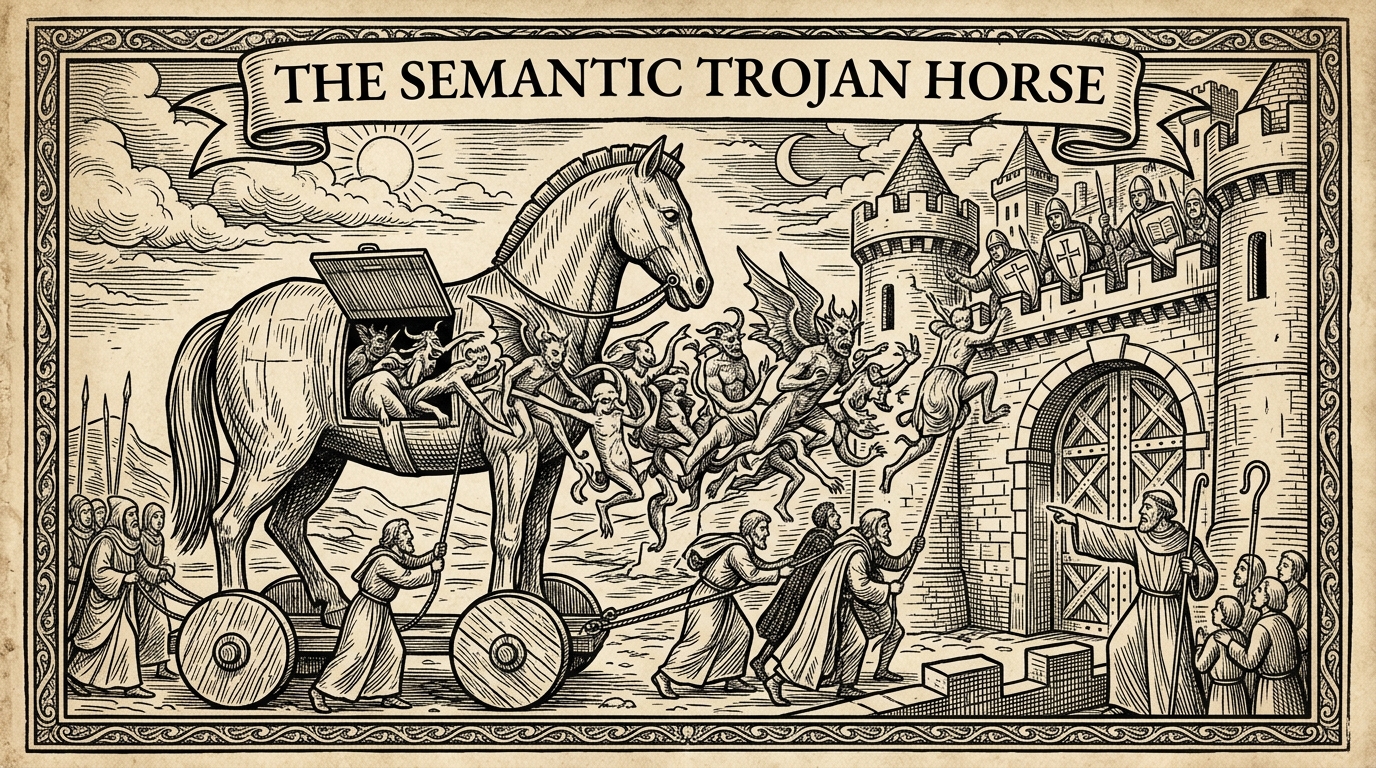
The central thesis of the hosts is that Elohim, the primary Hebrew term for God, should be understood not as a term of being, but as a term of function. Van Dorn states this plainly: “in none of these cases, do these words (e.g., Elohim, Theos, Deus, God) actually derive from anything having to do with essence or being, or nature. They all derive from function” (Van Dorn and Moffitt, “The History of the Word ‘God,’” 08:04). He concludes that because the word’s root relates to “power” or “might,” any being that wields power can, therefore, be rightly called an elohim. “Elohim does not mean omnipotent,” he claims, “It means power. It’s not an incommunicable attribute… It’s a communicable attribute that all kinds of entities could possess” (Van Dorn and Moffitt, “The History of the Word ‘God,’” 11:21). This seemingly academic point is, in fact, a Trojan Horse. By reducing the term to a job description, they pry open a category that includes not only Yahweh but a pantheon of lesser, created spiritual beings—angels and demons—all of whom they would call “gods.” This argument is not only critically flawed but stands in direct opposition to the entire stream of orthodox Christian theology.
The Etymological Fallacy and Canonical Usage
First, this argument commits a classic etymological fallacy. A word’s ancient root does not determine its meaning; canonical usage is determinative. The lexical evidence is overwhelming. The term אֱלֹהִים (ʾĕlōhîm) appears over 2,600 times, with the vast majority of these (2,331 instances) referring specifically to the one God of Israel (Hoogendyk, “אֱלֹהִים”). This statistical weight establishes its primary sense. This is powerfully confirmed in the Bible’s first verse: “In the beginning, Elohim created…” (Gen 1:1 ESV). The verb used here, ברא (bārāʾ), is used consistently in Scripture to refer to the divine act of creating, bringing something into existence in a way that only God can (Hoogendyk, “ברא”). The unique action (bārāʾ) thus defines the unique subject (ʾĕlōhîm) right from the outset. The word’s meaning is therefore cemented not by a speculative ancient root, but by the divine actions, exclusive attributes, and required worship that are indissolubly linked to it throughout the entire canon of Scripture.
The Witness of the Confessions
Second, this functional redefinition places itself in direct opposition to the great confessions of our faith, which are the fruit of centuries of careful biblical exegesis. The Westminster Confession of Faith begins its description of God not with His function, but with His being: “There is but one only, living, and true God, who is infinite in being and perfection, a most pure spirit, invisible, without body, parts, or passions; immutable, immense, eternal, incomprehensible, almighty, most wise, most holy…” (WCF 2.1). This is the language of ontology. Our confessions, in line with the historic creeds of the church, define God by who He is. The “Reformed Fringe” proposal overturns this foundational principle, replacing the God who is with a god who merely acts—a title reducible to a power level. This is a direct contradiction to the scriptural declaration, “I AM WHO I AM” (Exod 3:14), a name that is the very definition of ontological self-existence. Bavinck summarizes the orthodox position: “In the dogma of the Trinity the word ‘person’ simply means that the three persons in the divine being are not ‘modes’ but have a distinct existence of their own” (Bavinck 2004, 2:302). The starting point is the divine being, the one essence. “Reformed Fringe” begins with a functional title and attempts to construct a pantheon from it.
The Misuse of Analogical Language
Third, we must address their persistent misuse of passages where elohim is applied to created beings (e.g., Ps 82:6; Exod 22:28). These are not, as they imply, evidence of a shared ontological category of divine beings. These are clear instances of analogy and delegation. Human judges are called elohim not because they are ontologically part of a class of gods, but because they are called to wield God’s delegated authority and judge according to His standard on His behalf. As John Calvin explains, “the name gods is to be understood of judges, on whom God has impressed special marks of his glory” (Calvin, Commentary on the Book of Psalms, 3:330). To take this analogous application and make it the basis for a literal, populated pantheon is a severe hermeneutical error. It is like arguing that because magistrates are called “ministers of God” (Rom 13:4), they are therefore ordained clergy, or that because believers are called “sons of God,” they are so in the same way as the Only-Begotten. The Westminster Larger Catechism rightly understands the “gods” of the First Commandment as anything “other than God himself” that we might “give that worship and glory to… which is due to him alone” (WLC 105), not as a class of actual, lesser deities with whom Yahweh competes for our loyalty.
The error promoted by Van Dorn and Moffitt is no small matter of semantics. It is a foundational corruption that blurs the non-negotiable, Creator-creature distinction that runs through the whole of Scripture. By emptying Elohim of its ontological weight and turning it into a functional title, they construct a Trojan Horse, hiding within its belly a host of lesser gods poised to invade the church’s understanding of God Himself. It is an error that must be identified and rejected without reservation, for on the identity of the one true God hangs all of our faith, hope, and worship.
Bibliography
Bavinck, Herman. Reformed Dogmatics. Vol. 2, God and Creation. Edited by John Bolt. Translated by John Vriend. Grand Rapids: Baker Academic, 2004.
Calvin, John. Commentary on the Book of Psalms. Bellingham, WA: Logos Bible Software, 2010.
Hoogendyk, Isaiah. “אֱלֹהִים.” In The Lexham Analytical Lexicon of the Hebrew Bible. Bellingham, WA: Lexham Press, 2017.
–. “ברא.” In The Lexham Analytical Lexicon of the Hebrew Bible. Bellingham, WA: Lexham Press, 2017.
Van Dorn, Doug, and Jon Moffitt. “The History of the Word ‘God.’” Reformed Fringe, August 24, 2025. Podcast audio. https://podcasts.apple.com/us/podcast/reformed-fringe/id1673785890?i=1000723422818.
–. “What ‘No Other Gods’ Doesn’t Mean.” Reformed Fringe, September 1, 2025. Podcast audio. https://podcasts.apple.com/us/podcast/reformed-fringe/id1673785890?i=1000724369041.