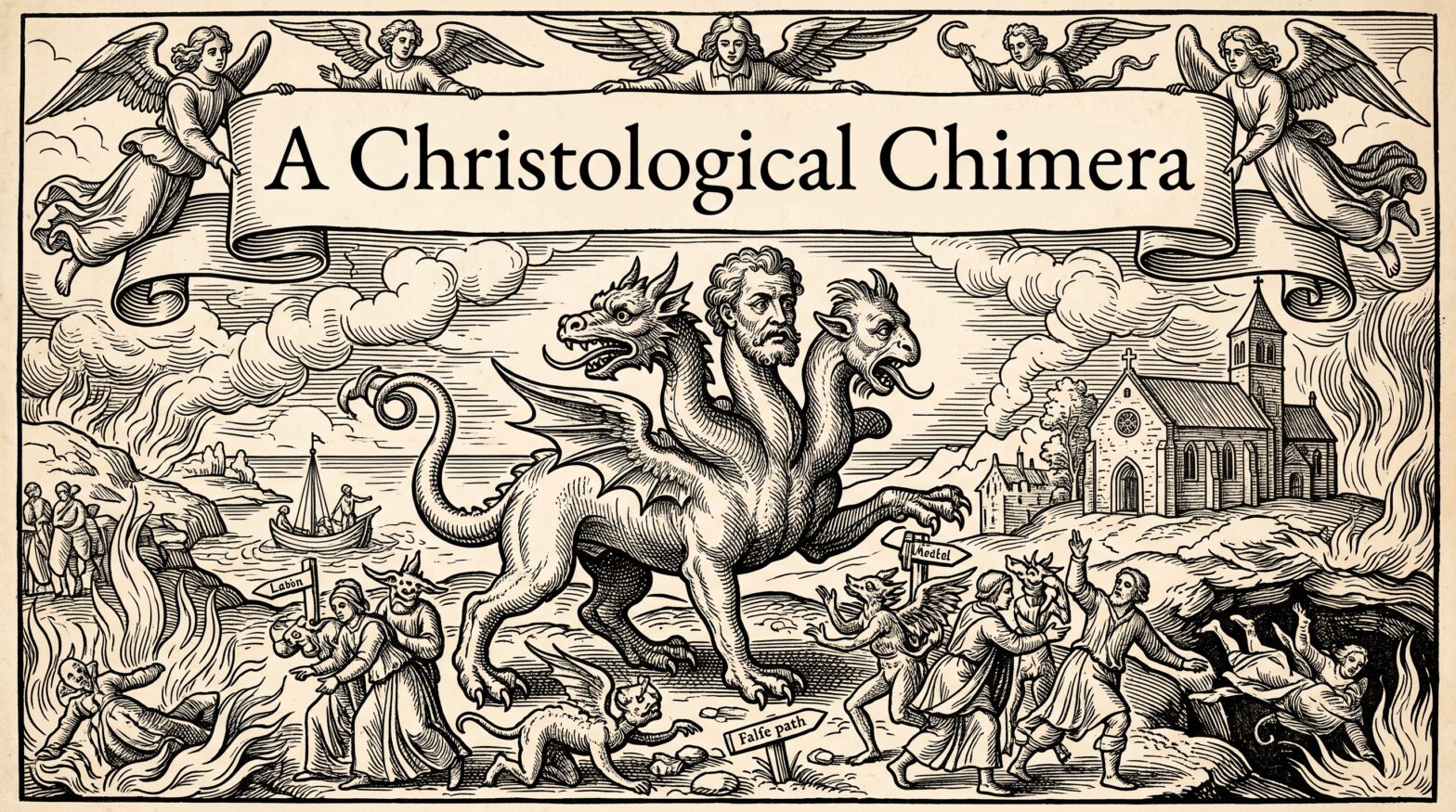
It is with a heavy heart, but a necessary resolve, that we arrive at the inevitable and catastrophic destination of the “Reformed Fringe” theological system: a direct assault on the person of our Lord and Savior, Jesus Christ. In the preceding articles, we have traced the destructive trajectory of this theology, from its foundational semantic and hermeneutical errors to its departure from the landmarks of Patristic orthodoxy. We have seen how a flawed method inevitably produces flawed conclusions. Now, we must confront the final and most dangerous of those conclusions. As Herman Bavinck reminds us, the doctrine of Christ is not merely one dogma among many, but “the central point of the whole system of dogmatics… In it, as the heart of dogmatics, pulses the whole of the religious-ethical life of Christianity.”[1] This article will argue that the Christology articulated by Doug Van Dorn is a profound and dangerous departure from the Christian faith, a teaching so erroneous that it presents another Jesus, dishonors the eternal Son of God, and, if held consistently, places its adherents outside the bounds of historic orthodoxy. Our response must be sharp and unwavering, not out of a desire for polemical victory, but out of a zealous love for the glory of Christ, “saving others by snatching them out of the fire.” (Jude 23 ESV)
The Central Error
The Unthinkable Assertion: A Creaturely Christ
In a moment of stunning theological recklessness, Doug Van Dorn laid bare the ultimate Christological consequence of his entire system. When discussing the identity of the Angel of the Lord in the Old Testament—whom the orthodox have always identified as the pre-incarnate Second Person of the Trinity—Van Dorn makes the following assertion:
Let me put it this way. He took the form of a created Elohim. An angel being, he’s the eternal word of God who came into this universe that he made to manifest by his word, and he became one of those creatures, and he is called the God of Israel… This is totally different from the incarnation because he is becoming an Elohim, not a human. He’s becoming an Ish not an Adam. That’s right. He’s becoming an angel, not a man, but he still, nevertheless became those things and he was one of them.[2]
It is critical to note that as this statement is made, co-host Jon Moffitt expresses only agreement. What is perhaps most disturbing about this exchange is the casual air of its delivery. Van Dorn says the quiet part out loud, presenting this radical redefinition of the Son of God as if it were a minor point of exegesis, seemingly unaware that he has crossed a line from the “fringe” into territory that the church has, for centuries, anathematized.
One might, in a spirit of charity, suggest that they simply spoke without fully understanding the grave theological implications of their words. But this is not an excuse; it is an admission of disqualification. The office of elder requires a man to be “able to teach” (1 Tim 3:2) and to “hold firm to the trustworthy word as taught.” (Titus 1:9) Let us not mince words. This is a wholesale rejection of the biblical and catholic doctrine of the person of Christ. To claim that the eternal Son of God “became one of those creatures” is to resurrect the essence of the Arian heresy.
Theological Consequences
The Necessary Denial of Divine Immutability
The core of the error lies in a single, catastrophic word: “became.” First, Scripture and the confessions unite in their testimony that God is immutable, or unchangeable. (Mal 3:6; Jas 1:17) Their own 1689 London Baptist Confession defines God as “immutable.” (2LBCF 2.1) Second, Van Dorn asserts that the eternal Son “became one of those creatures.” The language of “becoming” is, by definition, the language of change. Third, we must contrast this with the careful, orthodox language of the Hypostatic Union. The confessions insist that in the incarnation, the Son assumed a human nature into union with His divine person, all “without conversion, composition, or confusion” of His divine nature. (2LBCF 8.2) He did not become a man in the sense that His divine being was altered; He remained fully and unchangeably God while also becoming fully man.
The inescapable conclusion of Van Dorn’s logic is that the Son is not immutable. A divine being who can “become” a creature, apart from the assumption of an additional created nature, is by definition a mutable being. This single error has catastrophic consequences. A mutable Son cannot be the immutable God confessed by the church. Furthermore, this error fractures the Trinity. If the Son possesses a mutable nature, while the Father and the Spirit possess an immutable one, then they do not share the same singular divine essence, and the Godhead is destroyed.
A Violation of Theological Parsimony and the Confession
The immediate Christological consequence of this pre-incarnate “angelophany” is a doctrine that is not only heretical but needlessly complex. The biblical witness and the catholic faith are perfectly satisfied by the doctrine of the two-natured Christ. Van Dorn’s system, however, requires the introduction of a third, superfluous nature. If the eternal Son first “became” an angelic nature, and then later assumed a human nature, Christ would not be one person with two natures, but one person with three natures: divine, angelic, and human. This is a bizarre novelty that is not required by Scripture, is explicitly denied by Scripture, (Heb 2:16) and is absent from their own confession.
It is a direct violation of the Christology confessed in Chapter 8 of the 1689 London Baptist Confession of Faith. The confession states that the Son of God “took unto Him man’s nature,” and that the two natures were joined “without conversion, composition, or confusion.” (2LBCF 8.2) Van Dorn’s model proposes a prior, unconfessed “conversion” of the Son into an angel and results in a “composition” of three natures, altering the orthodox doctrine into an unrecognizable state.
The Biblical and Historical Witness
The Uncreated Creator (John 1, Colossians 1)
The prologue to John’s Gospel is a definitive statement of the Son’s identity. “In the beginning was the Word, and the Word was with God, and the Word was God… All things were made through him.” (John 1:1, 3) The Word is eternal, the Word is fully God, and the Word is the agent of all creation. He is not, and can never be, a creature. Paul echoes this in Colossians, describing Christ as the one by whom “all things were created, in heaven and on earth, visible and invisible, whether thrones or dominions or rulers or authorities—all things were created through him and for him.” (Col 1:16)
The Angel of the Lord: A Unified Orthodox Witness
The orthodox identification of the Angel of the Lord as a Christophany is the consistent witness of the Reformed tradition. Charles Hodge provides a definitive summary, concluding that the Angel who appeared to the patriarchs “is none other than He whom we now recognize and worship as our God and Saviour Jesus Christ.”[3] Hodge is clear that it was the “Λόγος ἄσαρκος” (the Word without flesh) who appeared, not the Word becoming a created angel. Augustine, wrestling with the same passages, never considers the heretical notion that the eternal Son could have become a creature, building his entire framework on the premise of divine immutability.[4] Michael Horton likewise explains that the title “angel” (messenger) refers to the Son’s mediatorial function, not an ontological transformation.[5]
The Soteriological Necessity of the God-Man
There is a profound theological logic undergirding why the Mediator must be both God and man. Athanasius explains that the Son had to assume a human body “capable of death” so that He could offer it “on behalf of all.”[6] The Son became man because only a man could die in the place of men. Geerhardus Vos elaborates that the Mediator must be fully God, because only a divine person is truly sui juris (“by his own right”) and can confer “infinite value” upon His work.[7] At the same time, Vos argues, the Mediator must be fully man, because justice requires that “payment for guilt must also take place through the same nature in which sin against God was committed.”[8] The “angel-Christ” of “Reformed Fringe” fails on both counts: as an angel, he cannot satisfy for human sin; as a creature, his work lacks infinite value. He is a mediator who cannot mediate, a savior who cannot save.
The Assumed Human Nature (Hebrews 1-2)
The opening chapters of Hebrews confirm this soteriological logic with apostolic authority. Chapter one demonstrates the Son’s infinite superiority to the angels. (Heb 1:6, 8, 10) Chapter two then defines the nature He assumed for our salvation. The text is surgically precise: “For surely it is not angels that he helps, but he helps the offspring of Abraham. Therefore he had to be made like his brothers in every respect.” (Heb 2:16–17) The apostolic witness could not be clearer. The Son of God assumed a human nature, and the text explicitly denies that He assumed an angelic one.
A Final Appeal
We are no longer in the realm of “fringe” or secondary matters. This is a substantive and damnable error.
To Jon and Doug: A Call to Repentance
My purpose here is not condemnation, but an urgent, pastoral call. I plead with you, Jon and Doug, to publicly and unequivocally retract this teaching. Repent of this monstrous Christology. Flee from this strange and dangerous path and return to the safe ground of the biblical and catholic faith.
To the Elders: A Call to Action
Finally, I must also address the elders who are charged with the oversight of these men. To Elders Curtis Delozier, Eric Lokker, and Ben May of Grace Reformed Church, and to Elders Peter Van Dorn and Stan Campbell of the Reformed Baptist Church of Northern Colorado: Brothers, you too have a sacred and solemn obligation. As shepherds, you are called to protect the sheep from wolves. When one of your pastors publicly articulates a doctrine so dangerously errant, you are duty-bound to act. The public commitments your churches have made to the 1689 Confession have been contradicted. Men who would so carelessly redefine the person of Christ have no business in the pulpit until this error is publicly and substantively recanted.
Key Terms/Concepts
- Arianism: The fourth-century heresy that denies the full divinity of Jesus Christ, teaching that the Son is the first and highest of God’s creatures, not eternally and essentially God.
- Sui Juris: A Latin legal term meaning “of one’s own right.” In theology, it refers to God’s absolute self-possession and independence, particularly used to describe the Son’s unique ability to freely offer Himself as a surety, as He is not a creature owned by another.
- Hypostatic Union: The orthodox doctrine that in the one person of Jesus Christ, two distinct natures—one fully divine and one fully human—are united “without confusion, without change, without division, without separation.”
- Immutability: The divine attribute of unchangeableness. God cannot change in His being, perfections, purposes, or promises. It is an incommunicable attribute essential to His nature.
- Christophany: A visible manifestation of God (theophany) or, more specifically, a pre-incarnate appearance of Jesus Christ (Christophany) in the Old Testament.
[1] Herman Bavinck, Reformed Dogmatics, ed. John Bolt, trans. John Vriend, vol. 3 (Grand Rapids: Baker, 2006), 274.
[2] Doug Van Dorn and Jon Moffitt, “What ‘No Other Gods’ Doesn’t Mean,” Reformed Fringe, 1 September 2025, https://podcasts.apple.com/us/podcast/reformed-fringe/id1673785890?i=1000724369041, 33:43–34:19.
[3] Charles Hodge, Systematic Theology, vol. 1 (New York: Charles Scribner and Company, 1872), 480.
[4] Augustine of Hippo, “On the Holy Trinity,” in Nicene and Post-Nicene Fathers, ed. Philip Schaff, vol. 3 of 1 (Buffalo: Christian Literature Company, 1887). 3.10.21.
[5] Horton, Michael S. Lord and Servant: A Covenant Christology. First edition. Louisville, KY: Westminster John Knox Press, 2005, 212.
[6] Athanasius of Alexandria, On the Incarnation, ed. and trans. John Behr, vol. 44a (Yonkers: St. Vladimir’s Seminary Press, 2011), 69.
[7] Geerhardus Vos, Reformed Dogmatics, ed. and trans. Richard Jr Gaffin, vol. 3 (Bellingham: Lexham Press, 2014), 21.
[8] Ibid., 24.
This error is an application of the errors Doug began with his article “Passing the Impassible Impasse” published in 2015 (and republished last year). I recommend you take a look at that. This goes even deeper
Thank you for sending this over. I glossed through this, and especially the conclusions. It does appear that he articulates a Hypostatic Union of sorts with the angels. Very troubling.