Loved ones, one of the most sobering principles in Scripture is the law of the harvest: “Whatever one sows, that will he also reap” (Galatians 6:7). God is endlessly gracious to His covenant children, but He does not leave them undisciplined. If we insist on living by manipulation, deceit, and grabbing for control, God will often place us in circumstances where we get a bitter taste of our own medicine.
In Genesis 29, Jacob the Deceiver finally meets his match. He has fled the Promised Land as a penniless fugitive, running from the murderous wrath of the brother he cheated. God’s grace met him at Bethel, but God’s discipline now waits for him in Haran. When Jacob arrives at the home of his uncle Laban, the master manipulator becomes the victim of a breathtaking betrayal, proving that God’s sanctifying work is often painful, deeply ironic, and perfectly exact.
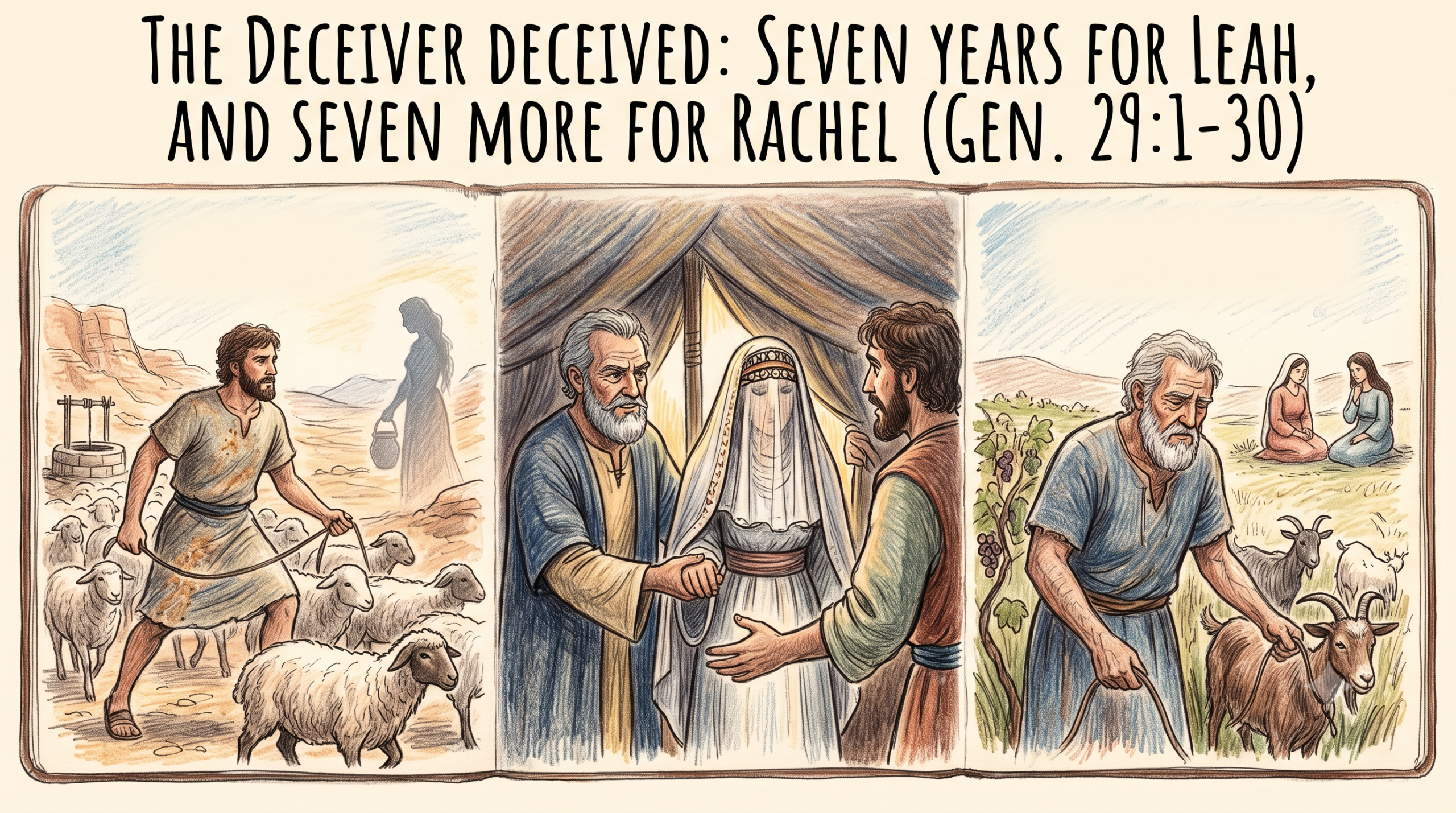
Genesis 29:1-30 records Jacob’s arrival in Haran, his deep love for Rachel, the heartbreaking deception by Laban regarding Leah, and the bitter consequences of the deceiver being deceived.
Verses 1–14
1 Then Jacob went on his journey and came to the land of the people of the east. 2 As he looked, he saw a well in the field, and behold, three flocks of sheep lying beside it, for out of that well the flocks were watered. The stone on the well’s mouth was large, 3 and when all the flocks were gathered there, the shepherds would roll the stone from the mouth of the well and water the sheep, and put the stone back in its place over the mouth of the well. 4 Jacob said to them, “My brothers, where do you come from?” They said, “We are from Haran.” 5 He said to them, “Do you know Laban the son of Nahor?” They said, “We know him.” 6 He said to them, “Is it well with him?” They said, “It is well; and see, Rachel his daughter is coming with the sheep!” 7 He said, “Behold, it is still high day; it is not time for the livestock to be gathered together. Water the sheep and go, pasture them.” 8 But they said, “We cannot until all the flocks are gathered together and the stone is rolled from the mouth of the well; then we water the sheep.” 9 While he was still speaking with them, Rachel came with her father’s sheep, for she was a shepherdess. 10 Now as soon as Jacob saw Rachel the daughter of Laban his mother’s brother, and the sheep of Laban his mother’s brother, Jacob came near and rolled the stone from the well’s mouth and watered the flock of Laban his mother’s brother. 11 Then Jacob kissed Rachel and wept aloud. 12 And Jacob told Rachel that he was her father’s kinsman, and that he was Rebekah’s son, and she ran and told her father. 13 As soon as Laban heard the news about Jacob, his sister’s son, he ran to meet him and embraced him and kissed him and brought him to his house. Jacob told Laban all these things, 14 and Laban said to him, “Surely you are my bone and my flesh!” And he stayed with him a month.
The Fugitive at the Well
Jacob’s arrival at the well in Haran intentionally echoes the journey of Abraham’s servant in Genesis 24. But the contrasts are striking. Abraham’s servant arrived with ten camels loaded with gold, silver, and gifts, representing the wealth of the patriarch. Jacob arrives alone, on foot, and empty-handed. He is the heir to the covenant, but practically, he is a destitute runaway.
When Rachel arrives with the sheep, Jacob exhibits a sudden eagerness and strength, stepping up to roll the large stone away to water her flock. Then, he kisses her and weeps aloud. This weeping is the emotional release of a man who has traveled hundreds of miles in terror, survived a lonely wilderness, encountered the living God at Bethel, and finally found the safety of his family.
Laban, hearing the news, rushes out to meet him. He enthusiastically embraces and kisses his nephew, bringing him into his home and declaring, “Surely you are my bone and my flesh!” At this moment, Laban is simply rejoicing in the arrival of a family member, though as the story unfolds, we will see how quickly this family dynamic turns into an opportunity for cheap labor.
Verses 15–20
15 Then Laban said to Jacob, “Because you are my kinsman, should you therefore serve me for nothing? Tell me, what shall your wages be?” 16 Now Laban had two daughters. The name of the older was Leah, and the name of the younger was Rachel. 17 Leah’s eyes were weak, but Rachel was beautiful in form and appearance. 18 Jacob loved Rachel. And he said, “I will serve you seven years for your younger daughter Rachel.” 19 Laban said, “It is better that I give her to you than that I should give her to any other man; stay with me.” 20 So Jacob served seven years for Rachel, and they seemed to him but a few days because of the love he had for her.
The Price of Love
After a month, Laban proposes a formal employment contract. Because Jacob has no money to offer as a traditional “bridewealth” (the dowry given to the bride’s family), he offers the only thing he has: his labor. He agrees to work for seven years for Laban’s younger daughter, Rachel.
The text draws a sharp contrast between the two sisters. Rachel is “beautiful in form and appearance.” Leah’s eyes, however, are described as “weak” (or delicate/tender). While scholars debate whether this means she had poor vision or simply lacked the bright, sparkling eyes prized in ancient beauty, the point is clear: Leah did not possess her sister’s physical attractiveness, and Jacob had no romantic interest in her.
Yet, in one of the most romantic sentences in all of Scripture, we are told that Jacob’s seven years of hard labor “seemed to him but a few days because of the love he had for her.”
Verses 21–30
21 Then Jacob said to Laban, “Give me my wife that I may go in to her, for my time is completed.” 22 So Laban gathered together all the people of the place and made a feast. 23 But in the evening he took his daughter Leah and brought her to Jacob, and he went in to her. 24 (Laban gave his female servant Zilpah to his daughter Leah to be her servant.) 25 And in the morning, behold, it was Leah! And Jacob said to Laban, “What is this you have done to me? Did I not serve with you for Rachel? Why then have you deceived me?” 26 Laban said, “It is not so done in our country, to give the younger before the firstborn. 27 Complete the week of this one, and we will give you the other also in return for serving me another seven years.” 28 Jacob did so, and completed her week. Then Laban gave him his daughter Rachel to be his wife. 29 (Laban gave his female servant Bilhah to his daughter Rachel to be her servant.) 30 So Jacob went in to Rachel also, and he loved Rachel more than Leah, and served Laban for another seven years.
The Deceiver in the Dark
When the seven years are completed, a grand wedding feast is held. In the ancient Near East, brides were heavily veiled, and the consummation of the marriage happened in the darkness of the bridal tent, often after heavy feasting and drinking. Laban uses this perfect cover to pull a ruthless bait-and-switch. He sends Leah into the tent instead of Rachel.
Imagine the shock of the next morning: “Behold, it was Leah!” Jacob is utterly outraged. “Why then have you deceived me?” he demands.
Laban’s response is a perfectly aimed dagger of divine irony: “It is not so done in our country, to give the younger before the firstborn.”
Read those words carefully. To give the younger before the firstborn. Jacob, the younger brother, had put on a disguise, gone into a dark room, and tricked his blind father into giving him the blessing of the firstborn. Now, Leah, the older sister, is disguised in the dark, tricking Jacob. The supplanter has been supplanted. The trickster has been tricked. Jacob is forced to look into the mirror of his own sin.
To secure Rachel, Jacob is forced to marry both sisters (completing Leah’s one-week bridal festival first) and commit to another seven years of indentured servitude. The family is now tragically fractured by polygamy, favoritism, and deceit—setting the stage for years of bitter rivalry.
Conclusion
This chapter is a masterclass in the severe mercy of God’s discipline. God loved Jacob too much to let him remain a deceitful, self-reliant manipulator. God uses Laban’s wickedness to break Jacob, discipline him, and shape him into a patriarch who will eventually learn to limp in dependence upon the Lord.
But there is also a profound Gospel picture here, particularly in the unloved sister, Leah. Jacob labored for Rachel because she was beautiful and desirable. He despised Leah because she was plain and forced upon him.
But the true and better Bridegroom, Jesus Christ, is entirely different. Jesus did not come from heaven to purchase a Bride who was naturally beautiful and flawlessly put together. He came for those who were weak, unlovely, and unwanted by the world. Like Jacob, Christ paid a staggering bride-price—not with seven years of labor, but with His own blood on the cross. He loves the unlovely, and through His sacrificial love, He washes His Bride, the Church, to make her radiantly beautiful in the eyes of God (Ephesians 5:25-27).
Key Terms
- Poetic Justice / Divine Discipline: The reality that God often allows our own specific sins to bring about our discipline (e.g., Jacob, who deceived his father in the dark regarding the younger/firstborn, is deceived in the dark by his uncle regarding the younger/firstborn).
- Bridewealth (Mohar): A standard ancient Near Eastern practice where a groom (or his family) gave a substantial gift of wealth to the bride’s family to compensate them for the loss of her labor. Jacob, being destitute, paid his with fourteen years of manual labor.
- Leah’s “Weak” Eyes: A description emphasizing that Leah lacked the striking, physical beauty and allure of her younger sister, Rachel.
- Bait-and-Switch: Laban’s treacherous tactic, utilizing the cultural customs of heavy veils and darkened tents to force a polygamous marriage and extort seven more years of labor from Jacob.