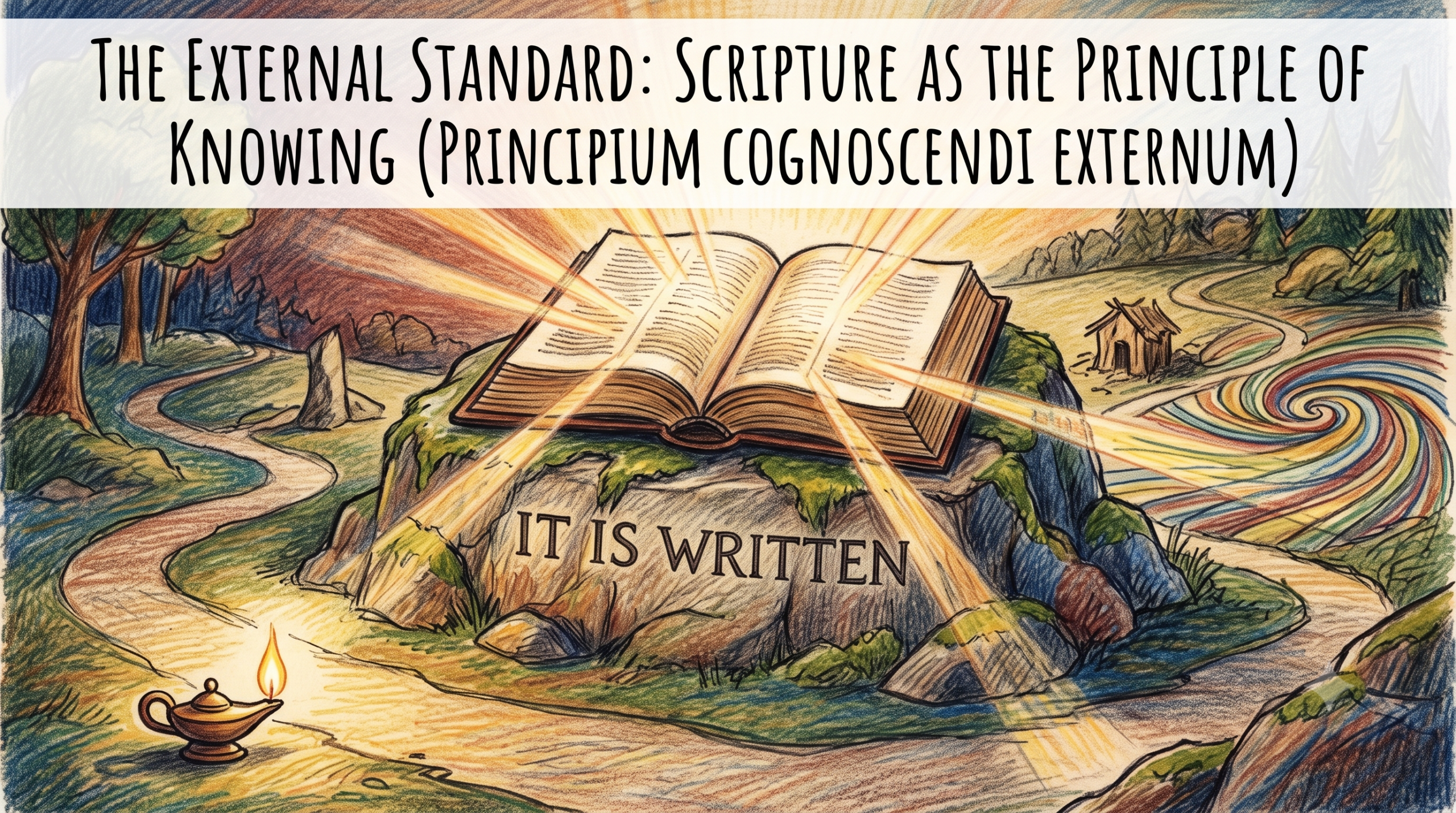
We live in an age drowning in subjectivity. In our post-truth culture, authority has been radically internalized. Truth is no longer viewed as an objective reality to be discovered and submitted to, but as a personal, fluid sentiment to be felt, constructed, and asserted. The ultimate virtue of our secular moment is “living your truth,” where any external standard that dares to judge or correct the individual conscience is immediately condemned as oppressive.
Tragically, this epistemological subjectivism frequently invades the church. It often wears a pious mask: Christians hunt for private promptings, internal impressions, and felt-needs experiences, treating their emotional states or intuitive impulses as the direct voice of God. In other quarters, authority is displaced onto human tradition or ecclesiastical hierarchy. In both cases, the objective ground of certainty is abandoned for the shifting sands of human experience.
If we are to escape this quicksand of subjectivism, we must recover the second pillar of classical Reformed prolegomena. Having confessed God Himself as our essential foundation, the Principium Essendi, we must now turn to the objective standard through which He has chosen to speak to us: Holy Scripture as the Principium Cognoscendi Externum.
Because finite and fallen creatures cannot manufacture true knowledge of God, Holy Scripture serves as the objective, external principle of knowing (principium cognoscendi externum), the infallible, self-attesting, and sufficient Word of God through which alone the Triune God authoritatively reveals Himself for our faith and obedience.
The Necessity of an External Principle: Why Nature Is Not Enough
In our earlier study of the Creator-creature distinction, we noted that all human knowledge of God is derivative, accommodated, and dependent on divine condescension. God must speak if we are to know Him.
While God has revealed His eternal power and divine nature through the created order, a general revelation that leaves all humanity without excuse (Romans 1:19–20, Psalm 19:1–2), this natural book of creation is insufficient for saving theological knowledge. General revelation reveals God’s existence and moral judgment, but it does not reveal the gospel of Jesus Christ. Furthermore, because our cognitive faculties are marred by the noetic effects of the Fall, fallen human reason routinely twists and suppresses the witness of nature, manufacturing idols from the theater of creation.
Therefore, for human beings to possess true, saving, and uncorrupted knowledge of God, an external, supernatural revelation was strictly necessary. God, in His sovereign grace, did not leave us to wander in natural darkness or to rely on fragile oral traditions. He committed His holy revelation to writing, establishing an unshakeable, objective standard external to the human mind.
Holy Scripture as the Principium Cognoscendi Externum
To understand Scripture as the external principle of knowing (principium cognoscendi externum), we must trace how classical Reformed scholasticism articulated the relationship between God and His written Word.
If God (Principium Essendi) is the uncreated Sun, Holy Scripture (Principium Cognoscendi Externum) is the objective beam of light that shines from that Sun into our darkness. The Scriptures are not a human discovery about God, nor are they merely human reflections on religious experiences. They are the objective Word spoken by God Himself through human instruments.
Organic Inspiration
Reformed orthodoxy maintains that all Scripture is “breathed out by God” (2 Timothy 3:16). The Holy Spirit did not bypass the personalities, vocabularies, or historical contexts of the human authors…a mechanical dictation theory that Reformed theology flatly rejects. Rather, through organic inspiration, the Spirit superintended the human authors so supernaturally that while they freely wrote using their own styles and research, the resulting text was precisely what God intended: the very Word of God in human language, truthful in all that it affirms.
Because Scripture is divine speech, it possesses the essential attributes of infallibility and inerrancy. God cannot lie (Titus 1:2); therefore, His written Word is entirely free from error in all matters of faith, practice, history, and physical reality.
The Self-Attesting Authority of the Word
Where does Scripture derive its ultimate authority? Is it authoritative because the church declares it to be so? Or because human reason validates its historical accuracy?
Classical Reformed theology answers with a resounding no. To subject the authority of Scripture to the approval of the church or the tribunal of human reason is to fall into reverse foundationalism.
Scripture is self-authenticating. It carries its own authority within itself because it is the voice of the supreme King. As the Westminster Confession of Faith famously declares:
The authority of the Holy Scripture, for which it ought to be believed, and obeyed, dependeth not upon the testimony of any man, or Church; but wholly upon God (who is truth itself) the author thereof: and therefore it is to be received, because it is the Word of God. (WCF 1.4)
Just as light requires no external lamp to prove that it is light, and just as the sun requires no flashlights to demonstrate that it is shining, so the Word of God carries its own divine light. The church does not create the canon; the church simply recognizes and submits to the divine voice speaking in the Scriptures.
The Sufficiency and Finality of Scripture
To confess Scripture as our principium cognoscendi externum is to affirm its absolute sufficiency (sufficientia).
The Scriptures contain everything necessary for God’s own glory and for human salvation, faith, and life. Nothing is to be added to this divine book at any time, whether by new revelations of the Spirit or traditions of men (Revelation 22:18–19).
This sufficiency stands as a twin-edged sword against two pervasive errors:
- Modern Charismatic Subjectivism & Mysticism: The notion that God provides binding, ongoing direct revelations, “words of knowledge,” or private interior voices that supplement or govern the Christian life.
- Traditionalism & Sacerdotalism: The elevation of human church traditions, papal decrees, or cultural customs to the same level of authority as the written Word.
Against both errors, Sola Scriptura asserts that the Canon is closed. God has spoken definitively in His Son (Hebrews 1:1–2), and that apostolic witness is fully preserved in Holy Scripture. We require no new revelations, no secret prophecies, and no human additions to govern the conscience of the believer.
Resting in the Objective “It Is Written”
Loved ones, let’s bring this home to the quiet, anxious places of our daily walk with God.
In a world filled with shifting opinions, cultural turbulence, and interior doubts, where do you look for certainty? It is tragically common for believers to spend their lives staring inward…analyzing the strength of their faith, hunting for emotional spiritual highs, or agonizing over whether a passing thought was “God speaking to them.”
This interior fixation is a trap. Your emotions will betray you. Your feelings change with your physical health, your sleep patterns, and your circumstances. If your assurance rests on your internal state, you will be tossed about by every wind of doubt.
This is why God, in His infinite mercy, gave us an external principle of knowing.
When Jesus was assaulted by the devil in the wilderness, He did not combat temptation by pointing to His feelings or appealing to private interior experiences. He repeatedly silenced the accuser with three unshakeable words: “It is written” (Matthew 4:4, 7, 10).
Your certainty does not rest on what is written in your heart, but on what is written in your Bible.
When you doubt your salvation, when you face ethical confusion, or when the noise of the digital world threatens to overwhelm your soul, step away from your computer screen, quiet your racing heart, and open the written Word of God. Look outside of yourself to the objective, unchangeable promise of God in Jesus Christ. The Bible is not a wax nose to be shaped by your desires; it is the immovable bedrock of divine truth. Rest your soul on its promises, submit your mind to its precepts, and walk forward in the confidence that God’s Word will outlast the stars.
Conclusion
Theology cannot survive on human speculation or subjective impressions. It requires an unshakeable, objective standard.
As we look forward to our final article in this Prolegomena section, we will examine the third member of the classical triad: the Principium Cognoscendi Internum—the Holy Spirit working through faith to open our eyes to behold the light of this written Word. But let us never separate the Spirit from the Word. The Spirit illuminates, but the Word instructs.
May we reject the subjectivism of our age, bowing our intellects before Holy Scripture as our sole infallible, self-attesting, and sufficient external standard, and declaring with the Psalmist: “Your word is a lamp to my feet and a light to my path” (Psalm 119:105).
Key Terms
- Principium Cognoscendi Externum (External Principle of Knowing): The objective, external standard of theological truth, identified in classical Reformed theology exclusively as Holy Scripture (the written Word of God).
- Autopistia / Autopistos (Self-Attestation): The doctrine that Holy Scripture possesses inherent, underived authority as divine revelation, authenticating itself to the believer without requiring external validation from human reason or church authority.
- Theopneustos (Divine Inspiration): The biblical term (2 Timothy 3:16) meaning “God-breathed,” affirming that Scripture is the direct, infallible product of divine inspiration through human authors.
- Sufficientia (Sufficiency of Scripture): The attribute of Holy Scripture affirming that it contains all revelation necessary for God’s glory and human salvation, faith, and life, rendering new divine revelations or binding human traditions unnecessary.
- Organic Inspiration: The orthodox doctrine that the Holy Spirit superintended the human writers of Scripture using their unique personalities, vocabularies, and contexts without error, in contrast to mechanical dictation theories.