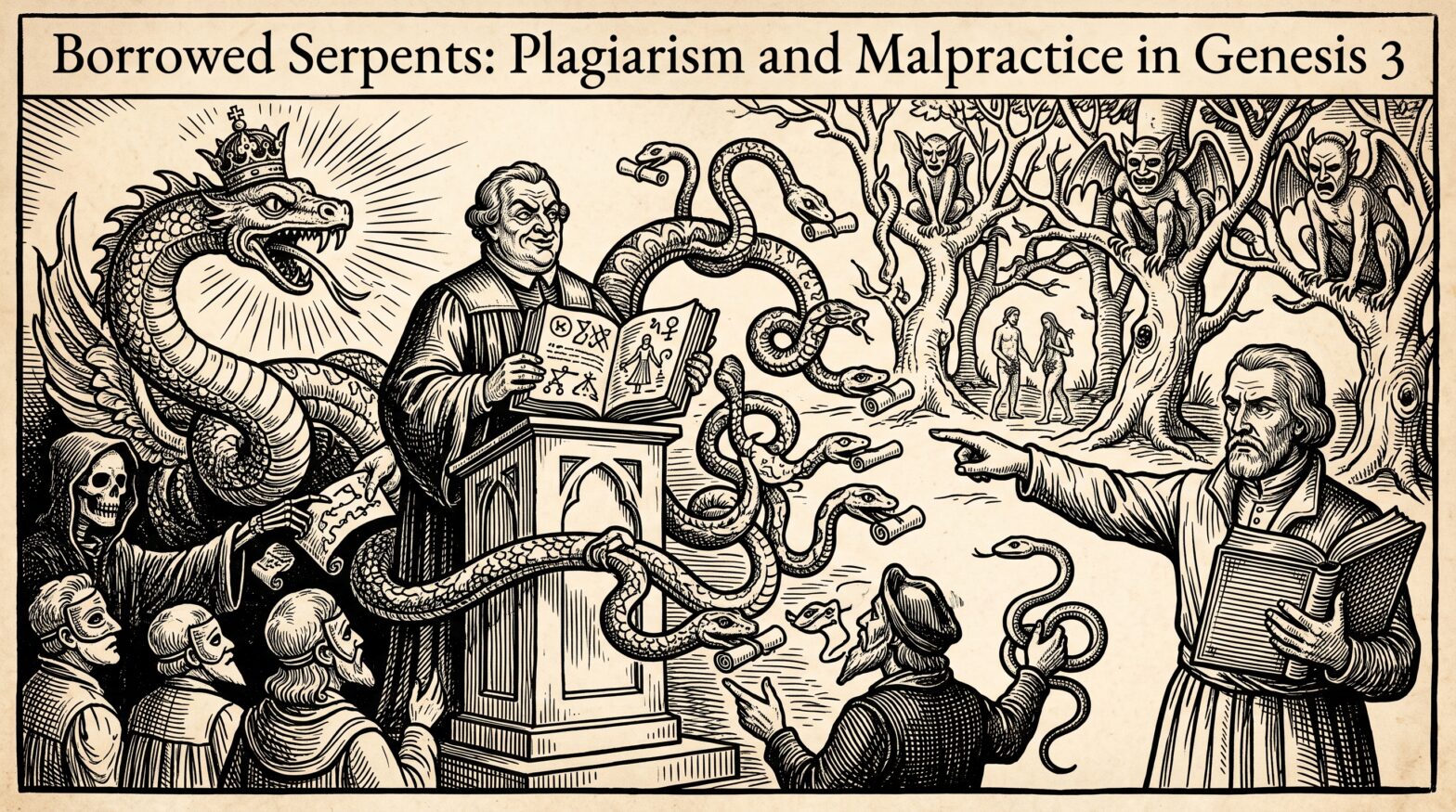
Having established the methodological error of “Reformed Fringe”—their rejection of confessional authority in favor of a speculative, “Naked Bible” approach—we now turn to a concrete example of this method in action. Their episode “Genesis 3: A Dragon in the Trees” serves as a perfect case study, revealing how their flawed hermeneutic inevitably leads to a… Continue reading Borrowed Serpents: Plagiarism and Malpractice in Genesis 3
Category: Apologetics & Polemics
The Pattern of Sound Words
Theological error does not arise from a vacuum. It is nearly always the product of a faulty hermeneutic, a flawed method of approaching and interpreting the sacred text. Before we can properly dissect the specific doctrinal errors of the “Reformed Fringe” podcast regarding the nature of God and Christ, we must first address the methodological poison… Continue reading The Pattern of Sound Words
The Semantic Trojan Horse
It is the solemn duty of every Christian to contend earnestly for the faith that was once for all delivered to the saints (Jude 3). This duty becomes particularly urgent when theological error, cloaked in familiar language, is presented to the church from platforms that carry an air of credibility. It is with this sense… Continue reading The Semantic Trojan Horse
William Lane Craig – Theopaschitism (6)
As we have seen previously, William Lane Craig holds to a view which he calls Neo-Apollinarianism. Although he claims that this is only a proposal, and thus claims a sort of theological immunity regarding its heretical implications, I don’t believe we should let him off the hook quite so easily. To briefly review, Neo-Apollinarianism is a slight… Continue reading William Lane Craig – Theopaschitism (6)
William Lane Craig – The Duplicitous Langage of Proposal (5.5)
Recently, Dr. Craig spoke on his podcast about his Christological Position. This was in response to an article forwarded to him from Richard Bushey titled Does William Lane Craig Have An Orthodox Christology? Some have asked me why this series has stalled out, wondering if I am done with my critique. I am not, but given that… Continue reading William Lane Craig – The Duplicitous Langage of Proposal (5.5)
William Lane Craig – Neo-Apollinarianism (5)
In the previous entries in this series, we have seen how Dr. Craig’s denial of realism (a position he calls anti-realism, rather than nominalism) has led him down the path of partialism (in which the three persons are not properly unified) and unitarianism (in which he implicitly treats the Trinity as though it were a… Continue reading William Lane Craig – Neo-Apollinarianism (5)
William Lane Craig – Unitarianism (4)
Last time, we talked about how Dr. Craig’s position of anti-realism undermines the fundamental unity of the Godhead. It does this by functionally denying that such natures exist are a thing considered differently than persons. Where classic orthodox trinitarianism relies on the idea that natures, or ousiai, exist and that persons, or hypostases, are more-or-less… Continue reading William Lane Craig – Unitarianism (4)
William Lane Craig – Partialism (3)
In the last post, we discussed how Dr. Craig’s self-described anti-realism flows contrary to the metaphysical assumptions which undergird the Church’s historical articulation of the doctrines of the Trinity (Nicaea 325 and Constantinople 381) and the Hypostatic Union (Chalcedon 451). This leads him to argue that the Trinity itself is the only “instance of the… Continue reading William Lane Craig – Partialism (3)
William Lane Craig – Anti-Realism (2)
As I mentioned in my introductory post, I have embarked on a project to assess and critique the Trinitarian and Christological theology of William Lane Craig. The errors, in my opinion, are grave enough to render him a teacher that Reformed Christians should not emulate, even in part. In today’s post, we will discuss Dr.… Continue reading William Lane Craig – Anti-Realism (2)
William Lane Craig – Introduction (1)
Recently, I have noticed a flare-up of interest in philosopher and apologist William Lane Craig among young Reformed Christians in various circles I run in. I have been investigating Dr. Craig’s apologetics and theology on and off for close to seven years now. Because of what I have identified as serious errors in Dr. Craig’s… Continue reading William Lane Craig – Introduction (1)