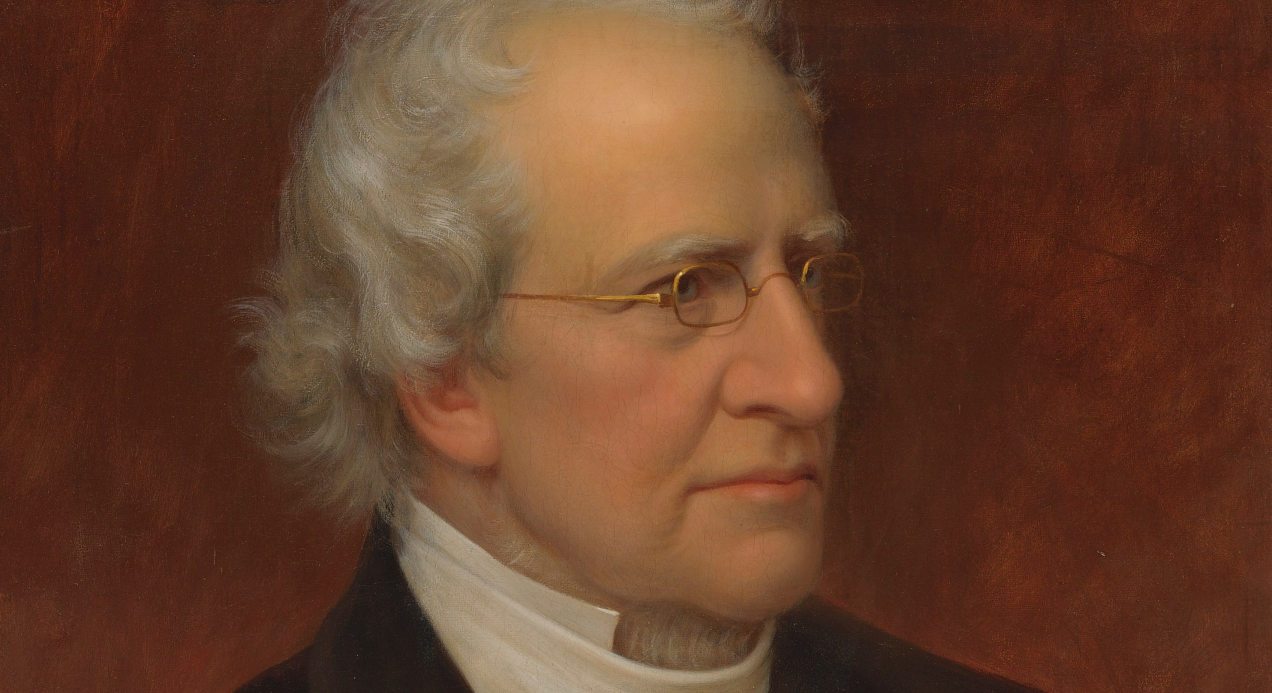
In our previous installments, we examined the flawed methodology of “Research by Ctrl+F” and the misuse of Augustine. Now, we move forward to the 19th century and the towering figure of Princeton theology: Charles Hodge.
Owen Strachan includes Hodge in his list of witnesses, citing his Systematic Theology to argue that the subordination of the Son is a standard Reformed belief. For many Reformed believers, Hodge is a gold standard. If Hodge held to ERAS, Strachan’s case is significantly strengthened. But as we have come to expect, the citation obscures more than it reveals.
Charles Hodge’s use of the term “subordination” is strictly limited to the Nicene concept of taxis (order of subsistence) and the economic role of the Messiah; he explicitly rejects the notion that this order implies a disparity of power or authority within the divine essence.
The Forensic Evidence: Strachan vs. Hodge
To understand the distortion, we must examine Strachan’s specific citation alongside Hodge’s full argument.
Strachan cites Hodge, writing:
The Father operates through the Son… The facts contained in this paragraph are summed up in this proposition: In the Holy Trinity there is subordination of the Persons as to the mode of subsistence and operation. 1:445).[1]
This sounds like a slam dunk for the ERAS position. Hodge admits “subordination.” But what does Hodge mean by that word?
Crucially, in the section immediately preceding the sentence Strachan extracts, Hodge lists the specific “facts” he is summarizing. He writes that the Father, Son, and Spirit “possess the same attributes… [and] are the same in substance, and equal in power and glory.”[2]
Hodge defines “subordination” strictly as the order of origin (taxis): The Father is first, the Son is second. He explicitly affirms their equality in power and glory. By stripping away Hodge’s definition and isolating the summary sentence, Strachan allows the modern reader to fill the word “subordination” with the concept of “authority structure,” a concept Hodge explicitly rejected when he affirmed their equality of power.
The Genealogy of Error: Grudem’s Influence
It is instructive to note that Strachan’s methodology mirrors that of Wayne Grudem, even where their specific citations diverge. In his own Systematic Theology, Grudem attempts to recruit Hodge by quoting a different section regarding the Nicene doctrine.
Grudem presents Hodge as saying:
The Nicene doctrine includes… the principle of the subordination of the Son to the Father… The subordination intended is only that which concerns the mode of subsistence and operation.[3]
However, what Grudem (and by extension, the ERAS method) obscures is Hodge’s surrounding context which defines “subordination” in a way that creates a firewall against hierarchy.
In the very section Grudem quotes, Hodge writes:
For as the same divine essence with all its infinite perfections is common to the Father, Son, and Spirit, there can be no inferiority of one person to the other in the Trinity. Neither does it imply posteriority; for the divine essence common to the several persons is self-existent and eternal.[4]
Both Strachan and Grudem engage in a “cherry-picking” methodology.[5] They scan the text for the word “subordination.” When they find it, they extract it, stripping away the author’s rigorous qualifications (equality of power, identity of essence, denial of inferiority). They then fill the emptied term “subordination” with their own meaning—authority and submission—a meaning Hodge explicitly rejected when he affirmed they are “equal in power.”
Taxis vs. Hierarchy
The confusion here—whether accidental or intentional—lies in the definition of the word “subordination.” Words change meaning over time, and theological terms often have precise technical definitions that differ from their common usage.
When Hodge uses the term “subordination,” he is translating the Latin dogmatic term subordinatio. In the context of Nicene Trinitarianism, this refers to Taxis (Order).
- Taxis (Order): The Father is the First Person because he is the Father (unbegotten). The Son is the Second Person because he is begotten of the Father. The Spirit is the Third Person because he proceeds from the Father and the Son. This is an order of relation and origin.
- Hierarchy (Authority): The view that one person has the right to issue commands and the other has the duty to obey based on their position.
Hodge affirms taxis. He acknowledges that the Father is the fons divinitatis (the fountain of divinity). But he vehemently denies that this order implies any inequality of power, glory, or authority.
Priority is Not Superiority
Hodge is careful to distinguish “priority” from “superiority.” In a hierarchy, the one at the top is superior in authority. In the Trinity, the Father has priority of order (he begets), but not superiority of essence or will.
Strachan’s argument depends on collapsing these categories. He assumes that if Hodge admits “subordination” (order), he must also admit “authority and submission” (hierarchy). But Hodge anticipates this error and guards against it.
The Son’s Obedience: Economic, Not Ontological
Where, then, does Hodge locate the obedience of the Son? If not in his eternal personhood, then where?
Hodge follows the standard Reformed distinction between the Ontological Trinity (God in Himself) and the Economic Trinity (God in his works). For Hodge, the obedience of Christ is a function of his Estate of Humiliation.
When the Son took on flesh, he voluntarily subjected himself to the law (Gal 4:4). He learned obedience through what he suffered (Heb 5:8). This obedience is proper to his human nature and his mediatorial office. It is not a property of his eternal deity. To read the obedience of the Incarnate Son back into the eternal life of the Logos is to confuse the economy with the theology.
Conclusion
Hodge does not help Strachan. Hodge uses the language of “subordination” in its classical, technical sense—a sense that Strachan fills with modern, hierarchical meaning. By stripping Hodge’s definition of “subordination” (order of subsistence) and filling the empty term with the sociological meaning of “subordination” (authority structures), Strachan makes Hodge affirm the very hierarchy he was careful to avoid.
Hodge teaches us that we can have order without hierarchy, and distinct persons without divided wills.
Key Terms
- Mode of Subsistence: The manner in which a divine person exists (e.g., the Father exists as unbegotten, the Son as begotten). This establishes order but not rank.
- Estate of Humiliation: The state of Christ from his conception to his burial, wherein he voluntarily humbled himself to be under the law.
- Mediatorial Office: The role of Christ as the mediator between God and man, which he fulfills in his incarnate state.
- Fons Divinitatis: “Fountain of Divinity,” a title for the Father indicating he is the source of the Son and Spirit by eternal generation and spiration, not by creation or command.
[1] Owen Strachan, “The Danger of Equating Eternal Authority & Submission with Arian Heresy,” Reenchant with Owen Strachan, 9 November 2021, https://owenstrachan.substack.com/p/the-danger-of-equating-eternal-authority.
[2] Charles Hodge, Systematic Theology, vol. 1 (New York: Charles Scribner and Company, 1872), 444.
[3] Wayne Grudem, Systematic Theology, 2nd ed. (Grand Rapids: Zondervan, 2020), 313-314.
[4] Charles Hodge, Systematic Theology, vol. 1 (New York: Charles Scribner and Company, 1872), 460-461
[5] It is important to note that while Strachan does not do this, Grudem severely truncates Hodge’s quote. The original is 732 words and spans more than a full-page Hodge’s original text. This is nearly 85% of the total word count, hidden in two ellipses. Grudem obscures several significant theological points by truncating the quote such that it appears to be a contiguous quote, when in reality it includes not only more text, but a full section break and structured argument.