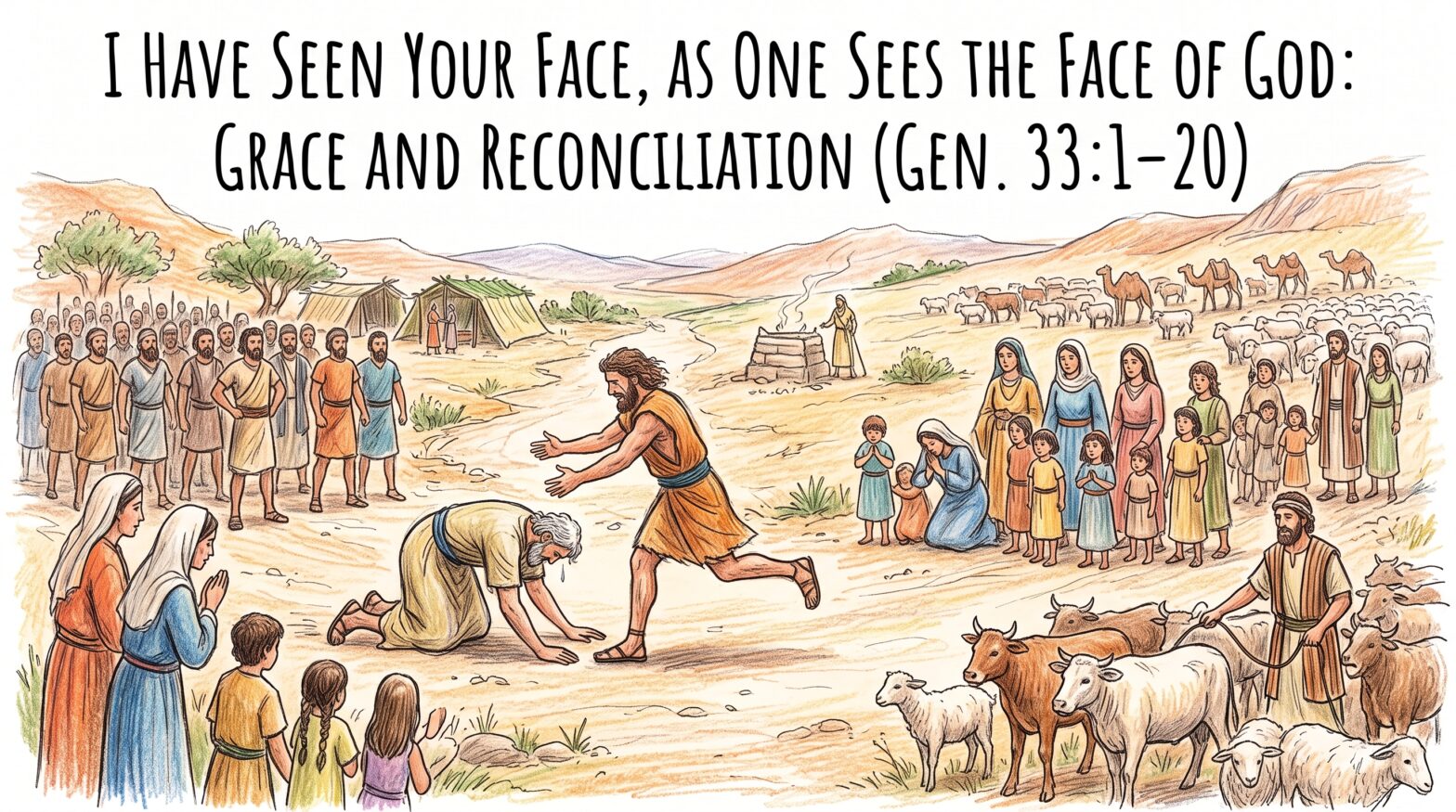
Twenty years of dread, guilt, and lingering fear can make a brother’s face look like an executioner. As Jacob looks up and sees Esau approaching with four hundred men, everything in his past says he should expect vengeance. Yet, what unfolds on the dusty road of Canaan is one of the most astonishing scenes of unexpected grace and reconciliation in the entire Old Testament.
Having wrestled with God at the Jabbok and received a limp and a new name, Jacob meets his brother not as a cunning manipulator trying to win by trickery, but as a humbled servant. God, who holds the hearts of all men in His hands, had softened Esau’s heart.
Genesis 33 records the emotional reunion of Jacob and Esau, the exchange of gifts and favor, their peaceful parting, and Jacob’s safe arrival in the Promised Land, marked by the worship of El-Elohe-Israel.
Verses 1–7
1 And Jacob lifted up his eyes and looked, and behold, Esau was coming, and four hundred men with him. So he divided the children among Leah and Rachel and the two female servants. 2 And he put the servants with their children in front, then Leah with her children, and Rachel and Joseph last of all. 3 He himself went on before them, bowing himself to the ground seven times, until he came near to his brother. 4 But Esau ran to meet him and embraced him and fell on his neck and kissed him, and they wept. 5 And when Esau lifted up his eyes and saw the women and children, he said, “Who are these with you?” Jacob said, “The children whom God has graciously given your servant.” 6 Then the servants drew near, they and their children, and bowed down. 7 Leah likewise and her children drew near and bowed down. And last Joseph and Rachel drew near, and they bowed down.
The Tearful Embrace
As the two large parties converge, Jacob organizes his family with care, placing the maidservants and their children first, followed by Leah and her children, and finally Rachel and Joseph at the rear.
Crucially, Jacob does not hide behind his family or send them ahead to face potential danger alone. The text highlights that “He himself went on before them.” The man who once grabbed heels from behind now steps out in front as a protective head and shepherd of his household.
As he approaches Esau, Jacob bows to the ground seven times, a standard ancient Near Eastern posture of deep respect and royal honor (frequently attested in ancient diplomatic letters). Jacob shows genuine humility, treating his brother with deference rather than asserting superiority.
Then comes the dramatic turning point. Instead of an armed charge, “Esau ran to meet him and embraced him and fell on his neck and kissed him, and they wept.”
This is nothing short of a miracle of divine providence. God had answered Jacob’s earnest prayer at the Jabbok (Gen. 32:11). The brother who had vowed murder twenty years prior (Gen. 27:41) now falls on Jacob’s neck in tears of genuine affection. When Jacob introduces his family, he humbly testifies to God’s unmerited favor: “The children whom God has graciously given your servant.”
Verses 8–11
8 Esau said, “What do you mean by all this company that I met?” Jacob answered, “To find favor in the sight of my lord.” 9 But Esau said, “I have enough, my brother; keep what you have for yourself.” 10 Jacob said, “No, please, if I have found favor in your sight, then accept my present from my hand. For I have seen your face, which is like seeing the face of God, and you have accepted me. 11 Please accept my blessing that is brought to you, because God has dealt graciously with me, and because I have enough.” Thus he urged him, and he took it.
Seeing the Face of God in Mercy
Esau inquires about the vast droves of livestock he encountered on the road. When Jacob explains that they were intended as a gift to gain favor, Esau initially declines, saying, “I have enough, my brother.” Esau had prospered materially in Edom and bore no remaining financial grudge.
However, Jacob urges Esau to receive the gifts. In doing so, Jacob utters one of the most remarkable statements in Genesis: “For I have seen your face, which is like seeing the face of God, and you have accepted me.”
Only hours earlier, Jacob had named the wrestling site Peniel (“Face of God”), declaring, “I have seen God face to face, and yet my life has been delivered” (Gen. 32:30). Now, as he looks upon the forgiving, welcoming face of the brother he had wronged, Jacob sees an earthly reflection of the divine mercy he experienced at the river. Just as God looked upon Jacob with grace rather than judgment, so Esau receives him with open arms.
Jacob also refers to his gift as a “blessing” (berakah). Twenty years earlier, Jacob had stolen Esau’s blessing through deceit. Now, enriched by God’s grace, Jacob freely bestows a lavish physical blessing upon his brother, restoring material abundance to him. Overwhelmed by Jacob’s insistence, Esau accepts the tribute.
Verses 12–17
12 Then Esau said, “Let us journey on our way, and I will go ahead of you.” 13 But Jacob said to him, “My lord knows that the children are frail, and that the nursing flocks and herds are a care to me. If they are driven hard for one day, all the flocks will die. 14 Let my lord pass on ahead of his servant, and I will lead on slowly, at the pace of the livestock that are ahead of me and at the pace of the children, until I come to my lord in Seir.” 15 So Esau said, “Let me leave with you some of the people who are with me.” But he said, “What need is there? Let me find favor in the sight of my lord.” 16 So Esau returned that day on his way to Seir. 17 But Jacob journeyed to Succoth, and built himself a house and made booths for his livestock. Therefore the name of the place is called Succoth.
Courteous Parting and Pastoral Prudence
Esau proposes that they travel together back to Seir (Edom), or that he at least leave an armed escort to accompany Jacob’s group. Jacob politely declines both offers.
Jacob points out the practical reality of his situation: his young children and nursing flocks cannot endure a rapid march without risking severe loss. He promises to journey at a comfortable pace for the livestock and children, indicating a general direction toward Seir.
While some readers question whether Jacob misled Esau by turning toward Succoth rather than immediately following him to Seir, the text presents Jacob acting with sound pastoral care for his vulnerable household. Furthermore, Jacob understood that their ultimate callings were distinct. Esau’s home was in the rugged country of Seir, whereas Jacob was called back to the land of Canaan promised to Abraham and Isaac.
Jacob stops temporarily at Succoth (meaning “Booths” or “Shelters”), building temporary structures to rest his livestock and family after their long journey from Mesopotamia.
Verses 18–20
18 And Jacob came safely to the city of Shechem, which is in the land of Canaan, on his way from Paddan-aram, and he camped before the city. 19 And from the sons of Hamor, Shechem’s father, he bought for a hundred pieces of money the piece of land on which he had pitched his tent. 20 There he erected an altar and called it El-Elohe-Israel.
Safe Arrival and Personal Worship
From Succoth, Jacob crosses the Jordan River and arrives safely at the city of Shechem in the central hill country of Canaan.
This safe arrival is a direct fulfillment of God’s promise at Bethel twenty years earlier: “I am with you and will keep you wherever you go, and will bring you back to this land” (Gen. 28:15).
Jacob purchases a plot of land from the sons of Hamor for a hundred pieces of money (qesitah). This is only the second recorded land purchase by the patriarchs in Canaan (the first being Abraham’s purchase of the cave at Machpelah in Gen. 23). Jacob secures a permanent stake in the Promised Land.
To mark this milestone, Jacob builds an altar and names it El-Elohe-Israel, which means “God, the God of Israel.”
This name is deeply significant. At Bethel, Jacob had spoken of God as “the God of my father Abraham and God of my father Isaac.” But now, having wrestled at Peniel and received his new name, Jacob claims the Almighty as his own God. Yahweh is no longer merely the God of his ancestors; He is personally the God of Israel.
Conclusion
Genesis 33 stands as a beautiful testament to the power of divine grace in healing fractured human relationships. Jacob spent decades fearing Esau’s vengeance, yet God transformed an imminent conflict into a scene of tearful reconciliation.
In Esau’s unexpected, forgiving embrace, Jacob caught a glimpse of the very heart of God, a God who welcomes penitent, limping sinners with open arms.
Ultimately, this story points us to the Gospel of Jesus Christ. We, like Jacob, were once alienated from God and fearful of His righteous judgment because of our sin. Yet, through the cross, God meets us not in wrath, but in overwhelming grace. In Christ, God “ran to meet us,” falling on our neck in mercy, forgiving our transgressions, and bringing us safely into His eternal promise. And as those who have received such immense divine mercy, we are called to reflect that same grace and reconciliation toward others.
Key Terms
- Bowing Seven Times: An ancient Near Eastern custom signifying high respect, honor, and formal submission toward a superior or king, demonstrating Jacob’s humble posture before Esau.
- “Face of God” (Peniel Connection): Jacob’s recognition of divine mercy mirrored in human forgiveness. Having seen God’s face at Peniel and lived, Jacob sees an echo of that saving grace in Esau’s forgiving smile.
- Succoth: Meaning “Booths” or “Shelters.” A location east of the Jordan River where Jacob built temporary shelters for his livestock, demonstrating practical care for his tired animals and children.
- El-Elohe-Israel: Meaning “God, the God of Israel.” The name Jacob gave to the altar he built at Shechem, marking his personal, firsthand covenant faith in the God who transformed him from Jacob into Israel.