We live in an age that equates love with emotional vulnerability. In our modern, psychologized world, authenticity is measured by how deeply an individual can be wounded by others, how openly they display emotional volatility, and how intensely they enter into shared distress. To love someone, we are told, means allowing our emotional equilibrium to be shaped, destabilized, and dictated by that person’s actions and experiences.
Tragically, contemporary theology has enthusiastically projected this creaturely vulnerability onto the uncreated God.
Over the past century, widespread movements within Western theology, from Jürgen Moltmann’s “theology of the crucified God” to Open Theism and popular therapeutic evangelicalism, have waged war against the classical Christian consensus. Classical theism is routinely caricatured as presenting a frozen, unfeeling monster: an aloof, stoic monolith who watches human anguish from a cold, metaphysical balcony without caring. In place of this historic bedrock, modern writers propose a “passible” deity: a god who suffers, weeps, undergoes fluctuating grief and ecstasy, and is emotionally dependent upon the history of His creation.
Yet our Christian instincts, grounded in the unshakeable testimony of Holy Scripture, recognize the catastrophe of such an inversion. A god who can be emotionally destabilized by His creatures is a god held hostage by His world. If God can be wounded, manipulated, or altered by creaturely suffering, He is not God.
To preserve the glory of the Almighty and the true consolation of the afflicted, we must reclaim one of the most vital safeguards of classical Christian orthodoxy: the doctrine of Divine Impassibility (Impassibilitas Dei).
Because God is simple, self-existent (a se), and pure act (actus purus), He is divinely impassible, incapable of undergoing emotional fluctuation, suffering, or being acted upon by creatures, ensuring that His steadfast love is not a fragile, reactionary passion, but an immutable, overflowing fountain of eternal perfection.
What Is Divine Impassibility? Without Passions
To understand divine impassibility, we must begin by clarifying our theological vocabulary. In modern English, “passion” refers to an intense romantic feeling or a fiery enthusiasm. In classical philosophy and Christian dogmatics, however, the word passion (derived from the Latin passio, which stems from pati, meaning “to suffer” or “to undergo”) carries a far more rigorous, technical definition.
A passion is an involuntary, reactive alteration of an agent’s internal state caused by an external object. When a creature experiences a passion, they are passive; they are acted upon from the outside. For instance, when you witness an unexpected tragedy, grief surges through your mind and body without your immediate consent. Your emotional state is altered, moved from potentiality into a new, reactive actuality by a creaturely circumstance outside your control.
When the historic confessions declare that the living God is “without body, parts, or passions” (WCF 2.1), they are denying that God can ever be the passive recipient of an external force.
Divine impassibility affirms that:
- God cannot suffer. He cannot undergo physical distress, emotional trauma, or loss. He possesses no capacity for injury, diminishment, or pain.
- God cannot undergo emotional change. He does not move from joy to sorrow, from contentment to frustration, or from tranquility to anxiety.
- God cannot be acted upon from without. No creature, event, or cosmic tragedy can intrude upon the divine essence, force God into a defensive reaction, or alter His eternal disposition.
Impassibility as the Logical Fruit of Simplicity and Aseity
Divine impassibility is not an isolated, speculative idea; it is the necessary logical consequence of the doctrines we have already established.
- In light of Divine Simplicity: Because God is simple and uncompounded, He is devoid of passive potentiality. He is Pure Act (Actus Purus). If God could undergo a passion, He would move from a prior state (not feeling grief) to a new state (feeling grief). This would mean He possesses unrealized potentiality, making Him composite and contingent.
- In light of Divine Aseity: Because God is underived and independent (a se), He depends on nothing outside Himself for His existence, knowledge, or beatitude. If a creature could cause God to suffer or react emotionally, the creature would be the primary cause of an internal change in God, demoting the Almighty to an ab alio recipient of creaturely influence.
God cannot be acted upon because He is the supreme, uncaused Actor of all reality.
The Scriptural Witness: Resolving the Relational Tension
When modern readers open the Bible, they frequently point to passages that speak of God’s “repentance,” “grief,” or “wrath,” assuming these texts refute classical impassibility:
- “And the Lord regretted that he had made man on the earth, and it grieved him to his heart.” (Genesis 6:6)
- “How can I give you up, O Ephraim? How can I hand you over, O Israel? … My heart recoils within me; my compassion grows warm and tender.” (Hosea 11:8)
How does classical Reformed orthodoxy reconcile these verses with the equally clear, categorical assertions that God cannot change His mind or experience human passions?
- “God is not man, that he should lie, or a son of man, that he should change his mind.” (Numbers 23:19)
- “And also the Glory of Israel will not lie or have regret, for he is not a man, that he should have regret.” (1 Samuel 15:29)
- “For I the Lord do not change; therefore you, O children of Jacob, are not consumed.” (Malachi 3:6)
- “Every good gift and every perfect gift is from above, coming down from the Father of lights, with whom there is no variation or shadow due to change.” (James 1:17)
To navigate these texts without collapsing into contradiction, classical dogmatics employs two indispensable tools: the recognition of anthropopathisms and the distinction between affections and passions.
Anthropopathisms: Accommodated Emotional Language
Just as Scripture uses anthropomorphisms (attributing physical human features to God, such as “hands,” “eyes,” or “wings”) to communicate spiritual realities to creaturely minds, it also uses anthropopathisms (attributing human emotional states and psychological reactions to God).
When Genesis 6:6 states that God “regretted” making man, the author is not reporting a metaphysical shift in the eternal mind of God. God did not suddenly realize that creation was a mistake! Rather, Scripture is describing the holy reaction of God’s immutable justice against human rebellion in terms that finite creatures can grasp.
As Herman Bavinck wrote regarding the unchanging nature of God:
Those who predicate any change whatsoever of God, whether with respect to his essence, knowledge, or wil[1]l, diminish all his attributes: independence, simplicity, eternity, omniscience, and omnipotence. This robs God of his divine nature, and religion of its firm foundation and assured comfort.
Bavinck clarifies that the apparent movement or change is not within God, but within creation in relation to God: “There is change around, about, and outside of him, and there is change in people’s relations to him, but there is no change in God himself.”[2]
When a ship alters its course from north to south, the steady, unchanging wind that once propelled it forward now drives against its bow. The wind has not changed direction; the ship has altered its relation to the wind. Similarly, when humanity apostatizes from righteousness to sin, they experience the single, simple, unchangeable holiness of God no longer as blessing, but as wrath. The change is entirely in the creature, not in the Creator.
Passions vs. Divine Affections: Expressions of Effect, Not Affect
Classical theologians carefully distinguished between creaturely passions and divine affections (affectiones).
In human beings, emotions are passive affects, reactions that storm through our souls, often overpowering our reason and driving us to act. But in God, what we call “love,” “mercy,” or “justice” are not passive emotional responses. They are active, immutable perfections of His eternal will.
When Scripture describes God’s mercy or wrath, it is describing expressions of effect, not affect. It describes what God sovereignly produces outside Himself toward creatures, not a psychological disturbance produced within Himself by creatures. God’s love is not an emotional mood that He slips into when we are obedient; God is love, infinite, unfluctuating, and sovereignly determined from all eternity.
Christology and the Cross: Did God Suffer?
The fiercest modern objection to divine impassibility centers upon the cross of Jesus Christ. If Christ is fully God, and if Christ suffered unimaginable torment on Calvary, does that not mean that God suffered?
Ancient heresies such as Patripassianism (the idea that the Father suffered on the cross) and Theopaschitism (the claim that the divine nature itself underwent pain and death) sought to answer this question by introducing suffering directly into the Godhead. Modern theologians follow in their footsteps, claiming that the crucifixion represents a rupture or shared agony within the Trinity itself.
Classical Christian orthodoxy, articulated at the Council of Chalcedon (451 AD), unequivocally rejects this error by honoring the hypostatic union and the proper rules of the communication of properties (communicatio idiomatum).
The Chalcedonian Distinction
Jesus Christ is one undivided divine Person (hypostasis) subsisting in two distinct, unconfused natures: a fully divine nature and a fully human nature.
- According to His human nature (secundum humanam naturam), Christ possessed a true human body and a reasonable human soul. He grew weary, thirsted, wept, suffered, and died.
- According to His divine nature (secundum divinam naturam), the Son remains eternally simple, immutable, omnipotent, and impassible (apathes).
When Jesus hung upon the cross, who was suffering? The Person of the Son was suffering, but He was suffering in and through His assumed human nature alone. The divine nature did not bleed, suffocate, or undergo torment. As Cyril of Alexandria famously summarized, the Son of God “suffered impassibly“… He genuinely suffered as a concrete subject, but He did so within the creaturely limits of the human flesh He assumed, while His divine essence remained entirely untouched by suffering.
If the divine nature itself had suffered, salvation would be completely overturned. A god who can suffer is a god who can be compromised, injured, or overcome. Christ’s divine nature did not suffer on the cross; rather, Christ’s impassible divine nature undergirded and imparted infinite value to the genuine human suffering He endured for our sins.
The Bedrock of Unshakable Consolation
Loved ones, modern theology promises that an impassible God is an unfeeling, detached stoic, and that what we truly need in our darkest valleys is a “fellow-sufferer who understands,” a god who weeps and aches beside us.
Do not be deceived by this sentimental trap.
Imagine you have fallen into a raging, violent river. You are drowning in the freezing water, swept away by the crushing current, gasping for breath. As you are about to go under, you look up and see a man standing on the shore.
What kind of rescuer do you need?
Do you need a man who jumps into the raging waters, gets caught in the exact same whirlpool, fractures his limbs against the rocks, and drowns alongside you in solidarity? Does his shared agony rescue you?
Not at all! You are now two drowning men instead of one.
What you desperately need is a rescuer whose feet are planted upon the immovable granite rock of the shore, someone who remains completely untouched by the violently swirling water, holding fast to an unshakeable anchor so that He can reach down with absolute strength and pull you out of the torrent.
A suffering god cannot save you from suffering.
If God were subject to emotional turmoil, He would be as fragile, vulnerable, and overwhelmed by the tragedies of this fallen world as you are. If God could experience grief and emotional injury, His ability to govern history, comfort His people, and overcome evil would be in permanent jeopardy.
Because God is impassible:
- His love cannot be extinguished. Human love is fragile and reactionary; it rises and falls based on the loveliness or unloveliness of the other person. But God’s love is an active, immutable perfection. He does not love you because you are lovely; He loves you because He is God, and His love cannot be eroded, diminished, or weary.
- His peace is unshakeable. When you enter the quiet, terrifying rooms of grief, when you lose a child, when the cancer diagnosis returns, or when your family fractures, you do not run to a god who is panic-stricken and weeping helplessly. You run to the Rock of Ages. You hide yourself in a Lord whose joy, peace, and beatitude are infinite and undisturbed, drawing strength from a Fountain that can never run dry.
- His promises are unbreakable. Because God is immune to moods, emotional shifts, or reactionary regret, His covenant promises in Christ Jesus are forever settled in heaven. He will never wake up tomorrow and feel differently about your justification.
Conclusion
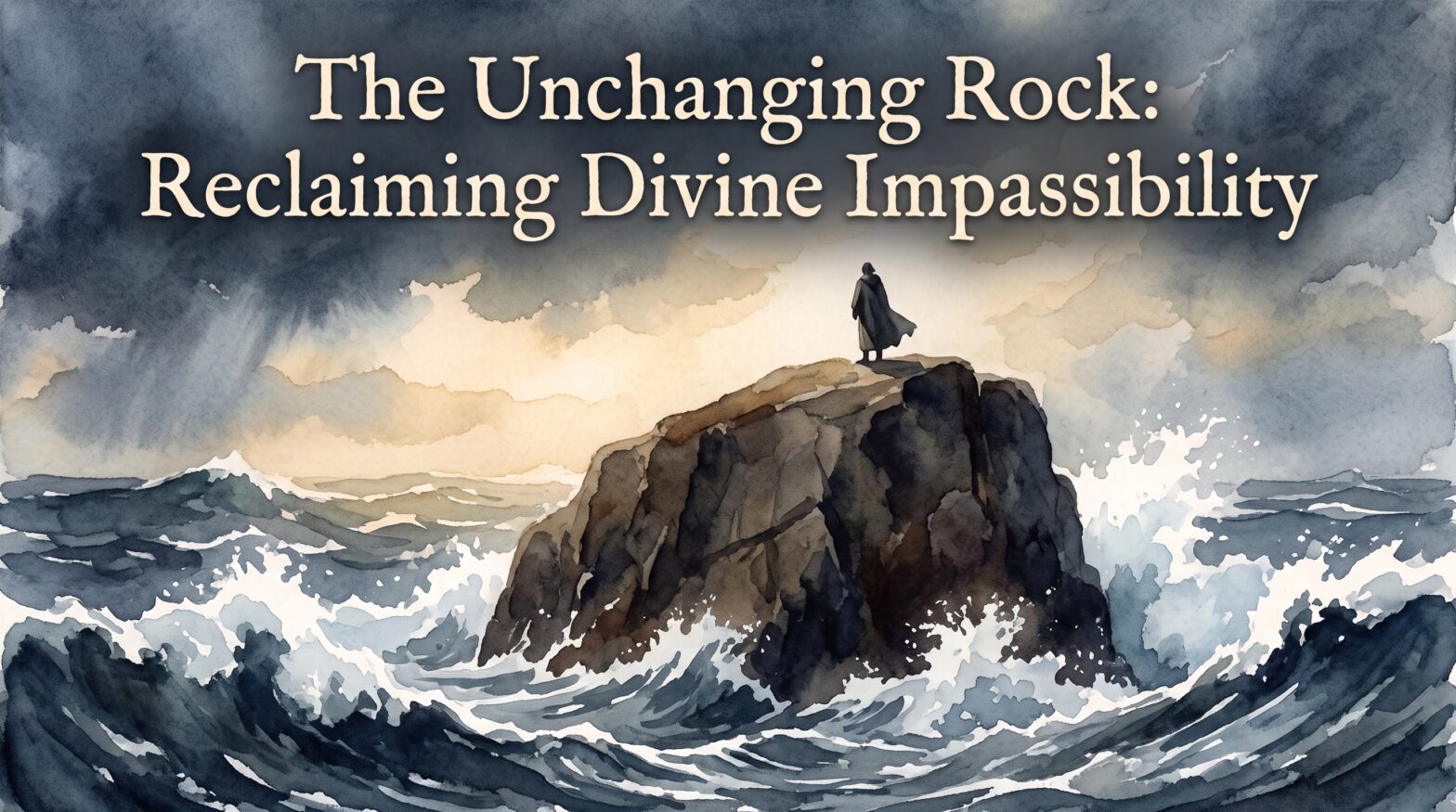
God is not a creature tossed upon the turbulent waves of circumstance. He is the infinite, unmoveable Rock in the midst of the storm.
Our next study turns to Divine Omnipresence, Eternity, and Infinity, exploring how God is entirely unbound by the creaturely limitations of space and time. For now, anchor your anxious heart to this glorious truth: creation fluctuates, but our God remains unchanged.
Impassible God, Father, Son, and Holy Spirit, free us from our fragile emotional projections. Draw us into the refuge of Your unchangeable, sovereign majesty, and secure us forever in Your immovable love. Amen.
Key Terms
- Divine Impassibility (Impassibilitas Dei): The classical orthodox doctrine that God is incapable of suffering, undergoing emotional changes, or being passively acted upon by any external creature or event. God possesses no passive potentiality and is fully actualized in His eternal essence.
- Passions (Passiones): Involuntary, reactive alterations of an agent’s internal psychological or physical state, caused by an external stimulus that moves the agent from potentiality to a new actuality. Creatures possess passions; God is entirely “without passions.”
- Anthropopathism: A figure of speech in Scripture that attributes human feelings, passions, or psychological reactions (e.g., regret, jealousy, grief) to God, accommodating divine, transcendent truth to finite creaturely understanding.
- Pure Act (Actus Purus): The scholastic designation of God as absolute, uncompounded actuality devoid of all passive potentiality. Because God has no potentiality to become anything other than He is, He cannot be moved or altered.
- Theopaschitism / Patripassianism: Ancient Trinitarian and Christological heresies asserting that the divine nature itself, or specifically the Person of the Father, suffered torment and death upon the cross, directly undermining divine immutability and impassibility.
- Communicatio Idiomatum (Communication of Properties): The Christological principle that the properties of both the divine and human natures belong to the single, undivided Person of Christ, such that the Person can be said to suffer in His human nature, while His divine nature remains strictly impassible.
[1] Herman Bavinck, Reformed Dogmatics, ed. John Bolt, trans. John Vriend, vol. 2 (Baker, 2004), 158.
[2] Ibid.