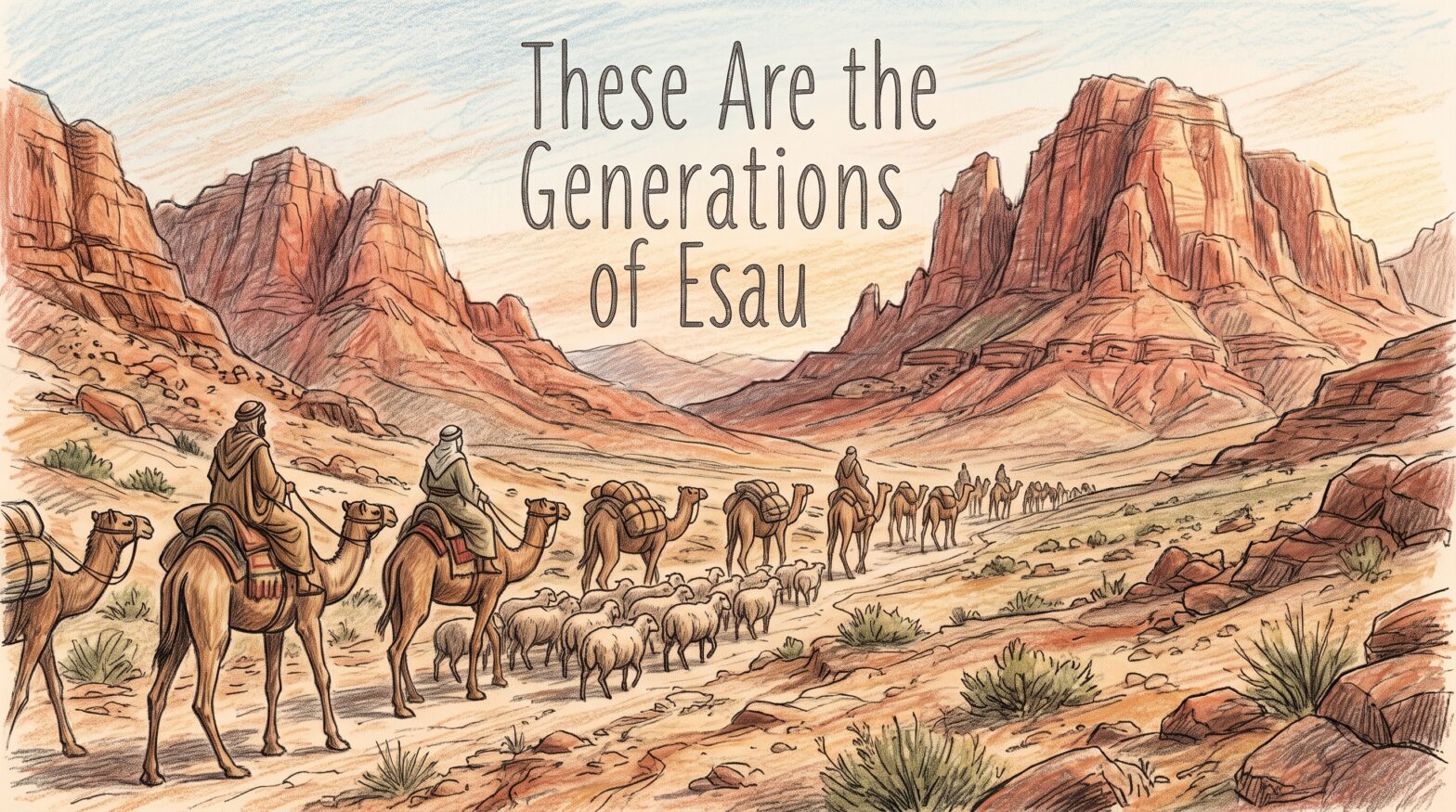
A chapter dominated by ancient names, tribal chiefs, and unfamiliar desert geography might seem like a dry detour in the patriarchal narrative. Yet, Genesis 36 occupies a vital and strategic place in redemptive history.
Throughout the Book of Genesis, the Holy Spirit employs a deliberate literary pattern: before tracing the chosen covenant line through whom the Seed of promise will come, Scripture pauses to record the history, prosperity, and lineage of the non-chosen line. Just as Genesis recorded the generations of Cain before Seth (Gen. 4–5), Japheth and Ham before Shem (Gen. 10–11), and Ishmael before Isaac (Gen. 25:12–19), the text now details the generations of Esau before turning its gaze exclusively to Jacob and his sons in Genesis 37.
Genesis 36 is far more than an ancient roster. It is a powerful witness to the meticulous faithfulness of God. Even though Esau was outside the Messianic covenant line, God honored His promises to Abraham and Isaac regarding Esau’s physical abundance (Gen. 25:23; 27:39–40). Furthermore, this chapter sets the stage for centuries of future biblical history, explaining the origin of Israel’s fierce historical neighbor, Edom, and illustrating the sobering contrast between worldly success that flourishes quickly and the slow, patient unfolding of God’s covenant promises.
Genesis 36 records the generations of Esau, his departure from Canaan to settle in Mount Seir, the tribal chiefs born of his wives, the integration and lineage of the native Horites, and the roster of eight Edomite kings who ruled long before Israel had a king.
Verses 1–8
1 These are the generations of Esau (that is, Edom). 2 Esau took his wives from the Canaanites: Adah the daughter of Elon the Hittite, Oholibamah the daughter of Anah the daughter of Zibeon the Hivite, 3 and Basemath, Ishmael’s daughter, the sister of Nebaioth. 4 And Adah bore to Esau, Eliphaz; Basemath bore Reuel; 5 and Oholibamah bore Jeush, Jalam, and Korah. These are the sons of Esau who were born to him in the land of Canaan. 6 Then Esau took his wives, his sons, his daughters, and all the members of his household, his livestock, all his beasts, and all his property that he had acquired in the land of Canaan. He went into a land away from his brother Jacob. 7 For their possessions were too great for them to dwell together. The land of their sojournings could not support them because of their livestock. 8 So Esau settled in the hill country of Seir. (Esau is Edom.)
The Departure to Mount Seir
The chapter opens with the classic structural formula of Genesis: “These are the generations” (Toledot). It explicitly identifies Esau with Edom (“Red”), a moniker linking back to his red complexion at birth and the red stew for which he traded away his birthright (Gen. 25:25, 30).
Verses 2–3 list Esau’s wives, showing his deep entanglement with the local Canaanite tribes (Hittites and Hivites) as well as the family of Ishmael. These marriages had been a source of deep grief to Isaac and Rebekah (Gen. 26:34–35), reflecting Esau’s disregard for the spiritual purity of Abraham’s line.
Yet, despite this spiritual indifference, God’s common grace and temporal blessing rested heavily on Esau. His family and herds multiplied so rapidly that the land could no longer support both him and Jacob. In language intentionally reminiscent of Abraham and Lot’s parting in Genesis 13:6, the text notes: “For their possessions were too great for them to dwell together.”
Notice the profound theological significance of verse 6: Esau willingly takes his vast household and migrates southeast to the rugged hill country of Mount Seir, leaving the land of Canaan entirely to his brother Jacob.
Esau was not forcibly driven out; he voluntarily abandoned the Promised Land because his heart was set on immediate, tangible, earthly possessions rather than the distant spiritual inheritance of Abraham. Without a single arrow shot or sword drawn, God sovereignly cleared the stage of Canaan for Jacob and his seed, ensuring that the covenant heir remained the sole inheritor of the Promised Land.
Verses 9–19
9 These are the generations of Esau the father of the Edomites in the hill country of Seir. 10 These are the names of Esau’s sons: Eliphaz the son of Adah the wife of Esau, Reuel the son of Basemath the wife of Esau. 11 The sons of Eliphaz were Teman, Omar, Zepho, Gatam, and Kenaz. 12 (Timna was a concubine of Eliphaz, Esau’s son; she bore Amalek to Eliphaz.) These are the sons of Adah, Esau’s wife. 13 These are the sons of Reuel: Nahath, Zerah, Shammah, and Mizzah. These are the sons of Basemath, Esau’s wife. 14 These are the sons of Oholibamah the daughter of Anah the daughter of Zibeon, Esau’s wife: she bore to Esau Jeush, Jalam, and Korah. 15 These are the chiefs of the sons of Esau. The sons of Eliphaz the firstborn of Esau: the chiefs Teman, Omar, Zepho, Kenaz, 16 Korah, Gatam, and Amalek; these are the chiefs of Eliphaz in the land of Edom; these are the sons of Adah. 17 These are the sons of Reuel, Esau’s son: the chiefs Nahath, Zerah, Shammah, and Mizzah; these are the chiefs of Reuel in the land of Edom; these are the sons of Basemath, Esau’s wife. 18 These are the sons of Oholibamah, Esau’s wife: the chiefs Jeush, Jalam, and Korah; these are the chiefs born of Oholibamah the daughter of Anah, Esau’s wife. 19 These are the sons of Esau (that is, Edom), and these are their chiefs.
The Sons and Chiefs of Esau
The narrative narrows to Esau’s family in their new homeland of Seir, detailing his sons, grandsons, and the tribal leaders known as chiefs (‘alluphim).
The term ‘alluph refers to the head of a thousand, a clan leader, or a territorial chieftain. While Jacob’s family remained a small, wandering caravan of shepherds living in tents, Esau’s descendants had already organized themselves into a formidable, structured aristocratic clan system.
Among the names recorded, two stand out with major significance for future biblical history:
Teman (v. 11): A grandson of Esau whose descendants settled a region famous throughout the ancient world for its traditional wisdom and philosophy. In the Book of Job, which many scholars believe reflects this very patriarchal era, Job’s primary counselor is introduced as “Eliphaz the Temanite” (Job 2:11), and later prophetic literature frequently invokes Teman as synonymous with Edom’s intellectual pride (Jer. 49:7; Obad. 8–9).
Amalek (v. 12): Born to Eliphaz through his concubine Timna. Amalek became the founding father of the Amalekites, the ruthless nomadic tribe that would ambush the weak and weary Israelites from behind shortly after their Exodus from Egypt (Ex. 17:8–16; Deut. 25:17–19). King Saul was later commanded to execute divine judgment upon them (1 Sam. 15), and centuries later, Haman the Agagite, who plotted to annihilate the entire Jewish race in Persia, was an Amalekite descendant (Esther 3:1). What began as a concubine’s son in Genesis 36 grew into the archetypal, perpetual enemy of the people of God.
Verses 20–30
20 These are the sons of Seir the Horite, the inhabitants of the land: Lotan, Shobal, Zibeon, Anah, 21 Dishon, Ezer, and Dishan; these are the chiefs of the Horites, the sons of Seir in the land of Edom. 22 The sons of Lotan were Hori and Hemam; and Lotan’s sister was Timna. 23 These are the sons of Shobal: Alvan, Manahath, Ebal, Shepho, and Onam. 24These are the sons of Zibeon: Aiah and Anah; he is the Anah who found the hot springs in the wilderness, as he pastured the donkeys of Zibeon his father. 25 These are the children of Anah: Dishon and Oholibamah the daughter of Anah. 26These are the sons of Dishon: Hemdan, Eshban, Ithran, and Cheran. 27 These are the sons of Ezer: Bilhan, Zaavan, and Akan. 28 These are the sons of Dishan: Uz and Aran. 29 These are the chiefs of the Horites: the chiefs Lotan, Shobal, Zibeon, Anah, 30 Dishon, Ezer, and Dishan; these are the chiefs of the Horites, chief by chief in the land of Seir.
The Native Horites of Seir
Scripture pauses to document the indigenous population of Mount Seir: the Horites (cave-dwellers or mountain-dwellers).
Rather than instantly eradicating them, Esau’s clan initially coexisted and intermarried with the Horite nobility. For example, Esau’s wife Oholibamah was a descendant of Zibeon the Horite (v. 2, 25), and Lotan’s sister Timna became the concubine of Esau’s eldest son Eliphaz (v. 12, 22). Eventually, Deuteronomy 2:12, 22 clarifies that Esau’s descendants conquered, dispossessed, and completely absorbed the Horites, establishing total dominion over the mountainous territory of Edom.
The text preserves a fascinating historical vignette in verse 24 regarding Anah, “who found the hot springs in the wilderness, as he pastured the donkeys of Zibeon his father.” In an arid, mountainous landscape like Seir, discovering natural thermal water springs was a miraculous, life-giving find, ensuring herds could thrive and human life could flourish in the desert. The inclusion of this obscure detail illustrates the authentic, historical eyewitness texture of Genesis.
Verses 31–43
31 These are the kings who reigned in the land of Edom, before any king reigned over the Israelites. 32 Bela the son of Beor reigned in Edom, the name of his city being Dinhabah. 33 Bela died, and Jobab the son of Zerah of Bozrah reigned in his place. 34 Jobab died, and Husham of the land of the Temanites reigned in his place. 35 Husham died, and Hadad the son of Bedad, who defeated Midian in the country of Moab, reigned in his place, the name of his city being Avith. 36Hadad died, and Samlah of Masrekah reigned in his place. 37 Samlah died, and Shaul of Rehoboth on the Euphrates reigned in his place. 38 Shaul died, and Baal-hanan the son of Achbor reigned in his place. 39 Baal-hanan the son of Achbor died, and Hadar reigned in his place, the name of his city being Pau; his wife’s name was Mehetabel, the daughter of Matred, daughter of Mezahab. 40 These are the names of the chiefs of Esau, according to their clans and their dwelling places, by their names: the chiefs Timna, Alvah, Jetheth, 41 Oholibamah, Elah, Pinon, 42 Kenaz, Teman, Mibzar, 43Magdiel, and Iram; these are the chiefs of Edom (that is, Esau, the father of Edom), according to their dwelling places in the land of their possession.
The Early Kings of Edom
Verse 31 introduces a remarkable historical observation: “These are the kings who reigned in the land of Edom, before any king reigned over the Israelites.”
Centuries before Saul was anointed or David ascended the throne in Jerusalem, Edom had already established an active monarchy. Notice the nature of this early Edomite kingdom:
- None of the eight kings mentioned are sons of the preceding king.
- They hail from different cities, clans, and regions (Bozrah, Teman, Avith, Rehoboth, Pau).
- This indicates that the Edomite monarchy was not an unbroken hereditary dynasty, but likely an elective monarchy, or a confederation of powerful chiefs who selected a supreme military ruler to lead them in times of war.
The phrase “before any king reigned over the Israelites” is not an anachronism; it is a profound theological checkpoint. Moses, writing to Israel on the threshold of Canaan, had just recorded God’s covenant promises to Abraham and Jacob that “kings shall come from your body” (Gen. 17:6; 35:11). Israel had been promised royal destiny. Yet, for centuries, Israel remained landless, enslaved in Egypt, and wandering in the desert without a king, while the unchosen line of Esau was already parading crowned monarchs and establishing fortified cities.
Conclusion
Genesis 36 presents a profound study in contrasting kingdoms: the Kingdom of Man versus the Kingdom of God.
To human eyes, Esau appeared to be winning. While Jacob was living as a sojourning shepherd in a foreign land, mourning the death of his beloved wife and weeping over the sins of his sons, Esau was building an empire. Esau’s line had political autonomy, military chieftains, organized government, and kings.
This illustrates a perennial spiritual principle: the seed of the serpent and the line of the flesh almost always flourish faster in this world than the seed of the woman. The worldly man seeks his inheritance now; like Esau, he wants his blessing in the present age.
Jacob, however, was willing to wait. Hebrews 11:13–16 reminds us that the patriarchs died in faith without having received the full realization of the promises, looking instead for a city with foundations, whose architect and builder is God.
Where are the kings of Edom today? Their palaces are ancient dust, their names forgotten footnotes in archaeological records, and their civilization obliterated (just as Obadiah prophesied: “The house of Esau shall be stubble… and there shall be no survivor for the house of Esau” [Obad. 18]).
Yet the humble, limping seed of Jacob produced the King of Kings, Jesus Christ.
Christ did not come with earthly grandeur or an immediate worldly crown; He took upon Himself the form of a servant, suffered outside the gates, and through His cross and resurrection secured an eternal kingdom that can never be shaken. Believers therefore have no reason to envy the rapid, superficial prosperity of the world. The kingdoms of this world will rise, reign, and turn to dust, but those who endure in covenant faith with Christ will reign with Him forever.
Key Terms
- Toledot (“These are the generations”): The recurring structural heading across Genesis (used twice here: vv. 1, 9) that organizes the book’s historical epochs, consistently treating collateral lines before returning to the chosen Messianic line.
- Mount Seir: The rugged, mountainous terrain located southeast of the Dead Sea where Esau settled. It became the sovereign territorial home of the nation of Edom.
- Chiefs (‘Alluphim): Tribal leaders, military captains, or heads of a clan (from the Hebrew root ‘eleph, meaning “a thousand” or “clan”). It reflects the early federal and aristocratic structure of Edomite society.
- Amalekites: The fierce nomadic tribe descended from Esau’s grandson Amalek (Gen. 36:12). They became relentless enemies of Israel, attacking them in the wilderness at Rephidim (Ex. 17), and standing as a perpetual symbol of fleshly opposition to God’s people.
- Elective Monarchy: The political system evident in early Edom (Gen. 36:31–39), where kingship did not pass down hereditarily from father to son, but rotated among different cities, tribes, and ruling chiefs.
- Immediate vs. Patient Inheritance: The theological contrast between Esau (who seized immediate worldly prosperity, territory, and political power) and Jacob (who endured suffering and wandering in faith, waiting for God’s eternal covenant promises to unfold).