Before a master builder lays the first stone of a great cathedral, he must first understand the ground upon which he builds. He must know its composition, its contours, and its load-bearing capacity. To do otherwise is to build on sand, guaranteeing the collapse of even the most magnificent structure. In our last article, we announced our project: the construction of a robust framework for Christian discipleship called Christian Stoicism. We laid out the why—the urgent need for an iron faith in our brittle, anxious age. Now, we must turn to the essential work of excavation. We must understand the ground.
Our task in this article is to answer a seemingly simple question: What, exactly, is a Stoic? For many, the word “stoic” conjures a caricature—a grim, emotionless figure who endures hardship with a stiff upper lip, a man of pure logic and no passion. This popular image, while not entirely baseless, is a shallow and misleading oversimplification. Stoicism was not merely a self-help program for managing emotions; it was a complete and comprehensive philosophy of life, a unified system encompassing a theory of the universe (physics), a method for clear thinking (logic), and a detailed guide to human flourishing (ethics). It was, for its adherents, an all-encompassing worldview.
If we are to engage this ancient philosophy—to discern what we can adopt, what we must adapt, and what we must reject—we have a scholarly and theological duty to understand it accurately. We cannot critique a caricature; we must interact with the system as it truly was. This requires us to temporarily set aside our theological scalpels and pick up the archaeologist’s brush, to gently sweep away the dust of centuries and expose the foundations of the Porch.
To properly engage with Stoicism for the purpose of Christian refinement, we must first understand it on its own terms—as a comprehensive philosophical system with a distinct history, a specific and pantheistic view of God (the Logos), and a coherent, virtue-centric theory of the good life—before we can subject it to a rigorous biblical and presuppositional critique.
The Painted Porch: A Brief History
Stoicism was not born in a vacuum. It emerged in the Hellenistic period, a time of immense social and political upheaval following the death of Alexander the Great. The old certainties of the Greek city-state (polis) had crumbled, leaving individuals to navigate a vast, often chaotic cosmopolitan world. In this environment, philosophies like Epicureanism and Stoicism arose to answer a pressing question: How can a man live a good and tranquil life in a turbulent world?
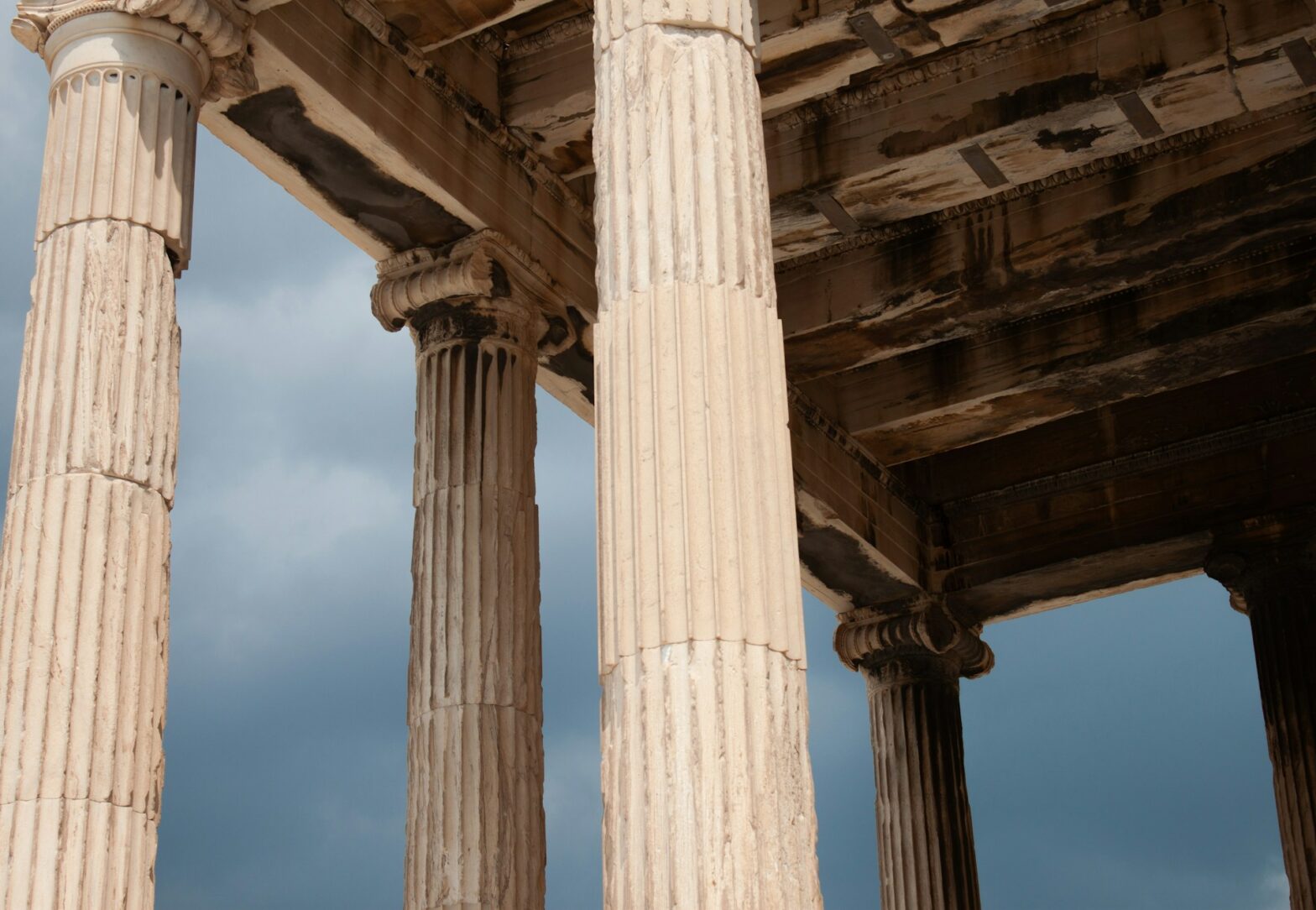
The Stoic school was founded in Athens around 300 B.C. by Zeno of Citium. He taught his students in a public colonnade known as the Stoa Poikile, or “Painted Porch,” from which the philosophy derives its name. The history of Stoicism is typically divided into three phases:
The Early Stoa (3rd Century B.C.)
This was the foundational period, dominated by the first three heads of the school: Zeno, his successor Cleanthes, and most importantly, Chrysippus. Chrysippus was the great systematizer of Stoicism. It was said that “if Chrysippus had not existed, the Stoa would not have existed either.” He authored hundreds of books (now almost entirely lost) that laid out the intricate details of Stoic physics, logic, and ethics, creating the comprehensive system that would endure for centuries.
The Middle Stoa (2nd-1st Centuries B.C.)
During this period, figures like Panaetius and Posidonius were instrumental in adapting Stoicism for a Roman audience. They softened some of its harsher, more paradoxical elements and applied its principles to the practicalities of Roman public and political life. This adaptation was crucial for its eventual widespread influence in the Roman Empire.
The Late Stoa (1st-2nd Centuries A.D.)
This is the period from which we have the most complete surviving works, and it is the era most people think of when they hear the word “Stoicism.” The three giants of this period are Seneca, a wealthy statesman and advisor to the Emperor Nero; Epictetus, a former slave who became a revered teacher; and Marcus Aurelius, the Roman Emperor whose private philosophical journal, now known as the Meditations, remains a classic of world literature. The writings of these Roman Stoics are less concerned with abstract system-building and more focused on the practical application of Stoic ethics to daily life.
The Stoic Worldview: An Integrated System
It is impossible to understand Stoic ethics without first grasping their view of the cosmos, for the two were inextricably linked. The Stoics saw philosophy as a unified organism. They compared it to an egg, where logic is the shell, ethics is the white, and physics (their term for theology and natural science) is the yolk. Or they likened it to a fertile field, where logic is the protective fence, physics is the soil, and ethics is the fruit. In every metaphor, the point is the same: the parts are inseparable and work together to produce a single, coherent whole.
Physics: A Rational, Divine Universe
The Stoic conception of the universe is profoundly different from the Christian one. For the Stoics, the cosmos was a single, living, rational being. They were materialists—believing that nothing exists except matter—and pantheists—believing that God is not a transcendent creator separate from the universe, but is immanent within it. This divine principle, which they called the Logos (a term we will see again in John’s Gospel), was conceived as a kind of rational, creative fire that permeates and governs all things.
Therefore, for the Stoics, the universe is God. Reality is a perfectly ordered, perfectly rational system. Everything that happens, from the rising of the sun to the fall of an empire, is a necessary and rational part of this divine plan. There are no accidents. There is no chaos. There is only the inexorable unfolding of divine reason, which they often called Fate or Providence.
Logic: The Fence Around the Field
Because the universe is fundamentally rational, human beings—as parts of that universe—possess a spark of that divine reason. Logic, for the Stoics, was the discipline of using this faculty correctly. It was the tool that allowed a philosopher to distinguish true from false impressions, to build sound arguments, and to avoid deception and error. It was the necessary training for the mind, protecting it from the irrationality that plagues the unphilosophical life.
Ethics: The Fruit of the Field
This brings us to the heart of the Stoic project: their ethics. If the universe is a perfectly rational system governed by the divine Logos, what is the goal of human life? Their famous answer was to live in agreement with nature. This does not mean running off to live in the woods. It means living in harmony with the rational order of the cosmos, and, more specifically, living according to our own nature as rational beings.
The good life, therefore, is a life of virtue. And for the Stoics, virtue is the sole good. Everything else that people typically pursue—health, wealth, reputation, pleasure, even life itself—is morally neutral. They are “indifferents.” The only thing that truly matters, the only thing that can make a man happy and fulfilled, is the state of his own soul, his own rational character.
The Core Tenets of Stoic Practice
From this worldview flows a set of practical principles designed to produce a virtuous and tranquil life. We will examine these in great detail in future articles, but for now, we must grasp the basics.
The Dichotomy of Control
Perhaps the most famous Stoic idea, articulated most clearly by Epictetus, is the distinction between what is in our control and what is not. In our control are our own judgments, our impulses, our desires—in short, the inner world of our mind. Not in our control are external things: our body, our property, our reputation, the actions of others, the events of the world. The Stoic sage focuses all of his energy on what is in his control and learns to be utterly indifferent to what is not. For the Stoic, the source of all human misery is the foolish attempt to control what we cannot, and the neglect of what we can.
The Four Cardinal Virtues
The virtuous life, for the Stoics, was expressed through four key virtues:
- Wisdom: The ability to distinguish good, bad, and indifferent.
- Justice: Treating others with fairness and kindness, as befits our social nature.
- Courage: Facing difficulty and danger with the right measure of rational confidence.
- Temperance (or Self-Control): Moderating our desires and appetites in accordance with reason.
These four virtues were not seen as separate qualities but as a unified whole. To have one was to have them all. A man was either perfectly virtuous (a “Sage”) or he was not.
Apatheia: Freedom from Passion
Finally, the inner state of the Stoic sage is one of apatheia. This is often mistranslated as “apathy.” It does not mean a complete lack of feeling. Rather, it means a state of being free from the pathe, the irrational, unhealthy, and disturbing passions. These are things like irrational fear, envy, lust, and rage. The Stoic does not seek to eliminate emotion, but to replace these disturbing passions with eupatheiai, or “good feelings,” which are rational, healthy, and in accordance with nature—such as rational joy, caution, and wishing. The goal is a deep and abiding tranquility, an inner citadel that cannot be breached by the chaos of the external world.
Conclusion: Setting the Stage for Critique
We now have a sketch of our subject. Stoicism is not a mere set of life hacks. It is a comprehensive worldview, grounded in a pantheistic physics, structured by a rigorous logic, and aimed at an ethic of virtue and tranquility. We see in it much that is admirable: a high regard for reason, a call to self-control and courage, a focus on inner character over outward circumstance. These are the seeds of truth, planted by God’s common grace in pagan soil.
But we also see the foundational errors that we, as Christians, must reject. A God who is identified with the cosmos is not the transcendent, personal Creator of Genesis 1. A virtue achieved by human will is not the holiness produced by the Holy Spirit. A tranquility found in self-sufficiency is not the peace that surpasses all understanding, found only in Jesus Christ.
Having excavated the foundations and understood the blueprint of the Stoa on its own terms, we are now prepared to bring it into the light of Scripture. In our next article, we will examine the theological basis for this entire project: the doctrine of General Revelation and the “seeds of truth” that God has sown throughout His creation.
Key Terms & Concepts
- Stoa Poikile: (Greek, “Painted Porch”) The public colonnade in the marketplace of Athens where Zeno of Citium first taught his philosophy, from which the school of Stoicism derives its name.
- Logos: (Greek, “Word,” “Reason”) For the Stoics, the divine, rational principle that permeates and governs the universe. They conceived of it as a creative, intelligent fire, making the cosmos a single, living, divine organism. This concept stands in stark contrast to the Christian understanding of the Logos as the personal, transcendent, and eternal Son of God (John 1:1).
- Apatheia: (Greek, “without passion”) The state of mind sought by the Stoic sage. It does not mean a complete absence of emotion, but rather a freedom from the irrational, disturbing, and unhealthy passions (e.g., rage, terror, lust).
- Adiaphora: (Greek, “indifferent things”) In Stoic ethics, any external thing that is neither virtue nor vice. This category includes health, wealth, pain, pleasure, and life itself. While some indifferents may be “preferred” over others, they are considered to have no bearing on one’s moral goodness or happiness.