We have spent the last few articles rejecting the errors of Stoicism—its impersonal God, its idol of self-sufficiency, and its small goal of tranquility. Now we come to the place where philosophy hits the hardest reality of human existence: Suffering.
Every man, if he lives long enough, will walk through the valley of the shadow of death. He will lose a child. He will face cancer. He will see injustice sweep over his nation. When the shadows fall, a philosophy is tested. It is easy to be a Stoic in the classroom; it is much harder in the ICU.
The Stoic and the Christian offer two radically different ways to handle the problem of evil.
The Stoic offers the armor of Redefinition and Resignation.
The Christian offers the armor of Realism and Hope.
The difference is not just semantic; it is the difference between a man who anesthetizes himself to endure surgery and a man who trusts the Surgeon to bring life out of death.
While the Stoic attempts to solve the problem of evil by mentally redefining suffering as “indifferent” and resigning himself to an endless cycle of Fate, the Christian faces evil as a real, intruding enemy that must be endured with patience, fought with prayer, and ultimately defeated by the Resurrection.
The Stoic Solution: The Mental Trick
How does the Stoic solve the “Problem of Evil”? Simple: He denies that it exists.
This is not to say he denies pain exists. He admits that physical pain, death, and poverty are real. But he denies that they are evil.
- Recall the dichotomy: The only “Good” is Virtue. The only “Evil” is Vice.
- Everything else—cancer, war, the death of a spouse—is “indifferent.”
Therefore, for the Stoic, “evil” is not something that happens to you; it is only something that happens in you. If a tyrant kills your family, the tyrant has committed evil (vice), but no evil has befallen you or your family. You have merely returned to the elements.
The Stoic advice, then, is a form of mental gymnastics. As Marcus Aurelius wrote:
Choose not to be harmed—and you won’t feel harmed. Don’t feel harmed—and you haven’t been.[1]
If you refuse to label the tragedy as “bad,” it ceases to be bad. The solution to suffering is to change your mind.
The Problem: The Inhumanity of Indifference
There is a certain toughness to this view that appeals to men. It feels invulnerable. But it comes at a terrible price: it requires us to dehumanize ourselves.
To look at the death of a child or the ravages of a plague and say, “This is not bad; this is indifferent,” is a lie. It violates the God-given design of the human heart. It sears the conscience.
- If death is not bad, why did Jesus weep at the tomb of Lazarus?
- If injustice is not bad, why does God promise to judge it?
The Stoic solves the problem of pain by killing the nerve endings of the soul. He creates a desert and calls it peace.
The Christian View: Evil is an Enemy
The Christian worldview is far more honest. We do not play word games with cancer. We call it what it is: The Enemy.
The Bible teaches that the world is not as it should be. It is fallen. Death is not a “natural process” to be accepted with a shrug; it is the “last enemy” to be destroyed (1 Cor. 15:26). It is the wages of sin (Rom. 6:23).
Therefore, the Christian is allowed to groan. Romans 8:22 tells us that “the whole creation has been groaning together in the pains of childbirth.” We do not smile vaguely at tragedy. We lament. We cry out, “How long, O Lord?”
Christianity is the only worldview robust enough to validate the horror of evil while simultaneously affirming the sovereignty of God. We do not deny the darkness; we stare into it and light a candle.
Resignation vs. Hope
This leads to the divergence in response.
- The Stoic response is Resignation.
- The Christian response is Hope.
The Stoic: Amor Fati (Love of Fate)
The Stoic tries to align his will with the will of the universe. Since the universe is determined, he accepts whatever happens as necessary. This eventually evolved (in later philosophy) into the idea of Amor Fati—loving one’s fate.
But this is a grim love. It is the prisoner falling in love with his cell because he knows he can never leave. And because the Stoics believed in cyclical history, there is no escape. The universe will burn up and repeat the exact same tragedy forever. It is an embrace of eternal futility.
The Christian: The Linear Victory
The Christian does not resign himself to a cycle; he hopes in a Line. History is going somewhere. It is heading toward a Day.
We endure suffering not because “it is what it is,” but because “this too shall pass.” We have a promise grounded in the reality that the Creator has already invaded history to redeem it and is now bringing that work to completion.
- “He will wipe away every tear from their eyes, and death shall be no more” (Rev. 21:4).
This is not the Stoic “inner citadel” holding out against a siege forever. This is the beleaguered garrison hearing the trumpets of the relieving army. Our endurance is fueled by the certainty of the Resurrection.
The Cross: The Answer Without an Argument
Ultimately, the Stoic argues his way out of suffering. The Christian looks to a Person.
The Cross of Jesus Christ is the death knell of Stoicism.
- On the Cross, God did not remain “impassible” or “indifferent.” He entered into the deepest possible suffering.
- On the Cross, Jesus did not say, “This pain is an indifferent thing.” He cried, “My God, my God, why have you forsaken me?”
The Gospel tells us that God takes evil so seriously that He died to defeat it. He did not explain it away; He bore it.
Conclusion: We Do Not Grieve as Others Do
The Christian Stoic is the strongest man in the room at a funeral. Not because he doesn’t care. Not because he has convinced himself that “death is natural.”
He is strong because he grieves with hope. He feels the full weight of the loss (Realism), but he feels the even greater weight of the Glory to come (Hope).
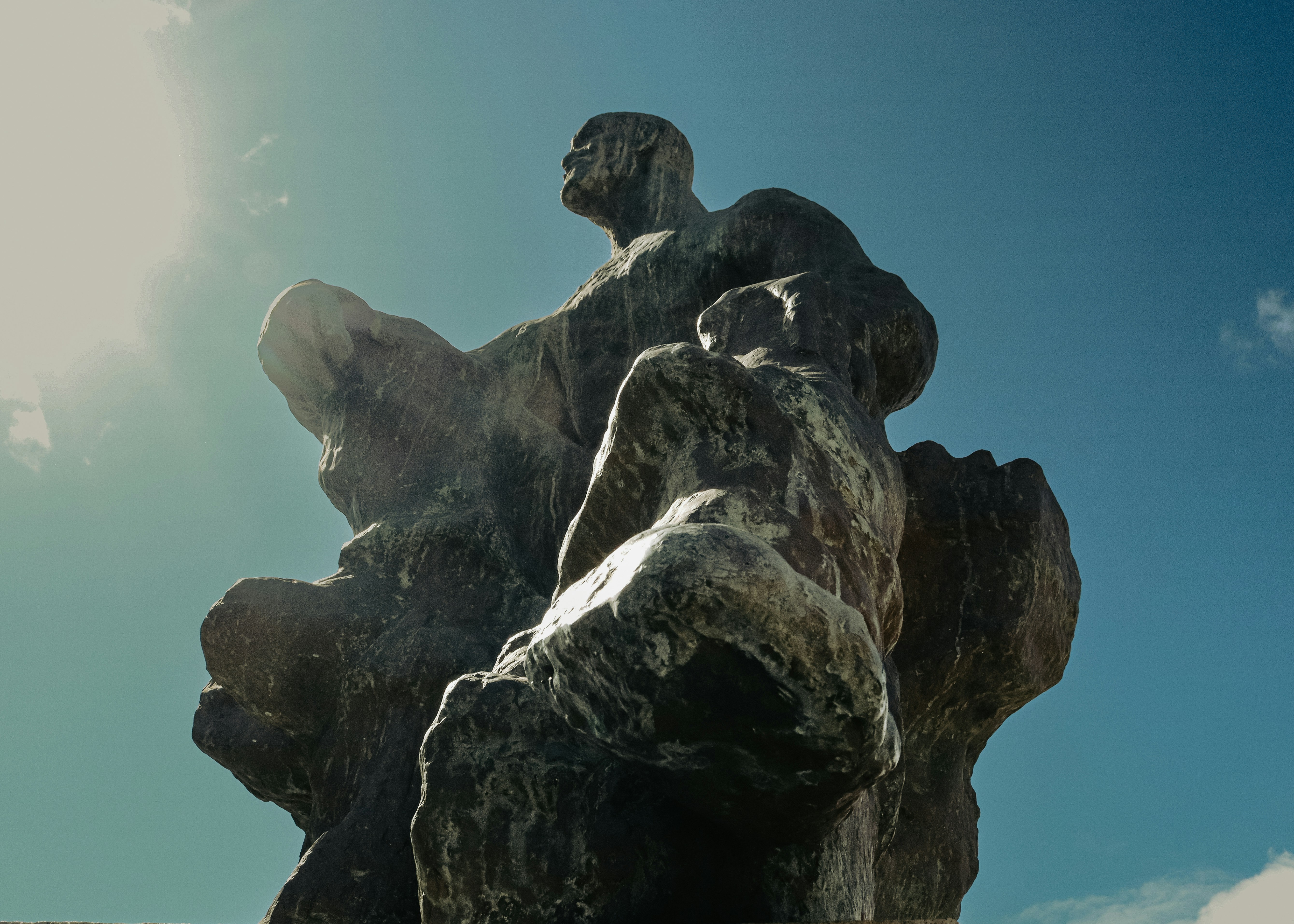
He does not have the blank stare of the statue. He has the tear-streaked face of the son who knows his Father is coming.
We reject the cold comfort of the Porch. We choose the rugged hope of the Empty Tomb.
In our next article, we will conclude our series by looking at the practical life of the Christian Stoic man—how he leads, how he dies, and how he leaves a legacy.
Key Terms
- Theodicy: The theological defense of God’s goodness and omnipotence in the face of the existence of evil.
- Amor Fati: (Latin, “Love of Fate”). A concept often associated with Stoicism (and Nietzsche) where one accepts and embraces everything that happens in life, including suffering and loss, as necessary and good.
- Eschatology: The theology of “last things” (death, judgment, heaven, and hell). The Christian linear view of history (Creation -> Fall -> Redemption -> Consummation) provides the basis for hope that Stoic cyclical history cannot.
- Resignation vs. Submission: Resignation is a passive acceptance of the inevitable (giving up). Biblical submission is an active entrusting of oneself to a personal Ruler (giving over).
[1] Marcus Aurelius, Meditations, trans. Gregory Hays (New York: The Modern Library, 2002), 4.7.
Pastor Tom, what a beautiful thing it is to have hope! Praise our God for leaving us with a promise and a fulfillment of an eternal life rich in the blessings that God has prepared for us. The End of Sin, and the End of Death are so welcomed. Life everlasting with our Lord and a New Heaven and a New Earth as God intended for us!!