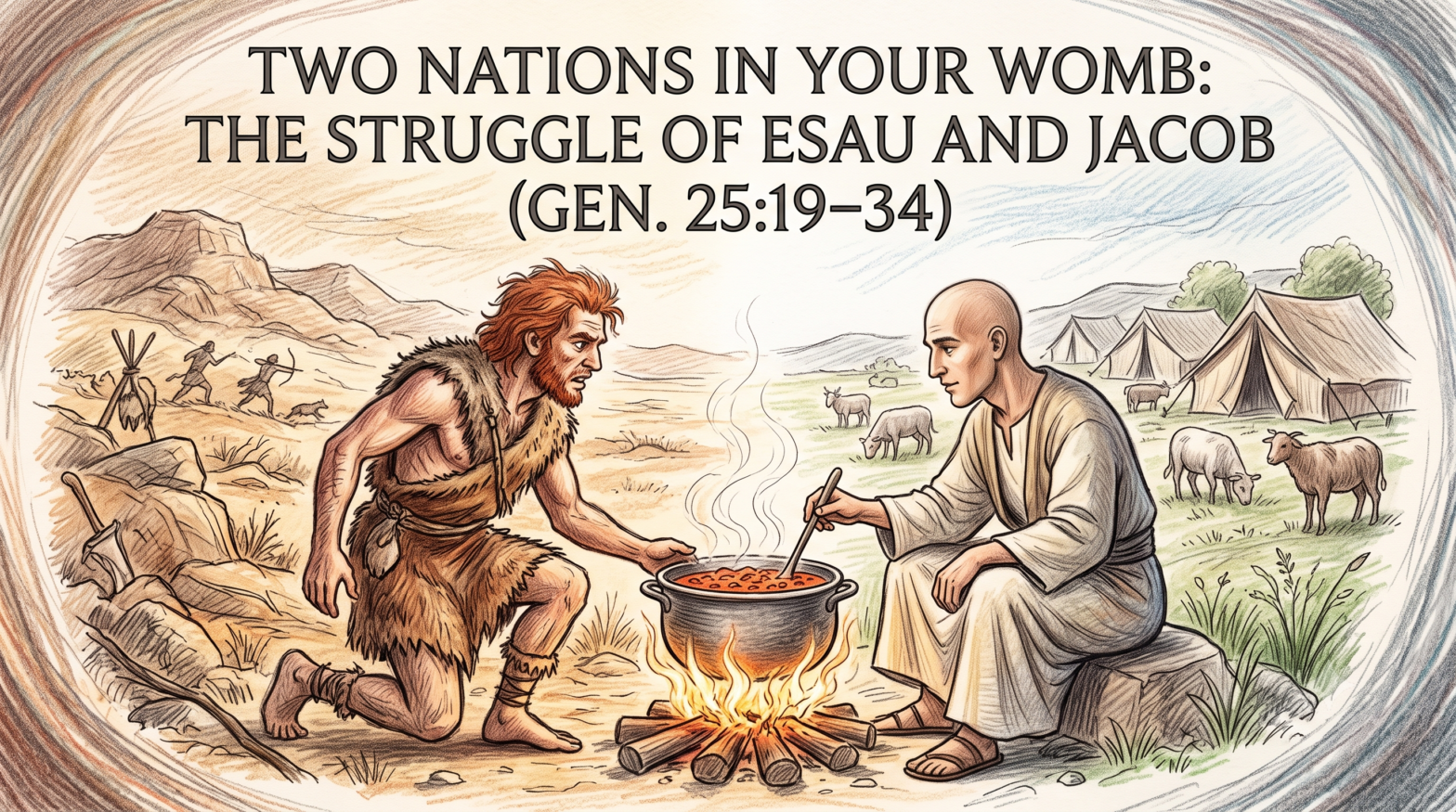
Loved ones, as we transition from the life of Abraham to the life of Isaac, we might expect the narrative to settle into a peaceful rhythm. The Promised Land is before them, the wealth is secured, and the pagan nations are kept at bay. Yet, we quickly discover that the greatest threats to the covenant line are not external armies, but internal struggles.
In the second half of Genesis 25, the focus narrows to a single family tent that becomes a heartbreaking battleground. Here we encounter barrenness, intense sibling rivalry, blatant parental favoritism, and a shocking disregard for the sacred things of God. Yet, overriding all of this human dysfunction is the stunning, sovereign grace of God, who announces His electing purposes before the children are even born.
Genesis 25:19-34 records the birth of Esau and Jacob, God’s sovereign prophecy regarding their futures, the division within Isaac’s home, and Esau’s profane decision to sell his birthright for a bowl of stew.
Verses 19–26
19 These are the generations of Isaac, Abraham’s son: Abraham fathered Isaac, 20 and Isaac was forty years old when he took Rebekah, the daughter of Bethuel the Aramean of Paddan-aram, the sister of Laban the Aramean, to be his wife. 21And Isaac prayed to the Lord for his wife, because she was barren. And the Lord granted his prayer, and Rebekah his wife conceived. 22 The children struggled together within her, and she said, “If it is thus, why is this happening to me?” So she went to inquire of the Lord. 23 And the Lord said to her, “Two nations are in your womb, and two peoples from within you shall be divided; the one shall be stronger than the other, the older shall serve the younger.” 24 When her days to give birth were completed, behold, there were twins in her womb. 25 The first came out red, all his body like a hairy cloak, so they called his name Esau. 26 Afterward his brother came out with his hand holding Esau’s heel, so his name was called Jacob. Isaac was sixty years old when she bore them.
Sovereign Grace in the Womb
The history of the patriarchs is marked by the recurring trial of barrenness. Sarah was barren, and now Rebekah is barren. Why does God do this? Because God wants to make it unmistakably clear that the children of the promise are not the result of human achievement or natural biology; they are the result of supernatural grace.
Notice the timeline: Isaac marries Rebekah at forty, and they have children at sixty. For twenty years, Isaac prays, and they wait. When God finally answers, Rebekah experiences a pregnancy so violently turbulent that she cries out to God, “Why is this happening to me?”
God’s answer is a staggering prophecy that sets the trajectory for the rest of the Old Testament: “Two nations are in your womb… the older shall serve the younger.” In the ancient world, the older son always received the primary inheritance and leadership (primogeniture). But God deliberately turns human custom upside down.
The Apostle Paul uses this exact verse in Romans 9:11-12 to explain the doctrine of sovereign election:
11 though they were not yet born and had done nothing either good or bad—in order that God’s purpose of election might continue, not because of works but because of him who calls— 12 she was told, “The older will serve the younger.”
God’s choice of Jacob over Esau was based entirely on His sovereign grace, not on their future behavior.
At birth, the first twin is hairy and red, earning the name Esau. The second comes out grasping his brother’s heel, earning the name Jacob (which means “heel-grabber” or “supplanter”). The struggle that began in the womb continues into the world.
Verses 27–28
27 When the boys grew up, Esau was a skillful hunter, a man of the field, while Jacob was a quiet man, dwelling in tents. 28 Isaac loved Esau because he ate of his game, but Rebekah loved Jacob.
The Divided Home
As the boys grow, their natures contrast sharply. Esau is a rugged outdoorsman, a man of the flesh, driven by his physical senses and passions. Jacob is a “quiet” man (the Hebrew word tam can mean settled or complete), dwelling in the tents, likely learning the history of the covenant from his father and grandfather (Abraham lived until the twins were 15).
Then we read one of the most tragic sentences in the book of Genesis: “Isaac loved Esau… but Rebekah loved Jacob.” This is the toxic root of the family’s future destruction. Isaac’s love for Esau is explicitly tied to his fleshly appetite (“because he ate of his game”). Rebekah’s love for Jacob may have been rooted in the prophecy she received, but she wrongly relies on manipulation rather than trusting God to fulfill His word. When parents play favorites, they weaponize their children against each other.
Verses 29–34
29 Once when Jacob was cooking stew, Esau came in from the field, and he was exhausted. 30 And Esau said to Jacob, “Let me eat some of that red stew, for I am exhausted!” (Therefore his name was called Edom.) 31 Jacob said, “Sell me your birthright now.” 32 Esau said, “I am about to die; of what use is a birthright to me?” 33 Jacob said, “Swear to me now.” So he swore to him and sold his birthright to Jacob. 34 Then Jacob gave Esau bread and lentil stew, and he ate and drank and rose and went his way. Thus Esau despised his birthright.
The Profane Trade
This famous scene is a masterful display of contrasting character flaws. Esau comes in from hunting, physically exhausted and dramatically hungry. He demands the “red stew.”
Jacob, true to his name, sees an opportunity to grab his brother’s heel. He refuses to show basic family compassion. Instead, he coldly calculates a business transaction: “Sell me your birthright now.” The birthright was the sacred privilege of the firstborn. It meant a double portion of the family wealth, the role of spiritual headship over the family, and the carrying forward of the Abrahamic covenant. Jacob wants the right things, but he goes about getting them in an entirely deceitful, opportunistic way.
But Esau’s sin is far worse. Driven entirely by his stomach, he exaggerates his plight: “I am about to die; of what use is a birthright to me?” Esau was not starving to death. He was just hungry, impatient, and enslaved to his immediate physical desires. He swears an oath, trades the eternal covenant promises of God for a temporary bowl of lentils, eats, wipes his mouth, and walks away.
The text renders a chilling verdict: “Thus Esau despised his birthright.” To despise something doesn’t necessarily mean to hate it; it means to treat it lightly, to assign no value to it, to view the sacred as common.
Conclusion
The New Testament uses Esau as a terrifying warning for anyone sitting in the church today. Hebrews 12:16 warns us to ensure “that no one is sexually immoral or unholy like Esau, who sold his birthright for a single meal.”
Esau is the patron saint of the immediate. He is the picture of a person who is willing to trade an eternity of joy with God for thirty minutes of fleshly gratification. How often do we do the exact same thing? We trade our spiritual witness for a moment of anger. We trade marital purity for a glance at a screen. We trade the deep, abiding presence of God for the immediate comfort of worldly entertainment.
Loved ones, do not despise your birthright. Through Jesus Christ, we have been given “to an inheritance that is imperishable, undefiled, and unfading, kept in heaven for you” (1 Peter 1:4). No bowl of stew this world offers is worth trading away the eternal riches we have in the Son of God.
Key Terms
- Sovereign Election: The biblical doctrine that God chooses individuals for salvation and specific purposes based entirely on His own gracious will, not on their foreseen faith, merit, or works (Rom. 9:11-12).
- Primogeniture: The ancient cultural law or custom granting the firstborn son the right to inherit the leadership of the family and a double portion of the estate. God repeatedly subverts this in Genesis (choosing Isaac over Ishmael, Jacob over Esau, Judah/Joseph over Reuben).
- Birthright (Bekorah): The rights and privileges belonging to the firstborn. In the patriarchs’ family, this included the spiritual transmission of the Abrahamic covenant.
- Despised: To regard something with contempt; to treat a holy, valuable thing as if it were common, cheap, or worthless.
- Profane / Unholy: As applied to Esau in Hebrews 12, it describes a person whose horizon is entirely limited to the physical, earthly world, possessing no spiritual appetite or reverence for God.