We live in an era characterized by a tragic divorce. In the modern church, we have allowed a devastating wall to be erected between the mind and the heart, between the study of doctrine and the pursuit of holiness. On one side of this wall stands a cold, detached academicism that treats the deep things of God as nothing more than a complex intellectual puzzle to be solved. On the other side stands a shallow, anti-intellectual emotionalism that values feelings over truth, reducing faith to a subjective therapeutic experience.
Both extremes are deadly.
Both represent a severe failure to understand what the study of Christian doctrine is actually for.
To heal this self-inflicted wound, we must return to the final movement of the classic scholastic maxim we have been exploring: Theologia a Deo docetur, Deum docet, et ad Deum ducit. Having established that our theology is taught by God as its source, and that it teaches God as its formal subject, we must now confront its ultimate, breathtaking telos: theology leads to God (ad Deum ducit).
Because theology is not a sterile academic exercise but a pilgrim science, its ultimate end is not intellectual self-aggrandizement, but the transformation of the entire man, leading him through worship and obedience to his final beatitude: the eternal, face-to-face enjoyment of the Triune God.
The Nature of the Science: Speculative or Practical?
To grasp why theology must lead to God, we have to look at a debate that occupied the finest minds of the medieval and Protestant scholastic eras. The question they wrestled with was simple yet profound: Is systematic theology a speculative (or theoretical) discipline, or is it a practical one?
A speculative science is one whose primary goal is the simple acquisition of knowledge for its own sake. Physics, metaphysics, and mathematics are classical examples; you study them to know how things work. A practical science, on the other hand, is one whose knowledge is oriented toward an action or an end outside of itself. Medicine is a practical science; you do not study the human body merely to collect anatomical data, but to heal the sick and preserve life.
When the Reformed orthodox theologians analyzed this question, they recognized that theology defies simple categorization. Under the leadership of brilliant thinkers like Francis Turretin, the Reformed consensus emerged that theology is a mixed science, but one that is eminently and principally practical.
We do not study God the way an entomologist studies an insect. We study God because He is our chief good, and the knowledge of Him is designed to produce love, worship, and obedience. The famous Puritan theologian William Ames captured this practical focus in the opening sentence of his classic work, The Marrow of Sacred Divinity, where he defined theology in a way that should be branded on the heart of every young man studying doctrine: “Theology is the doctrine of living to God.”
If your theology does not teach you how to live to God, then it is not true Christian theology. It is merely a baptized philosophy. The knowledge of God is never an end in itself; it is always a road that terminates in His presence.
The Pilgrim’s Path: Theologia Viatorum
To keep our feet on this road, we must understand our current location in the history of redemption. The Reformed orthodox made another crucial distinction when describing the knowledge of God: the distinction between the theology of the homeland (theologia patriae) and the theology of the road (theologia viatorum).
The Theology of the Homeland
The theologia patriae is the knowledge possessed by the saints and angels currently in glory. It is a theology of sight, of immediate presence, and of perfect, unclouded communion. They no longer see through a glass darkly; they see Him as He is.
The Theology of the Road
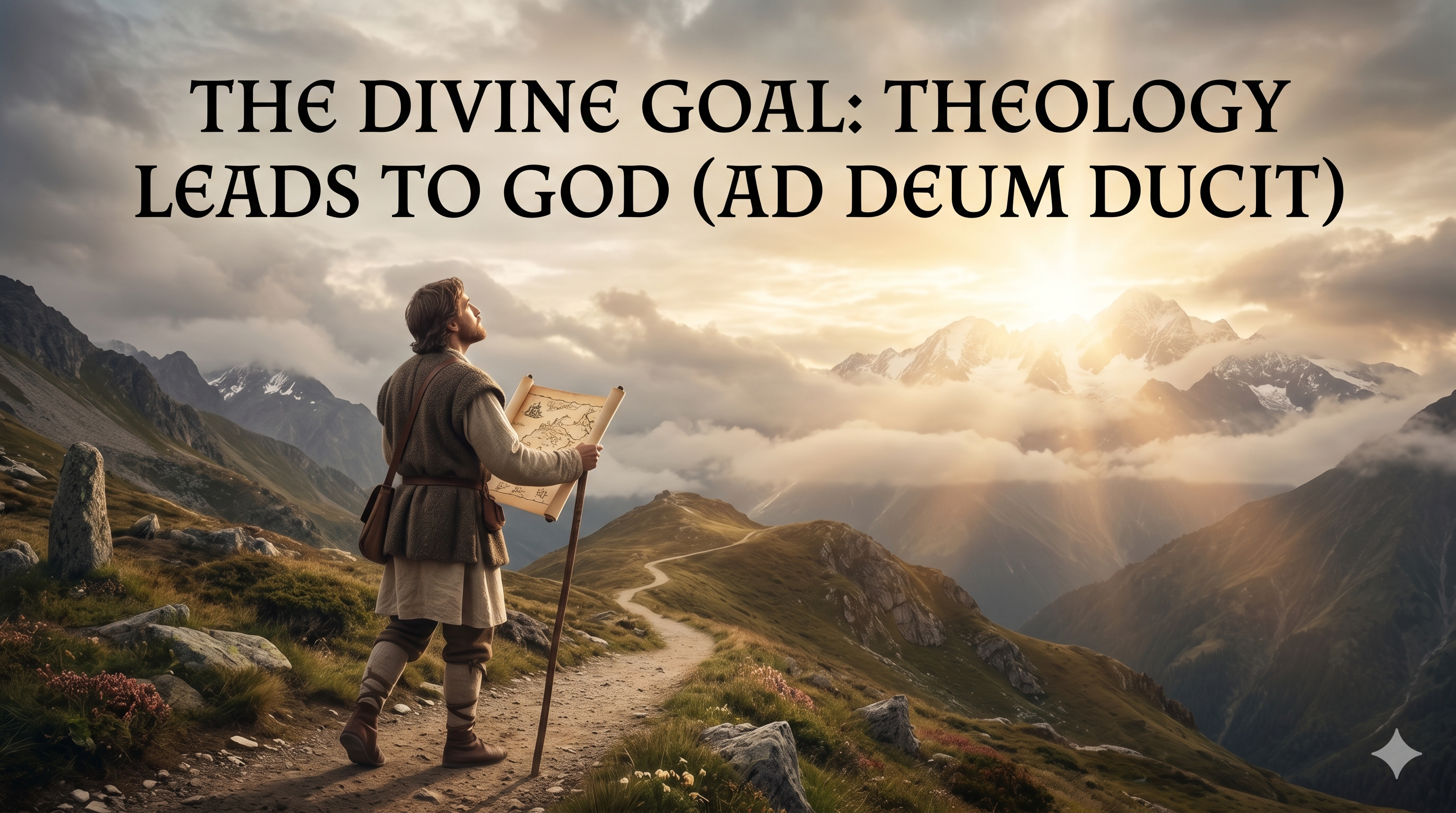
By contrast, our theology in this life is theologia viatorum—the theology of pilgrims on the road. We are travelers journeying through a wilderness, and our systematic theology is our map. A map is an incredibly valuable document; it tells us where the rivers are, where the cliffs are, and how to reach our destination. But only a fool would mistake the map for the destination itself. No one goes on vacation, spreads a road map on the hood of his truck, pitches a tent on top of it, and claims he has arrived at the Grand Canyon.
Our theology is pilgrim theology. It is designed to guide our steps, protect us from dangerous detours, and keep our eyes fixed on the horizon. If your systematic study of the covenants, the decrees of God, or the dual natures of Christ does not actually propel your feet forward in the Christian life—if it does not make you a more faithful husband, a more diligent father, a more committed churchman, and a more humble servant—then you have fallen in love with the map and forgotten the country.
From Orthodoxy to Doxology
Loved ones, this is where we must speak with absolute, painful honesty—and I say this not as a detached observer, but as someone who must confess his own complicity. We live in a digital age where the “theology bro” culture has turned the recovery of Reformed theology into a highly competitive blood sport.
In many ways, the Reformed Pub Facebook group served as a prime, textbook arena for this very combative phenomenon. Having served as an admin of that group during some of its most active and volatile years, I must look back with genuine soberness and admit that I played a direct role in cultivating and fostering that unhealthy environment. I know firsthand how intoxicating it is to spend hours on social media arguing about the active obedience of Christ, the mechanics of supralapsarianism, or the classical view of divine impassibility, all while harboring a heart that is cold, prayerless, and bitter.
If we are not careful, we can use the glorious, blood-bought truths of the Reformed faith to build monuments to our own intellectual vanity. We want to be right more than we want to be holy. We want to master the text more than we want to be mastered by the Spirit.
But when we do this, we are committing a form of spiritual treason.
True orthodoxy (right belief) must always lead to orthopraxy (right practice) and orthopathy (right affection). If your theology does not regularly erupt into doxology, you have missed the entire point of the exercise. The Apostle Paul, in his letter to the Romans, spends eleven chapters laying down the most historically dense, intellectually demanding systematic theology in all of Scripture. But how does he close that massive theological section? He does not write a technical exam. He breaks out into spontaneous, knee-knocking worship:
33 Oh, the depth of the riches and wisdom and knowledge of God! How unsearchable are his judgments and how inscrutable his ways! 34 “For who has known the mind of the Lord, or who has been his counselor?” 35 “Or who has given a gift to him that he might be repaid?” 36 For from him and through him and to him are all things. To him be glory forever. Amen. (Romans 11:33–36)
For Paul, the deeper the theology, the louder the praise. The mind was instructed so that the heart could catch fire. If your study of systematic theology does not lead you to look at your Savior with tears of gratitude in your eyes and a song of praise on your lips, then you are doing it wrong. You are collecting dried leaves of information instead of tasting the living fruit of communion.
The Ultimate Telos: The Beatific Vision
What, then, is the final destination of this pilgrim journey? Where does this road ultimately lead?
The classical Christian tradition, warmly embraced by the best of Reformed orthodoxy, has always pointed to the beatific vision (visio Dei) as the ultimate end of human existence. This is the promise that one day, the faith that guided our pilgrim steps will be swallowed up in sight.
In this life, our knowledge of God is mediated. We see Him through the spectacles of Scripture, through the sacraments, and through the eyes of faith. But the day is coming when the veil will be torn away forever. As the Apostle John writes with breathless anticipation, “Beloved, we are God’s children now, and what we will be has not yet appeared; but we know that when he appears we shall be like him, because we shall see him as he is” (1 John 3:2).
The great English Puritan John Owen spent the final days of his life writing a masterpiece titled The Glory of Christ. In it, he argued that the eternal happiness of heaven consists entirely in the beholding of the transcendent glory of Jesus Christ. The beatific vision is not a passive viewing of a beautiful object; it is a transformative, soul-ravishing encounter that eternally conforms us to the image of the One we behold.
Our systematic theology in this life is the training ground for that eternal sight. We study the attributes of God now so that we will not be total strangers to His beauty when we see Him on His throne. We study the person and work of Christ now so that we can begin to learn the language of the country we are marching toward.
Every page of systematic theology you read should be read with this final hope in view. We are preparing our eyes for the blinding, beautiful light of the face of God.
Conclusion
As we bring this introductory trilogy to a close, let us bind these three clauses of the scholastic maxim to our hearts: Theologia a Deo docetur, Deum docet, et ad Deum ducit.
May we never attempt to study theology apart from the Divine Teacher (a Deo docetur), lest we fall into intellectual pride. May we never make theology about anything other than the Divine Subject (Deum docet), lest we fall into therapeutic pragmatism. And may we never allow our theology to terminate anywhere short of the Divine Goal (ad Deum ducit), lest we fall into a dead, sterile intellectualism.
Loved ones, the road before us is long, and the landscapes of doctrine we are about to traverse are vast and high. But the goal is nothing less than God Himself. Let us pack our bags, lace up our boots, and step onto the trail with humble minds and burning hearts, knowing that every step we take in the truth is a step closer to home.
Key Terms
- Beatific Vision (Visio Dei): The ultimate, supernatural end of human existence, wherein the glorified believer beholds God face-to-face in heaven, resulting in perfect happiness, likeness to Christ, and eternal communion.
- Theologia Viatorum (Theology of the Way): The finite, mediated, and struggling knowledge of God possessed by believers in this life. It is sufficient for salvation and godly living, but is characterized by faith rather than sight.
- Theologia Patriae (Theology of the Homeland): The perfect, unmediated, and glorious knowledge of God possessed by the saints and angels in heaven, characterized by sight, immediate presence, and direct enjoyment.
- Doctrina Deo Vivendi: A Latin phrase meaning “the doctrine of living to God.” Famously used by William Ames, it highlights that the essence of systematic theology is fundamentally practical, aiming at a life of warm piety, worship, and obedience.
Tony
Drop me an email . Read your posts over at the Heidelblog