Since the Enlightenment, Western philosophy has been captive to a fatal epistemological inversion. Ever since René Descartes retreated into his private study and declared, “Cogito, ergo sum” (“I think, therefore I am”), modern culture has made the autonomous human mind the starting point for all reality. We begin with our own doubts, our own reason, and our own empirical observations, attempting to construct a ladder of certainty from ourselves up to the heavens.
Tragically, contemporary Christian thought frequently adopts this exact same human-centered starting point. We often approach systematic theology as if God were a mysterious defendant standing trial before the supreme tribunal of human reason. We line up cosmological, teleological, and moral arguments, attempting to prove His existence as the final conclusion at the end of a human logical chain. We act as though human reason is the solid ground on which we stand, while God is a hypothetical proposition waiting to be validated by our intellect.
But this is a profound and dangerous inversion of reality.
If we begin with autonomous human reason, we will never arrive at the God of Holy Scripture. We will only ever construct an idol made in our own intellectual image.
To complete our foundational Prolegomena before entering Theology Proper, we must recover the classical Reformed doctrine of the principia theologiae—the foundational principles of theology—and bow before the supreme, uncreated foundation of all existence: God Himself as the Principium Essendi.
True systematic theology does not begin with autonomous human reason constructing a path to God, but must acknowledge God Himself as the absolute Principium Essendi—the essential, uncreated foundation of all being and truth—without whom no reality, no revelation, and no theological knowledge could possibly exist.
The Anatomy of a Principium: The Foundations of Theology
To understand why God must be recognized as the foundation of being, we must grasp how classical Reformed scholasticism defined the word principium (plural: principia). Derived from the Latin term for “beginning,” “origin,” or “first principle,” a principium in classical dogmatics refers to an ultimate, underived premise that cannot be proven by anything prior to itself because there is nothing prior to it.
Just as geometry relies on self-evident axioms that cannot be proven within the system itself, so all human knowledge relies on foundational principles. In Reformed systematic theology, the scholastics identified three distinct, interconnected principia that govern the entire discipline:
- Principium Essendi (The Essential Principle / Foundation of Being): God Himself. He is the objective, uncreated, ontological ground of all reality.
- Principium Cognoscendi Externum (The External Principle of Knowing): Holy Scripture. It is the objective, divine revelation through which God communicates truth to creatures.
- Principium Cognoscendi Internum (The Internal Principle of Knowing): The Holy Spirit working through Faith. It is the subjective, internal illumination by which the human heart receives and understands divine revelation.
Notice the unalterable, organic relationship among these three principles. At the apex stands the Principium Essendi—God Himself—as the sole uncreated origin. Flowing directly from His self-existent being are the two subordinate principles of knowing (principia cognoscendi). The external principle (Holy Scripture) serves as the objective Word spoken by God, while the internal principle (the Holy Spirit) serves as the subjective light given by God to open creaturely eyes.
Before there can be an external word spoken or an internal eye opened, there must be the self-existent Being who speaks and illuminates. Epistemology (how we know) must always yield to ontology (what exists). God is not merely one topic among many within systematic theology; He is the indispensable condition for the existence of theology itself.
God as the Ontological Ground of Reality
To confess God as the Principium Essendi is to affirm that He is the ultimate Source of all existence, truth, and goodness. As the apostle Paul declared to the philosophers on Mars Hill, “In him we live and move and have our being” (Acts 17:28).
The Primary Cause of All Secondary Causes
In our previous exploration of the Creator-creature distinction, we noted that God possesses aseity—underived, self-existent life within Himself (John 5:26). Everything outside of God is created, contingent, and derived.
This means that God is the primary cause (causa prima) of all reality. Every atom in the universe, every law of logic, every moral imperative, and every human thought exists solely because the self-existent God willed it into being and actively sustains it by the word of His power (Colossians 1:17, Hebrews 1:3). As Herman Bavinck wrote in the opening volume of his Reformed Dogmatics:
Thus God was the essential foundation (principium essendi) or the principle of existence (principium existendi) of all that has been created, hence also of science and specifically again of theology.[1]
Knowledge Follows Being: Epistemology Rests on Ontology
Modern philosophy committed a tragic error when it separated knowing (epistemology) from being (ontology), attempting to establish rules for human thought without reference to God. But classical Reformed theology insists that knowledge follows being (scientia sequitur esse).
You cannot have true knowledge without first having reality, and you cannot have reality without the God who creates and sustains it. Yet we must avoid the error of voluntarism—the mistaken notion that truth is an arbitrary dictate of the divine will. Truth is not an abstract standard floating independently above God to which He must conform, nor is it an arbitrary rule made up on a divine whim. Rather, truth is grounded in the absolute perfection of God’s unchangeable nature and character, and in the objective reality He has fashioned in accordance with His wisdom. Human reason does not invent truth; it merely re-thinks God’s thoughts after Him as we observe His nature and His created order.
The Danger of Reverse Foundationalism: When God Becomes a Conclusion
Understanding God as the Principium Essendi exposes a subtle error that plagues much of modern conservative theology: what we might call reverse foundationalism.
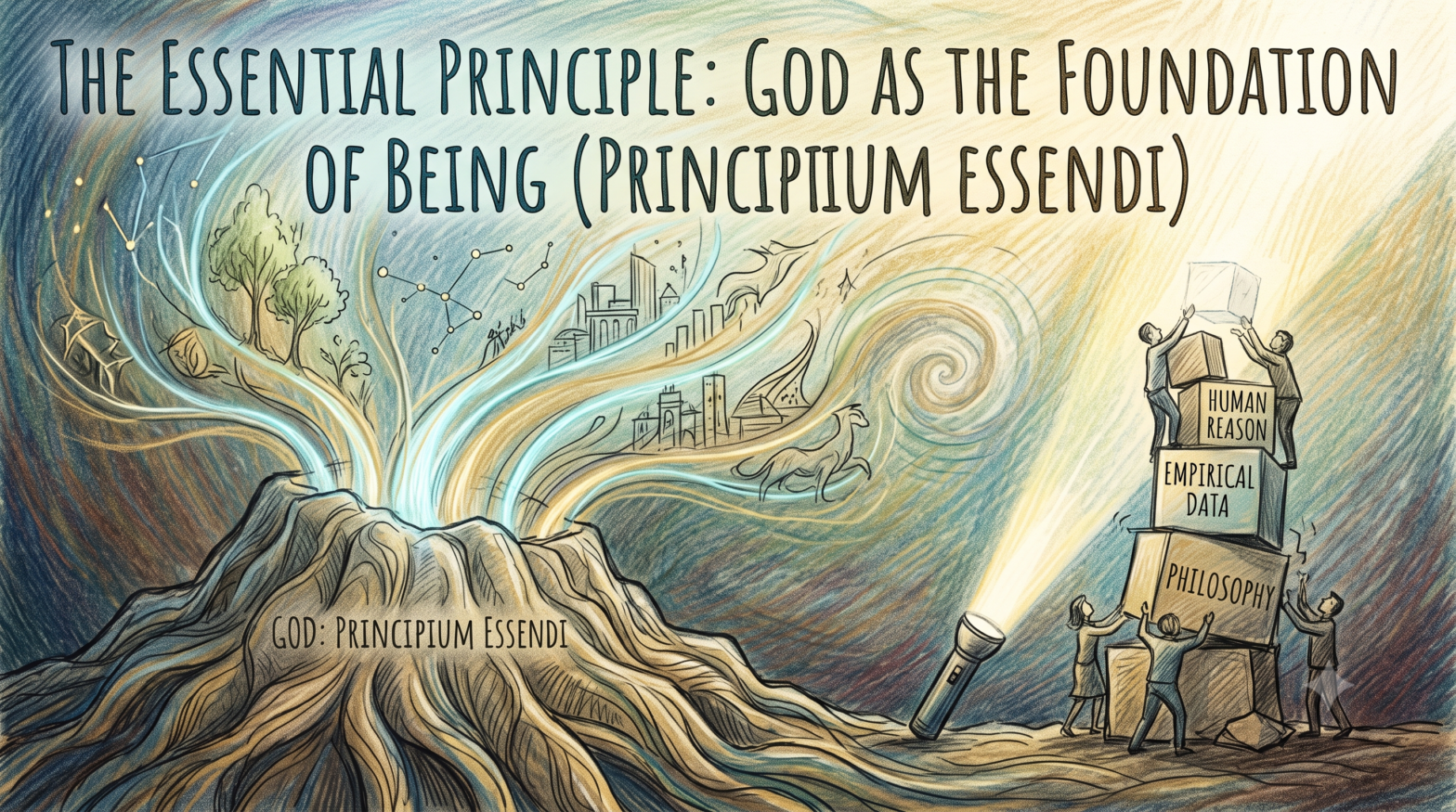
Reverse foundationalism occurs whenever we attempt to validate God using autonomous human standards. In this inverted model, human reason and empirical logic act as the primary, unshakeable foundation upon which everything else must be constructed. God is reduced to a mere conclusion sitting at the top of the structure—a proposition to be evaluated, tested, and “proven” by the supreme authority of human judgment.
In contrast, historic biblical presupposition recognizes the true structural reality: God Himself (Principium Essendi) is the ultimate foundation. Human reason, empirical evidence, and divine revelation do not form a foundation that supports God; rather, they are created realities sustained and illuminated by God.
When we adopt a reverse posture, we make human reason the ultimate judge and God the accused party who must earn our intellectual approval.
As the great Reformed theologian Cornelius Van Til relentlessly argued, attempting to prove the God of the Bible using autonomous human reason is like using a flashlight to search for the sun.
You do not need a flashlight to see the sun; the sun is the very light that illuminates the flashlight, the air you breathe, and the ground under your feet.
God is not a missing piece of evidence to be fitted into a human worldview. He is the foundational Sun whose self-existent light makes evidence, reason, logic, and coherent thought possible in the first place. To treat God as a mere conclusion is to demote the Creator into a creature and to elevate the creature into the supreme judge of the cosmos.
The Pastoral Target: Resting in the Absolute Foundation in an Anxious World
Loved ones, let’s bring this lofty theological principle down to the quiet places of our hearts and minds.
We live in a culture experiencing a massive crisis of certainty. We are bombarded by shifting moral standards, conflicting news cycles, rapid technological disruptions, and the relentless noise of digital commentary. In online spaces, young men often feel a crushing sense of intellectual anxiety. We feel as though the entire weight of defending God, preserving orthodoxy, and winning cultural battles rests squarely on our frail, internet-connected shoulders.
We act as though Christianity is a house of cards, and that if we fail to craft the perfect argument or win every online dispute, the living God Himself might somehow lose His sovereignty or cease to exist.
This spiritual anxiety stems directly from forgetting that God is the Principium Essendi.
Your intellect does not sustain God; God sustains your intellect. The truth of Christianity does not hang in the balance of human debates. Long before you were born, long before digital networks existed, and long after the present secular age has crumbled into forgotten dust, the Triune God remains seated on His unshakeable throne…self-existent, independent, and utterly serene in His eternal majesty.
Recognizing God as this essential principle brings profound intellectual rest. It frees you from the hubris of feeling that you must be the ultimate defender of reality. It invites you to step off the judge’s bench, lay down your prideful intellectual weapons, and sit at the feet of the Almighty with the docility of a child.
When your faith is anchored in God as the Principium Essendi, your certainty no longer depends on the sharpness of your mind or the strength of your emotions. It rests upon the unshakeable bedrock of His self-existent being. You can rest quietly in His sovereignty, knowing that He who spoke the universe into existence is fully capable of defending His own truth and preserving His own church.
Conclusion
Theology is not a tower built by human hands reaching up to heaven. It is a river of light flowing down from the throne of God.
As we move forward in our Prolegomena to examine the external standard of Scripture (Principium Cognoscendi Externum) and the internal witness of the Holy Spirit (Principium Cognoscendi Internum), we must never lose sight of our ultimate foundation.
Scripture is authoritative because it is the Word of God. The Holy Spirit illuminates because He is the Spirit of God. Salvation is effective because it is the work of God. Everything in our faith, our worship, and our lives begins and ends with the self-existent Lord of hosts. We must cast aside all autonomous human pride, bowing before Him not as a hypothetical conclusion, but as the supreme, eternal, and glorious Principium Essendi, the Foundation of all being, to whom belongs all glory, honor, and dominion forever and ever. Amen.
Key Terms
- Principium Essendi (Essential Principle / Foundation of Being): The foundational principle of theology referring to God Himself as the ultimate, self-existent, and uncreated ground of all reality, truth, and existence.
- Principium Cognoscendi Externum (External Principle of Knowing): The objective, external standard of theological knowledge, which classical Reformed theology identifies exclusively as Holy Scripture (the written Word of God).
- Principium Cognoscendi Internum (Internal Principle of Knowing): The subjective, internal mechanism through which theological truth is received and understood, consisting of the supernatural illumination of the Holy Spirit and the gift of faith.
- Principia Theologiae (Principles of Theology): The classical scholastic triad (Principium Essendi, Principium Cognoscendi Externum, and Principium Cognoscendi Internum) that establishes the ontological and epistemological foundations of systematic theology.
- Reverse Foundationalism: The modern epistemological error that treats autonomous human reason or empirical evidence as the primary foundation for truth, reducing God from the ultimate principle of reality to a mere conclusion to be proven.
[1] Herman Bavinck, Reformed Dogmatics, ed. John Bolt, trans. John Vriend, vol. 1 (Baker, 2003), 211–212.