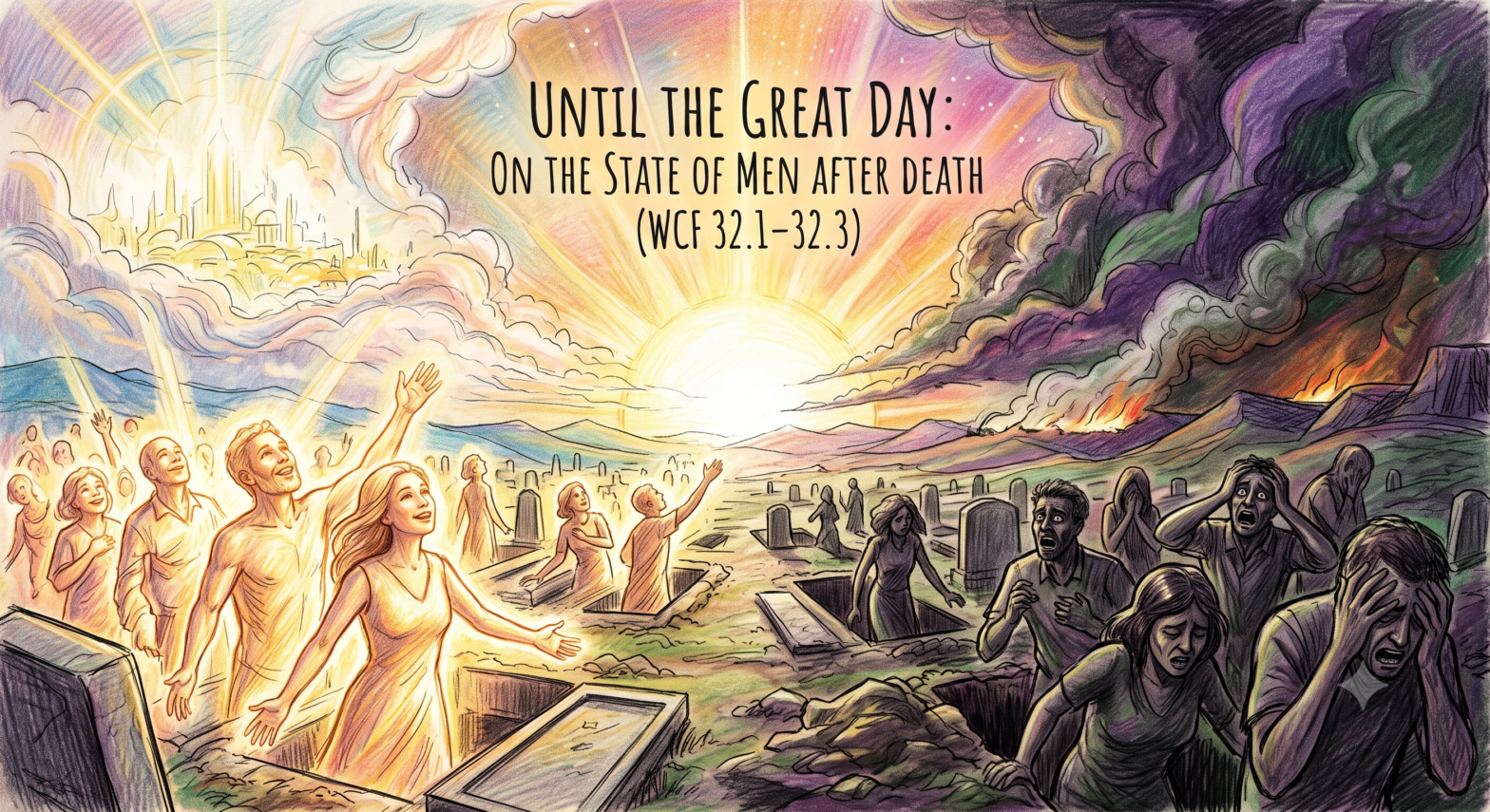
Death is the great, unavoidable reality of human existence. Because modern secular culture has no answer for death, it largely tries to ignore it. Meanwhile, popular religion is often filled with comforting but unbiblical sentimentalities, such as the idea that humans become angels when they die, or that the ultimate goal of salvation is simply existing as a disembodied spirit in the clouds forever.
In Chapter 32, the Westminster Confession cuts through the cultural noise and the theological errors of the medieval church to present a robust, terrifying, and profoundly glorious biblical vision of the afterlife. It reminds us that while our souls immediately face God upon death, the story of redemption is not complete until the physical resurrection of the dead at the end of history.
The Confession teaches that upon death, human bodies decay while conscious, immortal souls immediately enter either heaven or hell, rejecting the ideas of soul sleep and purgatory; and that at the Last Day, the bodies of all men will be resurrected and reunited with their souls—the unjust to dishonor, and the just to eternal glory.
The Intermediate State (WCF 32.1)
What exactly happens the moment you close your eyes in death? The Confession calls this the “state of men after death” (often referred to by theologians as the intermediate state, because it is the period between an individual’s death and the final resurrection).
First, the divines acknowledge the physical reality of the curse (Gen. 3:19): “The bodies of men, after death, return to dust, and see corruption.” But the body is not the whole person. The soul has an “immortal subsistence.”
The Confession immediately refutes the error of soul sleep (the belief that the soul goes unconscious or ceases to exist until the resurrection). The souls of men “neither die nor sleep.” Instead, they “immediately return to God who gave them.” From that moment, there are only two possible destinies:
- The Righteous: Their souls are “made perfect in holiness.” This is a staggering promise—the very moment a believer dies, their lifelong battle with indwelling sin is instantly and permanently over. They are received into the highest heavens, where they consciously “behold the face of God, in light and glory.”
- The Wicked: The souls of unbelievers are “cast into hell, where they remain in torments and utter darkness.” They do not cease to exist, nor do they get a second chance; they are consciously “reserved to the judgment of the great day.”
The paragraph concludes with a devastating blow to Roman Catholic theology. For centuries, Rome taught the existence of Purgatory (a place of fiery purging where imperfect Christians suffer to pay off the temporal debt of their sins before entering heaven) and Limbus Patrum/Infantum (Limbo). The Confession forcefully brings the church back to the strict limits of biblical revelation: “Beside these two places, for souls separated from their bodies, the Scripture acknowledgeth none.”
The Resurrection of the Body (WCF 32.2)
If the souls of the righteous are already perfectly holy and enjoying the presence of God in heaven, is the story over? No. The intermediate state is wonderful, but it is not the final goal of Christian hope. In WCF 32.1, the righteous souls in heaven are described as “waiting for the full redemption of their bodies.”
Christianity is not a religion of escapism. God created the physical world, and He intends to redeem it. Therefore, at the Last Day, two things will happen:
- The Living: “Such as are found alive shall not die, but be changed” (1 Thess. 4:17). The generation of believers alive when Christ returns will bypass physical death, having their bodies instantly glorified.
- The Dead: “All the dead shall be raised up.”
The Confession emphasizes the continuity of the body: we will be raised “with the self-same bodies, and none other.” God is not going to throw your old body in the cosmic trash and build you a completely new one from scratch. He is going to redeem and resurrect the very body you have now.
However, while there is continuity, there is also change. The body will be raised “with different qualities.” As Paul explains in 1 Corinthians 15, the body that was sown perishable will be raised imperishable; what was sown in weakness will be raised in power. This transformed physical body will then be reunited with the soul “for ever.”
A Resurrection to Honor and Dishonor (WCF 32.3)
Finally, the Confession clarifies a terrifying, often-overlooked biblical truth: everyone will be physically resurrected, not just Christians. The resurrection of the dead is a universal event, but it has two radically different outcomes (John 5:28-29):
- The Unjust: The bodies of the wicked “shall, by the power of Christ, be raised to dishonour.” They are raised by Christ’s power in His role as the sovereign Judge. They will endure the final judgment and eternity not merely as disembodied spirits, but in physical bodies capable of experiencing the just wrath of God.
- The Just: The bodies of believers will be raised “by His Spirit, unto honour.” Because the Holy Spirit dwells in believers, He will quicken their mortal bodies, making them “conformable to His own glorious body.”
This is the ultimate Christian hope. We will not float on clouds playing harps as ghosts. We will live on a physically resurrected New Earth, in physically resurrected bodies, completely free from sickness, sin, and death, shining with the same physical glory as the resurrected Lord Jesus Christ.
Conclusion
For the believer in Jesus Christ, the grave is not a terrifying abyss; it is merely a waiting room. The Confession arms the Christian to face physical death with profound courage. We know that the moment we breathe our last, our souls will be perfected and ushered into the joyous presence of God. And we know that the bodies we leave behind in the dirt are not lost forever. They belong to Christ, and at the sounding of the final trumpet, He will call them forth from the dust to shine like the stars forever.
Key Terms
- The Intermediate State: The theological term for the condition of people between their physical death and the future, final resurrection at the Last Day.
- Soul Sleep (Psychopannychy): The unbiblical belief that the soul ceases to exist or goes into an unconscious slumber upon death until the resurrection. The Confession affirms that souls “neither die nor sleep.”
- Purgatory: A Roman Catholic dogma teaching the existence of a third, temporary location where believers must suffer to purge away the remaining temporal punishments for their sins before entering heaven. The Confession rejects this completely.
- Glorification: The final step in the application of redemption, occurring at the resurrection, when the believer’s physical body is transformed to be immortal, imperishable, and conformed to the glorious body of Jesus Christ.