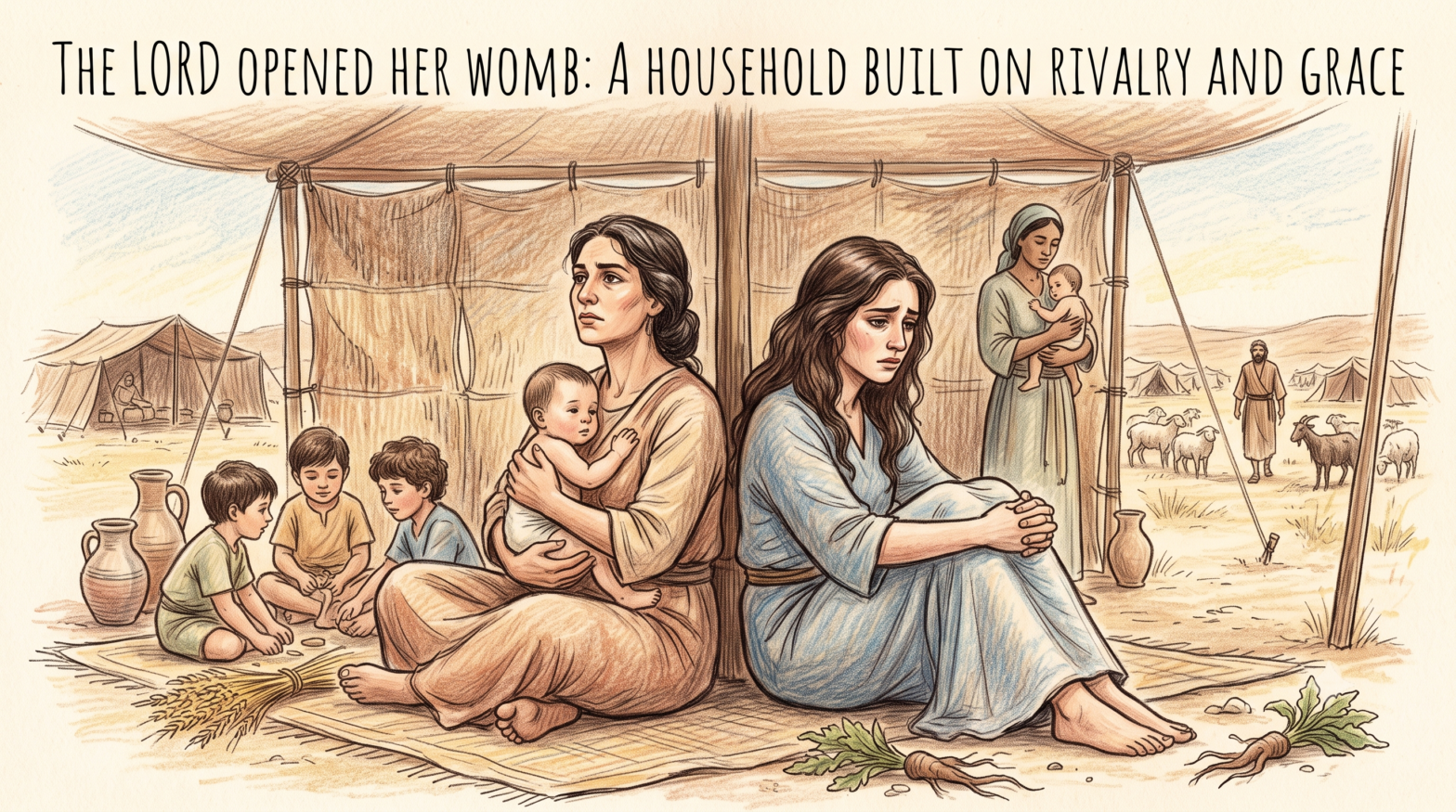
Loved ones, when we look closely at the patriarchs of our faith, we are rarely presented with a picture of domestic tranquility. In fact, if you want an argument against the practice of polygamy, you need look no further than the tent of Jacob.
Following Laban’s treacherous deception, Jacob is now married to two sisters. He loves the younger, beautiful Rachel, and he despises the older, soft-eyed Leah. What follows is a heartbreaking, multi-year struggle between two desperate women…one fighting for the love of her husband, the other fighting for the ability to have children.
Yet, Genesis 29 and 30 are not just a soap opera of human dysfunction. They are a profound testimony to the sovereignty and compassion of God. God sees the unloved. He hears the desperate. And in His mysterious providence, He uses this bitter, competitive family to build the twelve tribes of Israel—the very foundation of the covenant nation.
Genesis 29:31–30:24 records the birth of Jacob’s first eleven sons (and one daughter), highlighting the painful rivalry between Leah and Rachel, and the unmerited grace of God in building the house of Israel.
Verses 29:31–35
31 When the Lord saw that Leah was hated, he opened her womb, but Rachel was barren. 32 And Leah conceived and bore a son, and she called his name Reuben, for she said, “Because the Lord has looked upon my affliction; for now my husband will love me.” 33 She conceived again and bore a son, and said, “Because the Lord has heard that I am hated, he has given me this son also.” And she called his name Simeon. 34 Again she conceived and bore a son, and said, “Now this time my husband will be attached to me, because I have borne him three sons.” Therefore his name was called Levi. 35And she conceived again and bore a son, and said, “This time I will praise the Lord.” Therefore she called his name Judah. Then she ceased bearing.
The Unloved Sister and the Grace of God
The text tells us plainly: “Leah was hated.” In biblical Hebrew, “hate” in this context often means “loved less,” but the emotional reality for Leah was agonizing. She was trapped in a marriage where she was clearly the unwanted, second-class wife.
But look at the beautiful response of God: “When the LORD saw that Leah was hated, he opened her womb.” God is fiercely compassionate toward the marginalized and the unloved. He intervenes to give Leah what Rachel so desperately wants.
Leah names her first three sons out of her deep, agonizing longing for Jacob’s affection:
- Reuben (“See, a son”): “For now my husband will love me.”
- Simeon (“Heard”): “Because the LORD has heard that I am hated.”
- Levi (“Attached”): “Now this time my husband will be attached to me.”
With each child, Leah hopes that bearing sons will finally win Jacob’s heart. But it doesn’t work. Human achievement cannot manufacture true love.
Then, something profound shifts in Leah’s heart with her fourth son. She stops focusing on Jacob and turns her eyes entirely to God. She names him Judah (“Praise”), declaring, “This time I will praise the LORD.” She finds her contentment not in her husband’s conditional affection, but in God’s unconditional grace.
And in a stunning display of divine sovereignty, it is through this fourth son—Judah, the son of the unloved, plain sister—that the royal line of King David, and ultimately the Lord Jesus Christ, will come.
Verses 30:1–8
1 When Rachel saw that she bore Jacob no children, she envied her sister. She said to Jacob, “Give me children, or I shall die!” 2 Jacob’s anger was kindled against Rachel, and he said, “Am I in the place of God, who has withheld from you the fruit of the womb?” 3 Then she said, “Here is my servant Bilhah; go in to her, so that she may give birth on my behalf, that even I may have children through her.” 4 So she gave him her servant Bilhah as a wife, and Jacob went in to her. 5And Bilhah conceived and bore Jacob a son. 6 Then Rachel said, “God has judged me, and has also heard my voice and given me a son.” Therefore she called his name Dan. 7 Rachel’s servant Bilhah conceived again and bore Jacob a second son. 8 Then Rachel said, “With mighty wrestlings I have wrestled with my sister and have prevailed.” So she called his name Naphtali.
The Desperation of the Favored Sister
While Leah is weeping over her lack of love, Rachel is weeping over her empty womb. She is Jacob’s favorite, but her barrenness causes her to erupt in bitter envy against her sister. She makes a dramatic, irrational demand of Jacob: “Give me children, or I shall die!”
Jacob’s response is harsh but theologically accurate: “Am I in the place of God…?” Jacob realizes that only God can open the womb, but his lack of empathy for his grieving wife is glaring.
In her desperation, Rachel resorts to the exact same fleshly tactic her grandmother-in-law, Sarah, used decades earlier. She gives her servant, Bilhah, to Jacob as a surrogate. (This practice was culturally acceptable in the ancient Near East, but it always produced devastating consequences in the biblical narrative).
Bilhah bears two sons, and Rachel names them, claiming them as her own victories in this bitter sibling war:
- Dan (“Judged/Vindicated”): “God has judged me, and has also heard my voice.”
- Naphtali (“Wrestling”): “With mighty wrestlings I have wrestled with my sister and have prevailed.”
Rachel views these children not as precious gifts from God, but as weapons to use against Leah.
Verses 30:9–13
9 When Leah saw that she had ceased bearing children, she took her servant Zilpah and gave her to Jacob as a wife. 10Then Leah’s servant Zilpah bore Jacob a son. 11 And Leah said, “Good fortune has come!” so she called his name Gad. 12Leah’s servant Zilpah bore Jacob a second son. 13 And Leah said, “Happy am I! For women have called me happy.” So she called his name Asher.
The War Escalates
Not to be outdone, Leah—who temporarily stopped having children—enters the surrogate war. She gives her servant, Zilpah, to Jacob. The competition has devolved into an absurd, heartbreaking race to produce heirs.
Zilpah bears two sons, and Leah’s naming reflects a return to a more secular, self-focused perspective, focusing on luck and social standing rather than praising God:
- Gad (“Good Fortune/Luck”): “Good fortune has come!”
- Asher (“Happy/Blessed”): “Happy am I! For women have called me happy.”
Verses 30:14–24
14 In the days of wheat harvest Reuben went and found mandrakes in the field and brought them to his mother Leah. Then Rachel said to Leah, “Please give me some of your son’s mandrakes.” 15 But she said to her, “Is it a small matter that you have taken away my husband? Would you take away my son’s mandrakes also?” Rachel said, “Then he may lie with you tonight in exchange for your son’s mandrakes.” 16 When Jacob came from the field in the evening, Leah went out to meet him and said, “You must come in to me, for I have hired you with my son’s mandrakes.” So he lay with her that night. 17And God listened to Leah, and she conceived and bore Jacob a fifth son. 18 Leah said, “God has given me my wages because I gave my servant to my husband.” So she called his name Issachar. 19 And Leah conceived again, and she bore Jacob a sixth son. 20 Then Leah said, “God has endowed me with a good endowment; now my husband will honor me, because I have borne him six sons.” So she called his name Zebulun. 21 Afterward she bore a daughter and called her name Dinah. 22 Then God remembered Rachel, and God listened to her and opened her womb. 23 She conceived and bore a son and said, “God has taken away my reproach.” 24 And she called his name Joseph, saying, “May the Lord add to me another son!”
Mandrakes and Miracles
The rivalry reaches a pathetic low point over a handful of mandrakes. In the ancient world, mandrakes were believed to be an aphrodisiac and a fertility treatment (often called “love apples”). Young Reuben finds some for his mother, Leah. Rachel, still desperate to get pregnant, asks for them.
What ensues is a degrading negotiation. Leah basically accuses Rachel of stealing her husband, and Rachel literally trades a night with Jacob in exchange for the fertility roots. Jacob is reduced to a pawn, “hired” out by his own wives.
Yet, God is not bound by their superstition. The text explicitly says, “God listened to Leah,” not to the magic of the mandrakes. She conceives again:
- Issachar (“Reward/Wages”): “God has given me my wages.”
- Zebulun (“Honor/Endowment”): “Now my husband will honor me.” (Notice she is still longing for Jacob’s approval).
- Dinah (The only daughter named).
Finally, after years of agonizing barrenness, grace breaks through for the favored wife. “Then God remembered Rachel, and God listened to her and opened her womb.” When the Bible says God “remembers,” it doesn’t mean He had forgotten; it means He is now acting decisively on His covenant promises.
Rachel gives birth to her firstborn, removing the deep cultural shame of barrenness:
- Joseph (“May He Add”): “God has taken away my reproach… May the LORD add to me another son!”
Conclusion
This is the messy, dysfunctional, chaotic origin story of the twelve tribes of Israel (with Benjamin yet to be born). Why does the Holy Spirit record this? Why doesn’t God choose a perfect, holy, unified family to build His nation?
Because God is making a brilliant theological point: He builds His kingdom on grace, not on human merit. The patriarchs of our faith were deeply flawed people. They manipulated, they competed, they envied, and they treated marriage like a transaction.
Yet, God’s purposes cannot be thwarted by our sin. God used the unloved Leah to bring forth the priestly tribe (Levi) and the royal, Messianic tribe (Judah). He used the barren Rachel to bring forth the savior of the family in Egypt (Joseph).
Loved ones, if God can build the nation of Israel out of this broken tent in Haran, He can certainly use you. Your family background, your current struggles, and your messy circumstances are not a barrier to God’s grace; they are the very canvas upon which He loves to paint His sovereign redemption. Look away from your own efforts to be loved or successful, and, like Leah with Judah, lift your eyes and simply praise the Lord.
Key Terms
- Polygamy: The practice of having multiple spouses. While tolerated in the Old Testament, the biblical narrative consistently demonstrates that it always leads to jealousy, division, and deep familial pain, deviating from God’s original design in Eden.
- “Hated” (Unloved): In biblical idioms, “hate” is often a relative term contrasting degrees of affection (e.g., Jacob loved Rachel more than Leah). However, it reflects the genuine emotional agony of being the rejected or second-class party.
- Surrogacy (Ancient Custom): The practice of giving a servant (like Bilhah or Zilpah) to a husband to bear children on behalf of a barren wife. While culturally legal in the ancient Near East, it was a fleshly attempt to force God’s hand (echoing Sarah and Hagar).
- Mandrakes: A Mediterranean plant whose roots vaguely resemble a human figure. In ancient folklore, they were believed to be powerful aphrodisiacs and fertility aids.
- “God Remembered”: A frequent biblical phrase (used with Noah, Abraham, Rachel, and Hannah) that does not imply cognitive forgetfulness, but rather signifies the moment God actively intervenes to fulfill His promises and show covenant mercy.