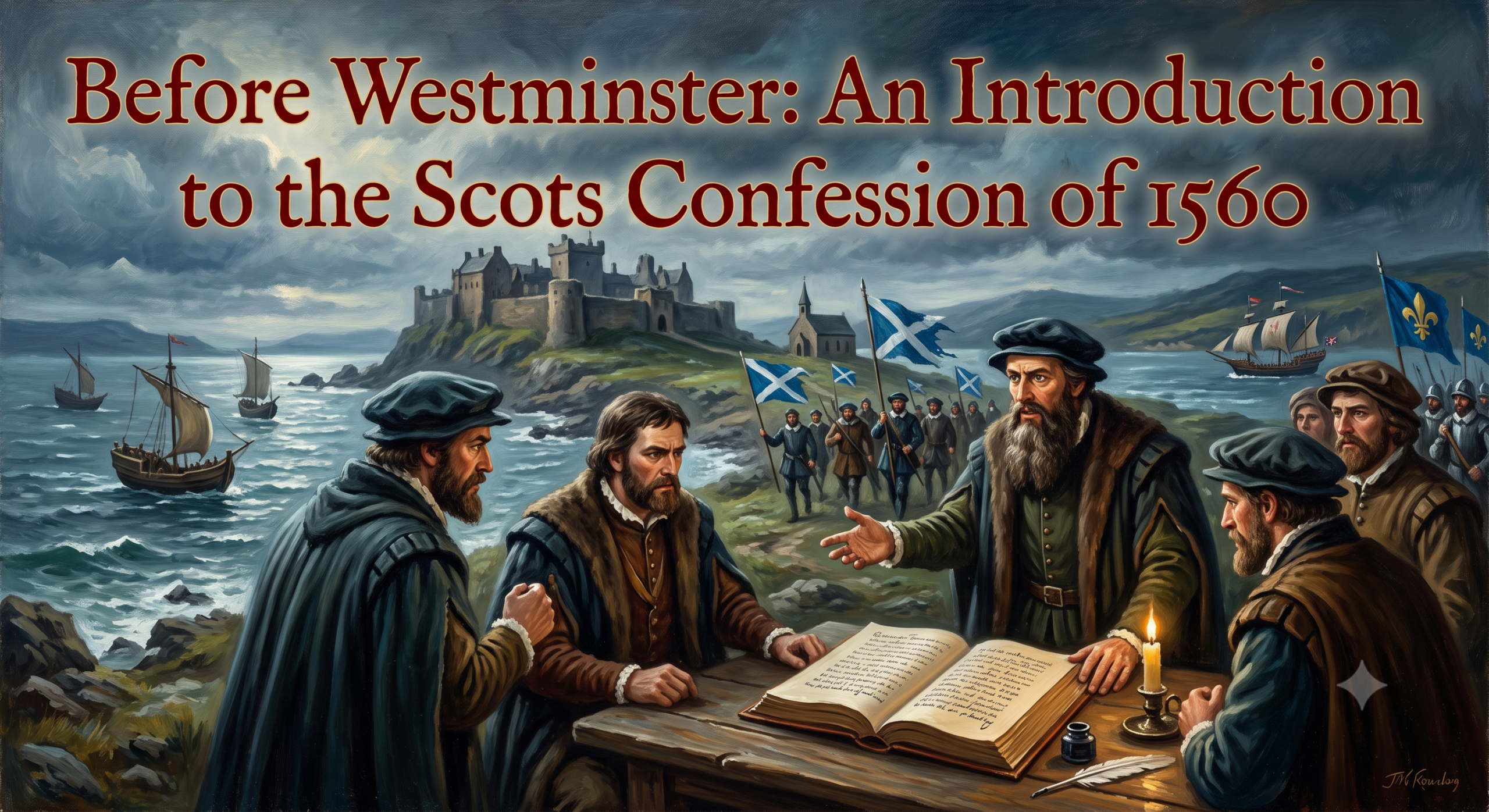
Modern Reformed Christians are often deeply familiar with the Westminster Standards (originating in 1640s England) and the Three Forms of Unity (originating in the continental Reformation). These documents are masterpieces of theological precision and continue to serve as the bedrock for conservative Presbyterian and Reformed denominations today.
But what did Reformed Christians believe before Westminster?
There is a wealth of wisdom, instruction, and spiritual vitality found in the lesser-known confessions of the 16th century. Understanding these earlier documents does more than just instruct us; it vividly demonstrates the beautiful consistency of Reformed theology across geography and time. While there is clear theological development—and the vocabulary is not always identical—the earlier confessions reveal that the Reformed faith was not invented in the 1640s.
To see this consistency, we are beginning a new series exploring the Scots Confession of 1560, a document that precedes the Westminster Confession by nearly a century, yet burns with the exact same Gospel fire.
(Note: The English translation of the text used throughout this series is from James T. Dennison Jr., “Reformed Confessions of the 16th and 17th Centuries in English Translation: 1523–1693.”)
The Late Bloom of the Scottish Reformation
Scotland came to the Reformation officially late in the game. Throughout the early 1500s, the nation was suffocated by a French, Roman Catholic hegemony. The powerful House of Guise and a succession of Catholic queens named Mary kept a tight, oppressive grip on the Highlands, aggressively discouraging the spread of Protestantism.
However, the truth could not be entirely kept out. By 1519, Lutheran ideas had begun to dribble into Scotland, prompting Parliament to officially ban them in 1525 under King James V. The cost of this new theology was blood. In 1528, Patrick Hamilton became the Scottish Reformation’s first martyr.
As the decades progressed, the theological influences shifted. When King Henry VIII broke England away from Rome, the “heresies” feared by the Scottish crown were no longer just German, but English. By the 1540s, the robust doctrines of the Swiss Reformation (flowing from men like Zwingli and Calvin) began to seep into Scotland’s universities. This led to the martyrdom of George Wishart, who was burned at the stake in 1546. Following Wishart’s death, his fiery attendant and bodyguard, a man named John Knox, was captured by French forces and enslaved in the galleys.
The Turning of the Tide
During the 1550s, the political and spiritual tension in Great Britain reached a boiling point. In England, Mary Tudor (“Bloody Mary”) was violently reviving Catholicism. In Scotland, the Queen Regent, Mary of Guise-Lorraine, solidified Rome’s hold over the Scots, grooming her daughter—Mary Queen of Scots—to continue the Catholic dynasty.
Yet, Protestant preachers continued to itinerate through the Scottish countryside. On December 3, 1557, a group of nobles known as the “Lords of the Congregation” made a historic covenant to preserve and promote the Protestant Reformation in Scotland. They invited John Knox to return from his exile in Geneva (where he had been studying under John Calvin) to spearhead the drive to abolish the Roman Mass.
The definitive geopolitical shift occurred in early 1560. An English fleet arrived off the Firth of Forth, leading to the Treaty of Berwick, which effectively replaced French military dominance with English influence north of the border. Shortly after, Mary of Guise died. The Scottish lairds seized the momentous opportunity.
The Confession of the “Six Johns”
A Reformation Parliament convened in July 1560. To officially establish the new Protestant faith of the realm, Parliament commissioned six ministers—all coincidentally named John—to draft a confession of faith. These “Six Johns” were:
- John Knox
- John Winram
- John Spottiswoode
- John Willock
- John Douglas
- John Row
Working at a blistering pace, they produced the Scots Confession in just four days. It was a document forged in the fires of persecution, marked by a raw, vibrant, and deeply pastoral tone. On August 17, 1560, the Scottish Parliament formally adopted the Confession. Exactly one week later, on August 24, Catholicism was officially abolished in Scotland.
The Legacy of 1560
The battle was not immediately over. Mary Queen of Scots stubbornly refused to recognize the Confession and relentlessly plotted to re-establish the Roman Catholic faith. Had she not ultimately alienated her own subjects through a series of profligate adulteries and political scandals, she might have succeeded. The Scottish Reformation was not recognized by royal law until 1567, after Mary was finally forced to flee to England.
The Scots Confession served as the vibrant, foundational confession of the Church of Scotland for nearly ninety years, until the Scottish church adopted the Westminster Confession in 1647 to promote uniformity across the British Isles.
As we walk through this Confession in the coming articles, you will notice a distinct difference in tone from Westminster. Where the Westminster Confession is careful, scholastic, and incredibly precise, the Scots Confession is passionate, urgent, and fiercely polemical. It is the theological battle cry of a church that had just survived the galleys and the stake. Yet, underneath the 16th-century rhetoric, we will find the exact same glorious Gospel of sovereign grace.
Key Terms and Figures
- John Knox (ca. 1514–1572): The fiery leader of the Scottish Reformation, a former galley slave, student of John Calvin, and primary author of the Scots Confession.
- The Six Johns: The six Scottish ministers commissioned by Parliament in 1560 to draft the new confession of faith.
- Lords of the Congregation: A group of Scottish Protestant nobles who covenanted together in 1557 to defend the Reformed faith and overthrow French Catholic dominance.
- Mary Queen of Scots (1542–1587): The Roman Catholic monarch who fiercely opposed the Scottish Reformation and the Scots Confession until her scandalous downfall and exile in 1567.