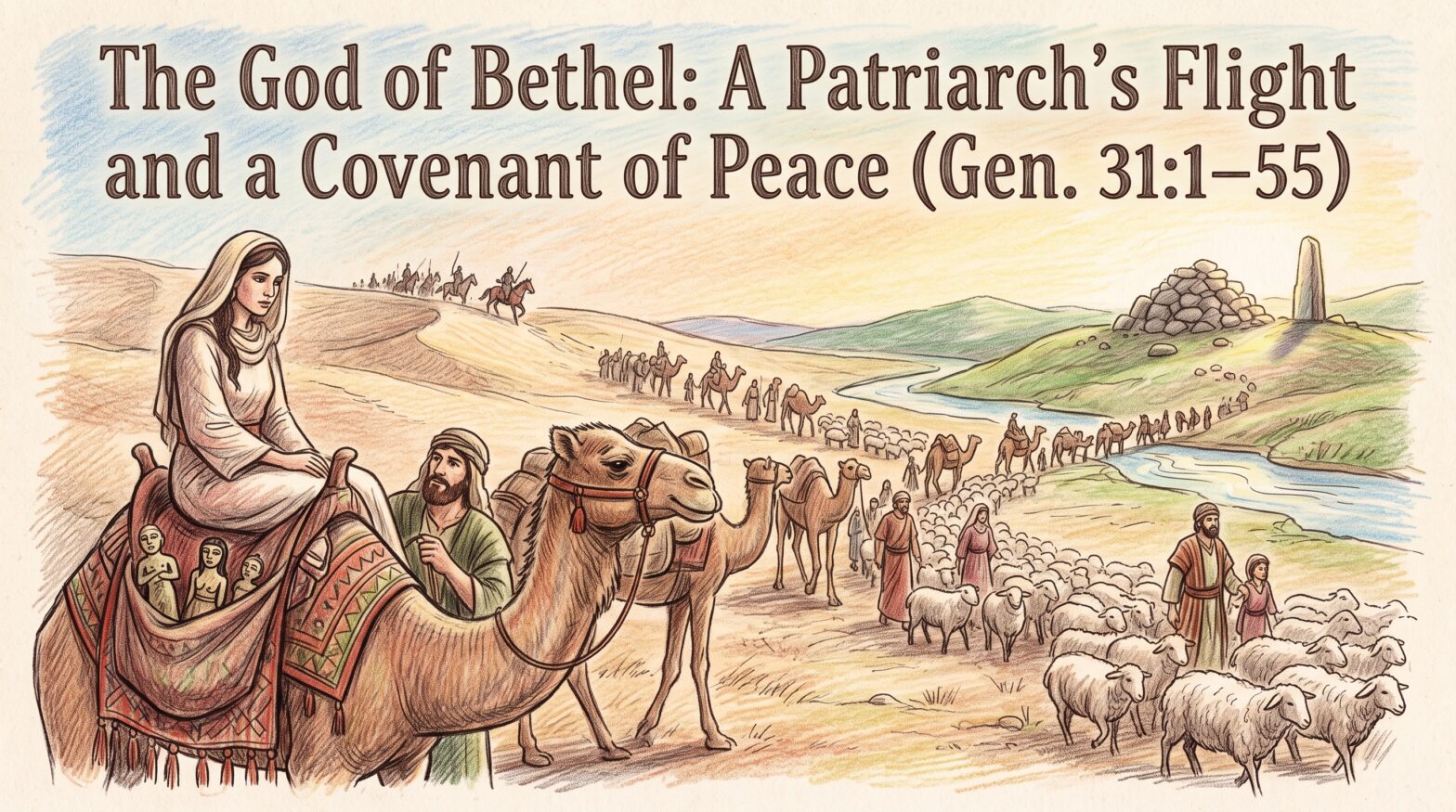
Loved ones, twenty years in exile can feel like an eternity. For two decades, Jacob has served his uncle Laban in Haran, enduring heat by day, frost by night, altered wages, and constant manipulation. Yet through it all, Yahweh has been quietly fulfilling His promise made at Bethel: protecting Jacob, multiplying his family, and providing for his household.
In Genesis 31, the long season of exile comes to a dramatic end. Hostility rises among Laban’s sons, Laban’s attitude grows cold, and God speaks clearly: it is time to go home. What follows is a high-stakes narrative of secret flight, hot pursuit, hidden idols, righteous indignation, and ultimately, a covenant of boundary and peace.
Above the human drama towers the faithful God who introduces Himself once more as “the God of Bethel,” the God who meets His people in their vulnerability and brings them safely home.
Genesis 31 records God’s command for Jacob to return to Canaan, his secret departure from Laban, Rachel’s theft of the household gods, Laban’s pursuit and God’s warning, Jacob’s vindication after twenty years of service, and the treaty sealed at Gilead.
Verses 1–16
1 Now Jacob heard that the sons of Laban were saying, “Jacob has taken all that was our father’s, and from what was our father’s he has gained all this wealth.” 2 And Jacob saw that Laban did not regard him with favor as before. 3 Then the Lord said to Jacob, “Return to the land of your fathers and to your kindred, and I will be with you.” 4 So Jacob sent and called Rachel and Leah into the field where his flock was 5 and said to them, “I see that your father does not regard me with favor as he did before. But the God of my father has been with me. 6 You know that I have served your father with all my strength, 7 yet your father has cheated me and changed my wages ten times. But God did not permit him to harm me. 8 If he said, ‘The spotted shall be your wages,’ then all the flock bore spotted; and if he said, ‘The striped shall be your wages,’ then all the flock bore striped. 9 Thus God has taken away the livestock of your father and given them to me. 10 In the breeding season of the flock I lifted up my eyes and saw in a dream that the goats that mated with the flock were striped, spotted, and mottled. 11 Then the angel of God said to me in the dream, ‘Jacob,’ and I said, ‘Here I am!’ 12 And he said, ‘Lift up your eyes and see, all the goats that mate with the flock are striped, spotted, and mottled, for I have seen all that Laban is doing to you. 13 I am the God of Bethel, where you anointed a pillar and made a vow to me. Now arise, go out from this land and return to the land of your kindred.’ ” 14 Then Rachel and Leah answered and said to him, “Is there any portion or inheritance left to us in our father’s house? 15 Are we not regarded by him as foreigners? For he has sold us, and he has indeed devoured our money. 16 All the wealth that God has taken away from our father belongs to us and to our children. Now then, whatever God has said to you, do.”
The Call to Return
The tension in Haran reaches a breaking point. Laban’s sons accuse Jacob of robbing their father’s estate, and Laban’s demeanor toward Jacob shifts noticeably. When human circumstances become hostile, God opens the door for departure. Yahweh commands Jacob: “Return to the land of your fathers… and I will be with you.”
Jacob calls Rachel and Leah into the privacy of the open fields to discuss the situation. He recounts how their father cheated him and changed his wages ten times yet acknowledges that God did not allow Laban to harm him. Jacob shares a key revelation: God had appeared to him in a dream, identifying Himself as “the God of Bethel.” God reminded Jacob of the vow made twenty years earlier when he was a penniless fugitive, reassuring him that God had seen Laban’s oppression and was now calling him home.
Surprisingly, Rachel and Leah agree without hesitation. They feel utterly alienated by their father, who treated them as foreigners, sold them into marriage for Jacob’s labor, and consumed their dowry/inheritance wealth for himself. Recognizing God’s hand in transferring Laban’s wealth to their children, they urge Jacob: “Now then, whatever God has said to you, do.”
Verses 17–24
17 So Jacob arose and set his sons and his wives on camels. 18 He drove away all his livestock, all his property that he had gained, the livestock in his possession that he had acquired in Paddan-aram, to go to the land of Canaan to his father Isaac. 19 Laban had gone to shear his sheep, and Rachel stole her father’s household gods. 20 And Jacob tricked Laban the Aramean, by not telling him that he intended to flee. 21 He fled with all that he had and arose and crossed the Euphrates, and set his face toward the hill country of Gilead. 22 When it was told Laban on the third day that Jacob had fled, 23 he took his kinsmen with him and pursued him for seven days and followed close after him into the hill country of Gilead. 24But God came to Laban the Aramean in a dream by night and said to him, “Be careful not to say anything to Jacob, either good or bad.”
Secret Flight and Divine Intervention
Jacob seizes an opportunity while Laban is away shearing sheep, a busy season that kept shepherd masters preoccupied. Jacob packs up his vast household, drives his herds, crosses the Euphrates River, and heads south toward the hill country of Gilead.
During the departure, Rachel secretly steals her father’s “household gods” (teraphim). In the ancient Near East (as seen in ancient legal records like the Nuzi tablets), these small family figurines often functioned as legal deeds or ancestral heirlooms tied to property claims, family leadership, and inheritance. Given that Rachel and Leah had just bitterly complained about Laban devouring their dowry and leaving them no inheritance (vv. 14–16), it is most likely that Rachel stole the teraphim as a form of financial restitution, a physical claim to recuperate the stolen wages and spent bride-price.
To be sure, both Laban and Jacob later refer to these objects as elohim (“gods”), which points toward a religious or syncretistic element in Laban’s house as well. However, understanding them primarily as legal heirlooms tied to lost inheritance best fits the immediate narrative flow, even as we hold these cultural nuances loosely.
When Laban learns of the escape three days later, he gathers an armed force of kinsmen and pursues Jacob for seven days. With a superior military force, Laban overtakes Jacob’s slow-moving caravan in Gilead.
Yet before Laban can strike, God steps in. Yahweh appears to Laban in a dream by night, issuing a stern divine warning: “Be careful not to say anything to Jacob, either good or bad.” God places a sharp muzzle on Laban, forbidding him from threatening, negotiating, or coercing Jacob to return.
Verses 25–35
25 And Laban overtook Jacob. Now Jacob had pitched his tent in the hill country, and Laban with his kinsmen pitched tents in the hill country of Gilead. 26 And Laban said to Jacob, “What have you done, that you have tricked me and driven away my daughters like captives of the sword? 27 Why did you flee secretly and trick me, and did not tell me, so that I might have sent you away with mirth and songs, with tambourine and lyre? 28 And why did you not permit me to kiss my sons and my daughters farewell? Now you have done foolishly. 29 It is in my power to do you harm. But the God of your father spoke to me last night, saying, ‘Be careful not to say anything to Jacob, either good or bad.’ 30 And now you have gone away because you longed greatly for your father’s house, but why did you steal my gods?” 31 Jacob answered and said to Laban, “Because I was afraid, for I thought that you would take your daughters from me by force. 32 Anyone with whom you find your gods shall not live. In the presence of our kinsmen point out what I have that is yours, and take it.” Now Jacob did not know that Rachel had stolen them. 33 So Laban went into Jacob’s tent and into Leah’s tent and into the tent of the two female servants, but he did not find them. And he went out of Leah’s tent and entered Rachel’s. 34 Now Rachel had taken the household gods and put them in the camel’s saddle and sat on them. Laban felt all about the tent, but did not find them. 35 And she said to her father, “Let not my lord be angry that I cannot rise before you, for the way of women is upon me.” So he searched but did not find the household gods.
The Search for the Idols
Laban confronts Jacob with hypocrisy, feigning offense that he was denied a joyful send-off with music and farewell kisses. He boasts of his power to do harm but admits that Jacob’s God constrained him. Laban then levels his main charge: “Why did you steal my gods?”
Jacob, completely unaware of Rachel’s theft, explains his fearful motive for fleeing secretly, and then makes a dangerous, rash pronouncement: “Anyone with whom you find your gods shall not live.”
Laban conducts a thorough search through the tents of Jacob, Leah, and the two servant wives, finding nothing. Finally, he enters Rachel’s tent. Rachel had hidden the teraphim inside a camel saddle and sat on them. Claiming she cannot rise due to her menstrual cycle, she prevents Laban from searching the saddle.
The literary scene fits a classic theme running throughout Scripture: false gods and idols being reduced to helpless rubbish, unable to speak, see, or defend themselves. Whether these images were primarily legal property markers or actual religious objects, they end up sat upon in a dirty camel saddle beneath a woman during her period, utterly humbled and powerless before the sovereign God of Israel.
Verses 36–42
36 Then Jacob became angry and berated Laban. Jacob said to Laban, “What is my offense? What is my sin, that you have hotly pursued me? 37 For you have felt through all my goods; what have you found of all your household goods? Set it here before my kinsmen and your kinsmen, that they may decide between us two. 38 These twenty years I have been with you. Your ewes and your female goats have not miscarried, and I have not eaten the rams of your flocks. 39 What was torn by wild beasts I did not bring to you. I bore the loss of it myself. From my hand you required it, whether stolen by day or stolen by night. 40 There I was: by day the heat consumed me, and the cold by night, and my sleep fled from my eyes. 41These twenty years I have been in your house. I served you fourteen years for your two daughters, and six years for your flock, and you have changed my wages ten times. 42 If the God of my father, the God of Abraham and the Fear of Isaac, had not been on my side, surely now you would have sent me away empty-handed. God saw my affliction and the labor of my hands and rebuked you last night.”
Jacob’s Vindication
When the search yields nothing, Jacob’s fear turns into righteous anger. For twenty years he has held his tongue; now he pours out two decades of pent-up grievance.
Jacob lays out his meticulous integrity as a shepherd. By ancient Near Eastern shepherd codes (such as the Code of Hammurabi), a shepherd was not held financially liable for animals killed by wild beasts if he brought proof. But Jacob absorbed those losses himself. He bore the burden of stolen stock, endured extreme weather, suffered sleepless nights, and served faithfully despite Laban changing his wages ten times.
Jacob attributes his ultimate survival and prosperity entirely to divine intervention: “If the God of my father, the God of Abraham and the Fear of Isaac, had not been on my side, surely now you would have sent me away empty-handed.” Jacob recognizes that his wealth was not the product of human cleverness, but God’s covenant mercy rebuking an abusive employer.
Verses 43–55
43 Then Laban answered and said to Jacob, “The daughters are my daughters, the children are my children, the flocks are my flocks, and all that you see is mine. But what can I do this day for these my daughters or for their children whom they have borne? 44 Come now, let us make a covenant, you and I. And let it be a witness between you and me.” 45 So Jacob took a stone and set it up as a pillar. 46 And Jacob said to his kinsmen, “Gather stones.” And they took stones and made a heap, and they ate there by the heap. 47 Laban called it Jegar-sahadutha, but Jacob called it Galeed. 48 Laban said, “This heap is a witness between you and me today.” Therefore he named it Galeed, 49 and Mizpah, for he said, “The Lord watch between you and me, when we are out of one another’s sight. 50 If you oppress my daughters, or if you take wives besides my daughters, although no one is with us, see, God is witness between you and me.” 51 Then Laban said to Jacob, “See this heap and the pillar, which I have set between you and me. 52 This heap is a witness, and the pillar is a witness, that I will not pass over this heap to you, and you will not pass over this heap and this pillar to me, to do harm. 53 The God of Abraham and the God of Nahor, the God of their father, judge between us.” So Jacob swore by the Fear of his father Isaac, 54 and Jacob offered a sacrifice in the hill country and called his kinsmen to eat bread. They ate bread and spent the night in the hill country. 55 Early in the morning Laban arose and kissed his grandchildren and his daughters and blessed them. Then Laban departed and returned home.
The Covenant at Gilead
Laban attempts one last boastful claim (“all that you see is mine”), but realizing he cannot prevail against God’s decree, he proposes a treaty.
They set up a standing stone pillar and a heap of stones to serve as a legal boundary marker and witness. Laban names the stone heap in Aramaic (Jegar-sahadutha), while Jacob names it in Hebrew (Galeed, “Heap of Witness”).
Laban also invokes the name Mizpah (“Watchtower”), declaring: “The Lord watch between you and me, when we are out of one another’s sight.” Modern culture often uses “Mizpah” as a warm blessing between friends, but in context, it was a solemn warning: May God keep an eye on you when I am not around to protect my daughters or enforce this treaty!
Notice the subtle theological distinction in verse 53. Laban swears by “The God of Abraham and the God of Nahor, the God of their father,” combining Yahweh with his ancestral Mesopotamian deities. But Jacob swears specifically by “the Fear of his father Isaac,” the one true, holy God of the covenant.
They ratify the covenant with a sacrifice and a shared meal. The next morning, Laban kisses his daughters and grandchildren, blesses them, and departs. The twenty-year season of Mesopotamian servitude is officially over, and the border to the Promised Land lies ahead.
Conclusion
Genesis 31 brings closure to Jacob’s exile in Haran and highlights the unwavering faithfulness of God in protecting His people. Laban attempted to exploit Jacob for twenty years, but God overruled human injustice, multiplied Jacob’s substance, and physically shielded him from harm.
When God calls Jacob back to Canaan, He introduces Himself as “the God of Bethel.” This title served as a powerful anchor for Jacob’s faith. It reminded him that the God who met him when he had nothing but a stone for a pillow was the same God who watched over him in exile and was now leading him home.
For believers today, God remains “the God of Bethel.” He sees every unfair circumstance, every silent burden, and every season of hardship. He promises never to leave nor forsake His children. Even when we are pursued by trials or confronted by hostility, the God of the covenant stands as our fortress, preserving us until He brings us safely to our ultimate, promised home.
Key Terms
- The God of Bethel: A title for God (Gen. 31:13) emphasizing His covenant faithfulness, historical encounters, and personal promises made to Jacob when he first fled Canaan (Gen. 28).
- Teraphim: Small household images or figurines. While both Laban and Jacob refer to them as elohim (“gods”), the narrative context slightly favors the legal heirloom view. In the ancient Near East, possessing teraphim often signified legal claims to family property, inheritance, and family leadership. Rachel likely stole them as a form of financial restitution to recover the dowry and inheritance her father had devoured (vv. 14–16). Regardless of their exact status, the text highlights their powerlessness as Rachel sits upon them in a camel’s saddle.
- Fear of Isaac (Pachad Yitzchaq): A unique, reverent name for God used by Jacob (Gen. 31:42, 53), reflecting the deep awe, holy fear, and absolute reverence due to the Almighty God worshipped by his father Isaac.
- Mizpah: Meaning “Watchtower.” In context, Laban’s invocation of Mizpah was an oath requesting God to act as an impartial judge and watchman to enforce the treaty boundaries when neither party was present to monitor the other.
- Galeed / Jegar-sahadutha: The Hebrew and Aramaic names given to the memorial heap of stones in Gilead, meaning “Heap of Witness.” It served as an enduring physical treaty marker between Jacob and Laban.