When we open the great confessions of the Reformation, we often find a distinct difference in where they choose to begin. The Westminster Confession of Faith, written nearly a century later in a highly scholastic era, begins with epistemology, how we know what we know, by dedicating its entire first chapter to the Holy Scriptures.
But the earlier, mid-sixteenth-century confessions, forged in the immediate fires of persecution and political upheaval, often begin directly with ontology, the reality of who God is. Like the Belgic Confession (1561) and the French Confession (1559), the Scots Confession of 1560 wastes no time. The “Six Johns” bypass all philosophical throat-clearing and plunge the reader straight into the blazing, majestic reality of the Triune God.
In Chapter 1, they establish the foundation for everything else that will follow. If we get God wrong, we get everything wrong.
The Confession teaches that there is only one infinite, incomprehensible, and triune God; that He demands our exclusive devotion, worship, and trust; and that He not only created all things, but actively sustains and rules the universe by His inscrutable providence for the ultimate manifestation of His own glory.
I. Of God
We confess and acknowledge one only God, to whom only we must cleave, whom only we must serve, whom only we must worship, and in whom only we put our trust. Who is eternal, infinite, immeasurable, incomprehensible, omnipotent, invisible, one in substance and yet distinct in three persons, the Father, the Son, and the Holy Ghost. By whom we confess and believe, all things in heaven and earth, as well visible as invisible, to have been created, to be retained in their being, and to be ruled and guided by His inscrutable providence, to such end as His eternal wisdom, goodness, and justice has appointed them to the manifestation of His own glory.
The Four “Onlys” of True Religion
The chapter opens with a rhythmic, pounding repetition of the word only. In a single sentence, the Reformers establish the boundaries of true religion: “We confess and acknowledge one only God, to whom only we must cleave, whom only we must serve, whom only we must worship, and in whom only we put our trust.”
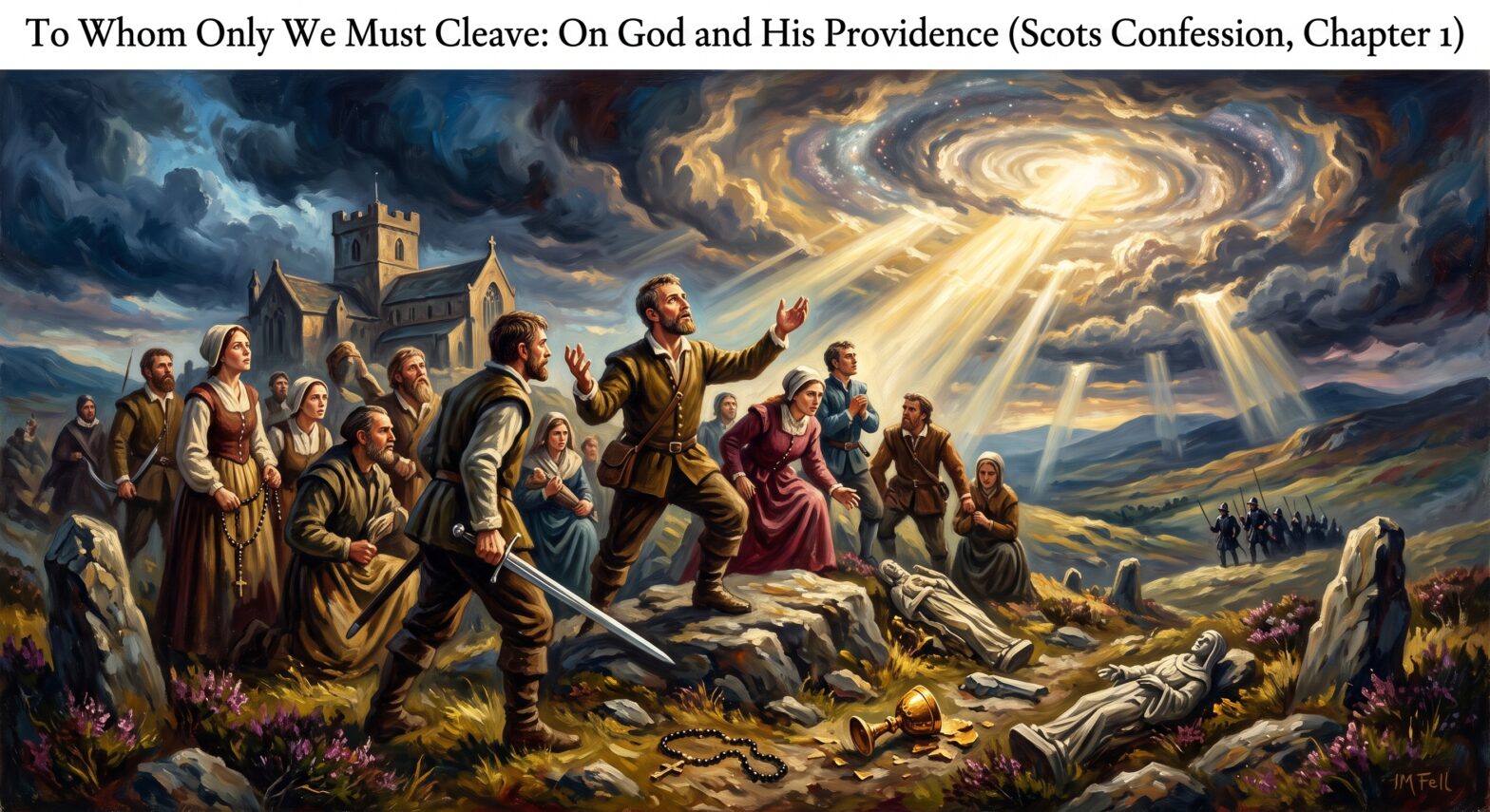
In the context of 1560 Scotland, this was a theological broadsword swung directly at the Roman Catholic establishment. For centuries, the medieval church had divided the spiritual loyalties of the Scottish people. While officially acknowledging one God, Rome practically taught the people to serve a pantheon of mediators. They were taught to pray to the saints, to worship the consecrated bread of the Mass, to trust in the merits of martyrs, and to cleave to the Virgin Mary for grace.
By aggressively repeating the word only, the Scottish Reformers are recovering the pure, unadulterated First Commandment: “You shall have no other gods before me” (Exodus 20:3).
Notice the deeply relational, pastoral progression of these four verbs:
- Cleave: This is a covenantal, marital word (Genesis 2:24). We do not merely acknowledge God’s existence; we are to be passionately, inextricably bound to Him in love.
- Serve: Our allegiance and our labor belong exclusively to our King. We are not our own.
- Worship: The glory and adoration of our hearts cannot be shared with statues, relics, or human traditions.
- Trust: In the day of trouble, whether facing the French Catholic armies or the galleys, our confidence rests in God alone, not in princes or political alliances.
While modern Protestants may not be tempted to pray to saints or bow before relics, the human heart remains an idol factory. We are constantly tempted to cleave to our bank accounts, serve our own ambitions, worship our political ideologies, and trust in our own intellect. The Scots Confession calls us back to radical, exclusive devotion.
The Incomprehensible Majesty
Having established our absolute duty toward God, the Confession pivots to describe His nature. The authors rattle off a stunning list of divine attributes: “eternal, infinite, immeasurable, incomprehensible, omnipotent, invisible.”
In theological terms, these are known as God’s incommunicable attributes—the characteristics of God that He does not share with human beings. We can be loving, just, and wise (communicable attributes), but we can never be eternal, infinite, or omnipotent.
Why is this list so important? Because humans have a persistent, sinful tendency to shrink God down to a manageable size. We want a God who fits into our logic, who operates according to our timelines, and who functions essentially as a slightly bigger, more powerful version of ourselves.
The Reformers utterly reject this. God is incomprehensible. This does not mean we can know nothing about Him (He has revealed Himself in Scripture!), but it means we can never know Him exhaustively. We can never wrap our finite minds around the edges of His infinite being. He is immeasurable, He cannot be quantified, contained, or localized to a physical building or a piece of bread. He is utterly transcendent, majestic, and completely other. A God you can fully comprehend is not a God worthy of your worship.
Historic, Triune Orthodoxy
Lest anyone accuse the Reformers of inventing a new religion, the Confession seamlessly weaves in the historic, orthodox doctrine of the Trinity: God is “one in substance and yet distinct in three persons, the Father, the Son, and the Holy Ghost.”
The Protestant Reformation was not a rejection of historic Christianity; it was a recovery of it. By affirming the ancient language of the Nicene Creed (“one in substance”), the Six Johns are proving to the watching world, and to the Catholic monarchs who accused them of radical heresy, that they are the true heirs of the historic, apostolic church.
Our salvation depends entirely upon this Triune reality. The Father decrees our salvation, the Son accomplishes it in history, and the Holy Spirit applies it to our hearts. Take away the Trinity, and the entire structure of the Gospel collapses.
The Comfort of Inscrutable Providence
After defining who God is, the Confession defines what God does. He is the Creator of “all things in heaven and earth… as well visible as invisible.”
But God did not simply wind the universe up like a clock and walk away, leaving it to run on natural laws or human free will. The Confession strikes a fatal blow against Deism, declaring that all things continue “to be retained in their being, and to be ruled and guided by His inscrutable providence.”
Every breath we take, every heartbeat, every movement of the stars, and every shift in geopolitical power is actively retained and guided by the sovereign hand of God.
For the men who wrote this document, this was not a dry academic theory. It was the only theology that could keep them sane. John Knox had survived nineteen months as a galley slave, chained to an oar. George Wishart and Patrick Hamilton had burned at the stake. Protestant families had lived for decades under the terrifying shadow of the Catholic sword. If history was just a series of random tragedies, or if Satan was truly winning, they would have despaired.
But they recognized that God’s providence is “inscrutable”—meaning its exact workings are often hidden from us, mysterious, and impossible to decode in the moment. We cannot always see why God allows specific suffering. Yet, we can trust the character of the God who wields that providence. The Confession reminds us that His providence is always appointed by “His eternal wisdom, goodness, and justice.”
Even when the providence is painful, it is being administered by a Father who is perfectly wise, unfailingly good, and perfectly just.
The Ultimate End: His Glory
Where is this grand, providential story going? The chapter concludes by pointing to the ultimate purpose of the universe. God has appointed all things, creation, history, salvation, and judgment, “to the manifestation of His own glory.”
Everything exists for God. You were not created simply to be happy, to find yourself, or to leave a legacy. You were created to display the glorious attributes of your Creator. When the Church stands firm in persecution, it manifests the glory of His sustaining grace. When a sinner repents, it manifests the glory of His mercy. When the wicked are finally judged, it manifests the glory of His justice.
As we continue through the Scots Confession, this single reality will serve as the North Star: Soli Deo Gloria. To God alone be the glory.
Key Terms
- Ontology vs. Epistemology: Ontology is the branch of theology/philosophy dealing with the nature of being (who God is). Epistemology deals with the nature of knowledge (how we know what we know).
- Incommunicable Attributes: The characteristics of God’s nature that He does not share with His creation, such as His infinity, eternality, omnipresence, and incomprehensibility.
- Trinity: The historic Christian doctrine that God is one in essence/substance, yet eternally existing in three distinct persons: Father, Son, and Holy Spirit.
- Providence: God’s completely holy, wise, and powerful preserving and governing of all His creatures and all their actions.
- Inscrutable: Impossible to fully understand, decode, or investigate; mysterious. Used to describe the hidden workings of God’s sovereign decrees.