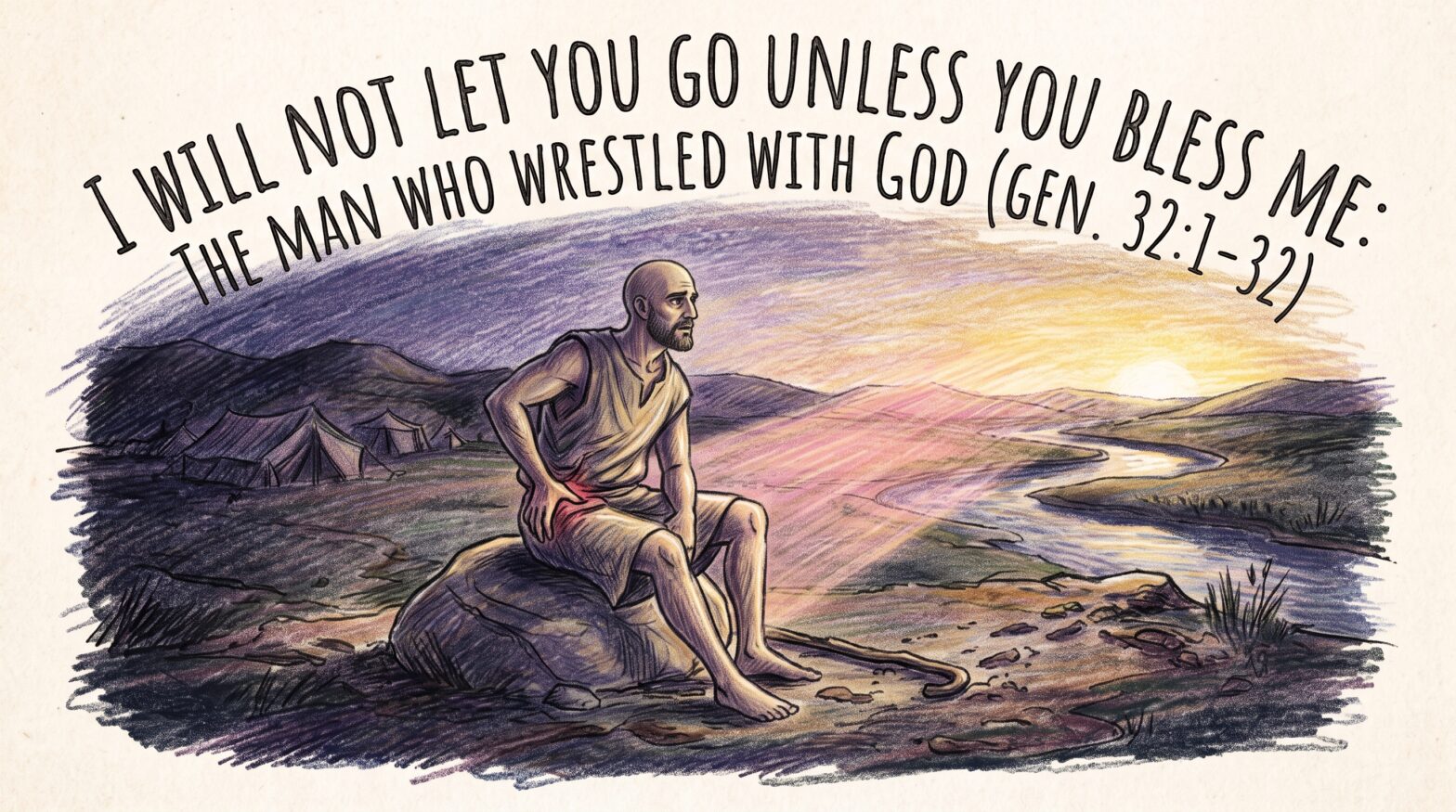
Loved ones, having finally closed the door on twenty years of servitude under Laban, Jacob turns his face back toward the Promised Land. But escaping the threat behind him brings him face-to-face with an even greater terror ahead: his brother Esau, whom he cheated out of his birthright and blessing twenty years earlier.
Genesis 32 records one of the most mysterious, agonizing, and pivotal nights in redemptive history. Facing potential annihilation, Jacob mobilizes his family, prepares extravagant gifts to reconcile with his brother, and pours out his heart in prayer. Yet before Jacob can meet Esau, God meets Jacob.
In the dark on the banks of the Jabbok, the master manipulator who spent a lifetime grabbing heels and striving in the flesh is finally brought to his knees. Stripped of his self-reliance and crippled in body, Jacob receives a new name and a new way of walking.
Genesis 32 records Jacob’s fear at Esau’s approach, his desperate covenant prayer, his strategic gifts, his mysterious midnight wrestling match with God at Peniel, and his transformation from Jacob the Supplanter into Israel.
Verses 1–8
1 Jacob went on his way, and the angels of God met him. 2 And when Jacob saw them he said, “This is God’s camp!” So he called the name of that place Mahanaim. 3 And Jacob sent messengers before him to Esau his brother in the land of Seir, the country of Edom, 4 instructing them, “Thus you shall say to my lord Esau: Thus says your servant Jacob, ‘I have sojourned with Laban and stayed until now. 5 I have oxen, donkeys, flocks, male servants, and female servants. I have sent to tell my lord, in order that I may find favor in your sight.’ ” 6 And the messengers returned to Jacob, saying, “We came to your brother Esau, and he is coming to meet you, and there are four hundred men with him.” 7 Then Jacob was greatly afraid and distressed. He divided the people who were with him, and the flocks and herds and camels, into two camps, 8thinking, “If Esau comes to the one camp and attacks it, then the camp that is left will escape.”
Two Camps and Mounting Terror
As Jacob enters the borderlands, God gives him a reassuring glimpse of the spiritual realm: angelic host encamp around him. Jacob names the place Mahanaim (“Two Camps” or “Double Camp”), recognizing that alongside his earthly caravan stands a divine army guarding his journey.
Seeking to gauge Esau’s posture, Jacob sends messengers ahead with a submissive greeting, referring to Esau as “my lord” and himself as “your servant.” But the messengers return with alarming news: Esau is marching to meet him accompanied by four hundred men, a formidable armed force.
Faced with Esau’s approaching force, Jacob experiences acute fear and distress. He responds with practical prudence, dividing his family and livestock into two separate camps so that if one is attacked, the other might escape. Practical foresight and wise planning are not at odds with faith; rather, Jacob pairs responsible stewardship with earnest prayer, taking wise precautions while seeking God’s ultimate protection.
Verses 9–12
9 And Jacob said, “O God of my father Abraham and God of my father Isaac, O Lord who said to me, ‘Return to your country and to your kindred, that I may do you good,’ 10 I am not worthy of the least of all the deeds of steadfast love and all the faithfulness that you have shown to your servant, for with only my staff I crossed this Jordan, and now I have become two camps. 11 Please deliver me from the hand of my brother, from the hand of Esau, for I fear him, that he may come and attack me, the mothers with the children. 12 But you said, ‘I will surely do you good, and make your offspring as the sand of the sea, which cannot be numbered for multitude.’ ”
The Model Prayer of a Broken Patriarch
In the grip of fear, Jacob prays what is arguably one of the most mature and beautiful prayers recorded in the Old Testament.
Notice how Jacob grounds his appeal:
- He invokes God’s Covenant Name and Command: He addresses Yahweh, the God of his fathers, reminding himself that he is in this vulnerable position because he obeyed God’s explicit command to return home (v. 9).
- He Confesses His Total Unworthiness: Jacob looks back on his life and acknowledges that his wealth is not the product of his cleverness, but of God’s unmerited hesed (steadfast love) and faithfulness. He left Canaan with nothing but a wooden walking stick; now he returns as two vast camps (v. 10).
- He Honestly Admits His Fear: Jacob conceals nothing, pleading openly for deliverance from Esau’s wrath (v. 11).
- He Holds God to His Promises: Jacob concludes by laying hold of God’s explicit word: “But you said, ‘I will surely do you good…’ “ (v. 12). True faith does not bargain; it reminds God of His own promises.
Verses 13–23
13 So he stayed there that night, and from what he had with him he took a present for his brother Esau, 14 two hundred female goats and twenty male goats, two hundred ewes and twenty rams, 15 thirty milking camels and their calves, forty cows and ten bulls, twenty female donkeys and ten male donkeys. 16 These he handed over to his servants, every drove by itself, and said to his servants, “Pass on ahead of me and put a space between drove and drove.” 17 He instructed the first, “When Esau my brother meets you and asks you, ‘To whom do you belong? Where are you going? And whose are these ahead of you?’ 18 then you shall say, ‘They belong to your servant Jacob. They are a present sent to my lord Esau. And moreover, he is behind us.’ ” 19 He likewise instructed the second and the third and all who followed the droves, “You shall say the same thing to Esau when you find him, 20 and you shall say, ‘Moreover, your servant Jacob is behind us.’ ” For he thought, “I may appease him with the present that goes ahead of me, and afterward I shall see his face. Perhaps he will accept me.” 21 So the present passed on ahead of him, and he himself stayed that night in the camp. 22 The same night he arose and took his two wives, his two female servants, and his eleven children, and crossed the ford of the Jabbok. 23He took them and sent them across the stream, and everything else that he had.
The Tributary Gift at the Jabbok
After praying, Jacob takes concrete action. He selects an enormous gift for Esau comprising over 550 animals (goats, ewes, rams, milking camels, cows, bulls, and donkeys). He arranges them into successive droves separated by distance, instructing his servants to repeat a humble message to Esau: “They belong to your servant Jacob… moreover, he is behind us.”
The language Jacob uses in verse 20 is rich with theological undertones: “I may appease him with the present…” The Hebrew word translated “appease” (kaphar) is the standard Old Testament word for “make atonement” or “cover.” Jacob seeks to turn away Esau’s wrath with a generous tribute before standing face-to-face with him.
Under the cover of night, Jacob moves his wives, children, and possessions across the ford of the Jabbok, a narrow, steep river canyon flowing into the Jordan. Having dispatched everything he owns, Jacob remains behind on the northern bank, entirely alone.
Verses 24–32
24 And Jacob was left alone. And a man wrestled with him until the breaking of the day. 25 When the man saw that he did not prevail against Jacob, he touched his hip socket, and Jacob’s hip was put out of joint as he wrestled with him. 26 Then he said, “Let me go, for the day has broken.” But Jacob said, “I will not let you go unless you bless me.” 27 And he said to him, “What is your name?” And he said, “Jacob.” 28 Then he said, “Your name shall no longer be called Jacob, but Israel, for you have striven with God and with men, and have prevailed.” 29 Then Jacob asked him, “Please tell me your name.” But he said, “Why is it that you ask my name?” And there he blessed him. 30 So Jacob called the name of the place Peniel, saying, “For I have seen God face to face, and yet my life has been delivered.” 31 The sun rose upon him as he passed Penuel, limping because of his hip. 32 Therefore to this day the people of Israel do not eat the sinew of the thigh that is on the hip socket, because he touched the socket of Jacob’s hip on the sinew of the thigh.
The Wrestling at Peniel
In the pitch darkness, a mysterious “man” suddenly grapples with Jacob. This is no mere dream or vision; it is a physical, exhausting combat that lasts until dawn.
Who is this opponent? The prophet Hosea later reflects on this event, declaring that Jacob “strove with the angel and prevailed; he wept and sought his favor” (Hosea 12:4). Jacob himself recognizes the divine identity of his combatant, naming the place Peniel (“Face of God”) because he saw God face to face and survived. This night encounter is a Christophany, a pre-incarnate appearance of the Son of God coming to confront, break, and redeem the patriarch.
John Calvin remarkably captures the theological intent of this encounter:
Wherefore it is right to keep in view this design of the vision, which is to represent all the servants of God in this world as wrestlers; because the Lord exercises them with various kinds of conflicts. Moreover, it is not said that Satan, or any mortal man, wrestled with Jacob, but God himself: to teach us that our faith is tried by him; and whenever we are tempted, our business is truly with him, not only because we fight under his auspices, but because he, as an antagonist, descends into the arena to try our strength.[1]
It is not Satan or a mortal enemy with whom Jacob ultimately contends, but God Himself. This reveals that in every trial and conflict, our primary business is truly with God, who uses these struggles to train His servants as spiritual wrestlers.
For hours, Jacob fights with all his determination. Seeing that Jacob will not yield, the opponent simply touches the socket of Jacob’s hip, instantly dislocating it. With a mere touch, divine power reveals the ultimate inadequacy of human strength compared to God’s sovereign might.
Yet, crippled and unable to wrestle any longer, Jacob shifts from striving to clinging. He throws his arms around his divine opponent and cries out: “I will not let you go unless you bless me.” This is the turning point of Jacob’s life. He no longer seeks blessings through trickery or wily bargaining. He seeks a blessing directly from God through helpless, desperate, clinging faith.
The divine visitor asks, “What is your name?” To receive the blessing, Jacob must openly confess who he is: Jacob, the supplanter, the trickster, the heel-grabber.
Then comes the transformation: “Your name shall no longer be called Jacob, but Israel.” Israel means “He strives with God” or “God strives.” Jacob “prevailed” not because he overpowered Almighty God, but because he persevered in clinging faith until he received God’s grace.
When Jacob asks for the opponent’s name, the divine visitor gently declines, His identity is already clear, and bestows the covenant blessing upon him.
As dawn breaks, the sun rises over Penuel. The patriarch walks across the border into the Promised Land, limping on his dislocated hip. He enters his inheritance physically weakened, but spiritually victorious.
Conclusion
The wrestling match at the Jabbok is a profound watershed moment in redemptive history. For over ninety years, Jacob relied on his natural intellect and self-sufficiency. But God brought Jacob to a place where he learned that his ultimate security lay not in his own strength, but in God’s grace.
God brought Jacob to a place of physical breaking so that he could truly become Israel. The limp was not a punishment; it was a permanent physical sign of grace. From that day forward, every step Jacob took was a reminder that his strength lay not in his self-reliance, but in his total dependence on God.
For believers today, Peniel offers a timeless lesson on the nature of spiritual transformation. All servants of God in this world are represented as wrestlers whom the Lord exercises through various conflicts. When trials arise, our business is ultimately with God Himself, who descends into our lives to test our faith, break our self-sufficiency, and teach us to cling to Him.
In Jesus Christ, we meet the One who entered an even deeper night of agony—in the Garden of Gethsemane and on the cross at Calvary. Christ was broken under the weight of divine judgment so that we, through helpless faith, could receive the eternal blessing of the Father and bear a new name.
Key Terms
- Mahanaim: Meaning “Two Camps” or “Double Camp.” Located north of the Jabbok River, it marks the place where Jacob encountered an encampment of God’s angels, reminding him of divine protection alongside his earthly family.
- Hesed (Steadfast Love): A foundational Hebrew covenant term (Gen. 32:10) referring to God’s loyal, unmerited, faithful love toward His covenant people, regardless of their unworthiness.
- Appease (Kaphar): The Hebrew verb used in Genesis 32:20 meaning to cover, propitiate, or appease. It is the same root used throughout Scripture for “atonement” (Yom Kippur), reflecting Jacob’s desire to turn away Esau’s wrath with a gift.
- Israel (Yisra’el): The new name given to Jacob (Gen. 32:28), meaning “He strives with God” or “God strives.” It signifies his transition from a self-reliant manipulator (Jacob) to a humbled servant whose strength is found in clinging faith.
- Peniel / Penuel: Meaning “Face of God.” The location along the river Jabbok where Jacob wrestled with the Lord face to face and received a divine blessing.
- Christophany: An Old Testament appearance of the pre-incarnate Son of God in human form. The mysterious “man” who wrestles with Jacob at the Jabbok and bestows the covenant blessing is understood to be a divine Christophany.
[1] John Calvin, Commentary on the First Book of Moses Called Genesis, trans. John King (Logos Bible Software, 2010), 195.