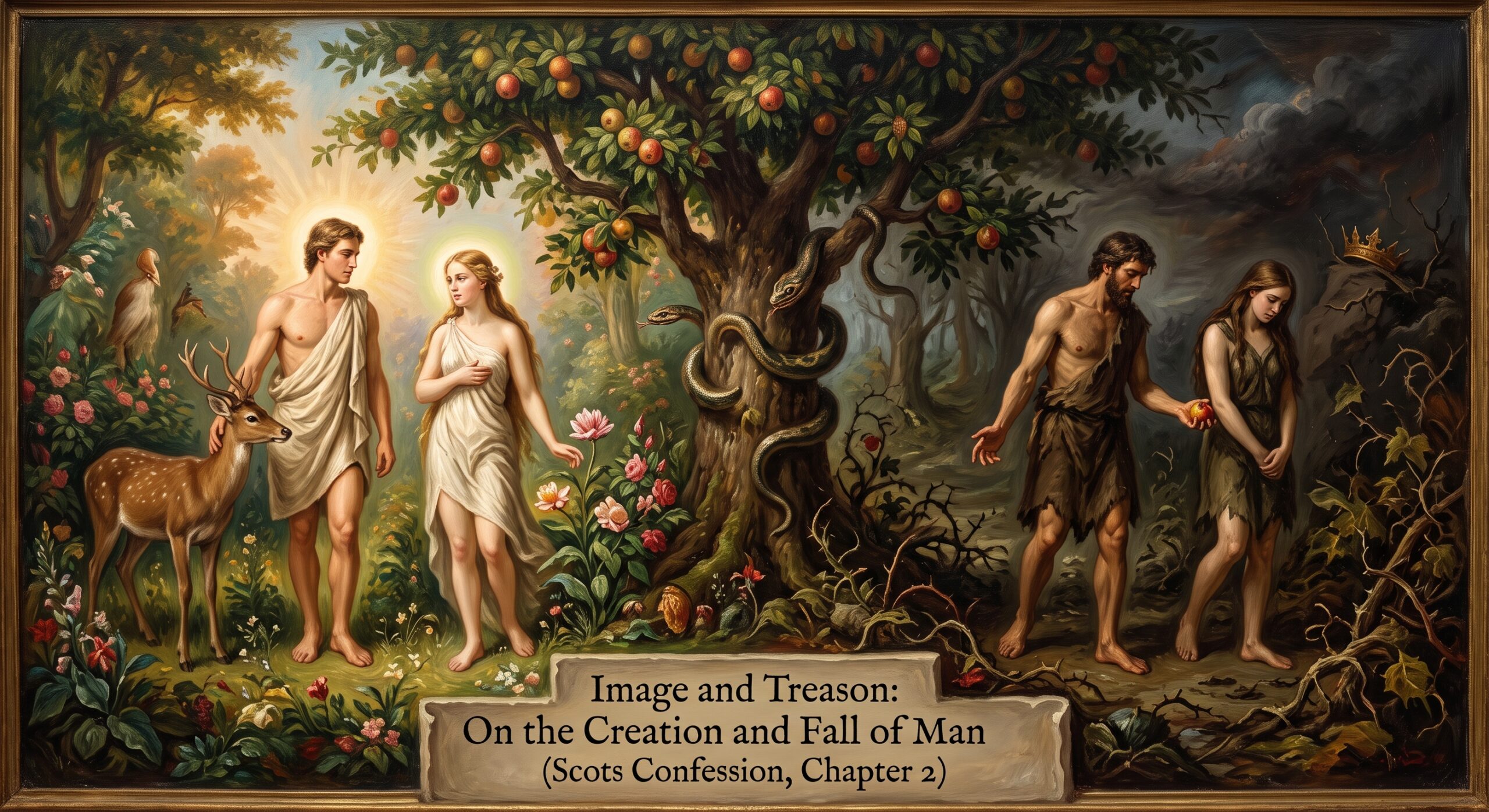
In the opening chapter of the Scots Confession, the Reformers fixed our eyes on the incomprehensible majesty of the Triune God. Having established the Creator, they immediately pivot in Chapter 2 to the pinnacle of His earthly creation.
In a single, breathtaking paragraph, the “Six Johns” cover the entire trajectory of early human history. They take the reader from the glorious heights of humanity’s original perfection in the Garden of Eden down to the catastrophic, muddy depths of our treason. Unlike modern systematic theologies that might spend hundreds of pages detailing the nuances of anthropology, the Scottish Reformers are urgent and direct.
If we want to understand the Gospel, we must first understand who we were originally created to be, and exactly how far we have fallen.
The Confession teaches that God created mankind in perfect righteousness, endowing Adam with true free will, wisdom, and lordship; but that man and woman willfully conspired against God’s explicit command, plunging themselves from perfection into the ruin and death threatened by the Creator.
II. Of the Creation of Man
We confess and acknowledge this our God to have created man (to wit, our first father Adam) to His own image and similitude. To whom He gave wisdom, lordship, justice, free will, and clear knowledge of Himself. So that in the whole nature of man, there could be noted no imperfection. From which honor and perfection, man and woman did both fall, the woman being deceived by the Serpent, and man obeying the voice of the woman: both conspiring against the sovereign majesty of God, who in express words had before threatened death, if they presumed to eat of the forbidden tree.
The Crown of Creation
Modern secular culture often views early man as a primitive, grunting hominid slowly clawing his way out of the darkness of ignorance. The biblical worldview, proudly echoed by the Scots Confession, presents the exact opposite picture. Early man was the absolute crown of creation, shining with the reflected glory of God.
The Confession states that God created man, “to wit, our first father Adam,” in His own “image and similitude.” But what exactly does the image of God entail? The authors do not leave us to guess. They list five specific endowments given to our first parents in Eden:
- Wisdom: Adam possessed a profound, unclouded understanding of the world around him.
- Lordship: God gave mankind the cultural mandate to exercise righteous dominion over the earth (Genesis 1:28). Adam was the viceroy of creation, ruling the physical world on behalf of the High King.
- Justice: This refers to moral uprightness. In his original state, man perfectly aligned with the moral character of God, possessing no internal corruption or sinful bent.
- Free Will: This is a crucial point for Reformed theology. While Calvinists rightly argue that fallen man’s will is currently enslaved to sin, we enthusiastically affirm that pre-fall man possessed true free will. Adam had the ability to choose obedience and life, and he had the ability to choose sin and death.
- Clear Knowledge of Himself: Adam did not have to philosophize or search the cosmos to find God. He enjoyed intimate, unhindered, and clear fellowship with his Creator.
The divines summarize this glorious state with a sweeping, absolute declaration: “So that in the whole nature of man, there could be noted no imperfection.” Humanity was pristine.
The Great Conspiracy
Tragically, the Confession does not linger in the beauty of Eden. The pivot is sharp and devastating. “From which honor and perfection, man and woman did both fall.”
Notice how the Confession describes the mechanics of the Fall from Genesis 3. It mentions “the woman being deceived by the Serpent,” acknowledging the craftiness of Satan and the introduction of a lie into the perfect world. However, it places a distinct weight on the failure of the man, noting that he fell by “obeying the voice of the woman.”
Adam was the federal head of the human race. He was the one who received the direct command from God regarding the forbidden tree, and he was the one tasked with the “lordship” to protect the garden. When the serpent attacked, Adam abdicated his leadership. Instead of obeying the voice of his Creator, he chose to obey a lesser voice.
This line of thinking is critical, representing an early articulation of what would later be formally known as the Covenant of Works. This concept carried through directly into the Westminster Standards, which utilize the language that we “sinned in him.” Adam’s failure as our federal head establishes a necessary parallel to the Covenant of Grace, which was made with Christ and “in him with all the elect as his seed.”
But the Scottish Reformers use a brilliant, chilling phrase to describe the true nature of this sin. Eating the fruit was not a mere mistake, a slip in judgment, or a slight moral failure. The Confession calls it “both conspiring against the sovereign majesty of God.”
To the men of 1560 Scotland, treason against a monarch was a visceral, bloody reality. They understood the gravity of political rebellion. By using the word conspiring, they frame the Fall of Man as a cosmic coup d’état. Adam and Eve were not victims of a misunderstanding. They knowingly allied with a demonic serpent to overthrow the authority of the Sovereign Lord of the universe. They wanted to be gods themselves.
The Express Word and the Final Threat
Why was this conspiracy so egregious? Because it was committed against the clear, undeniable revelation of God.
The Confession concludes by noting that God “in express words had before threatened death, if they presumed to eat of the forbidden tree.” Adam could not plead ignorance. He had the “clear knowledge” of God, and he had the “express words” of the covenant. God had plainly stated the boundaries of human flourishing and the deadly consequences of rebellion.
When humanity presumed to cross that boundary, the threatened death became a reality. It was a spiritual death that severed their fellowship with God immediately, and it was a physical death that would eventually return their perfect bodies to the dust.
Conclusion
Chapter 2 of the Scots Confession is deeply sobering. It strips away all our modern excuses. We cannot blame our sin on our environment, our genetics, or a lack of education. Mankind was given a perfect environment, a perfect nature, and the clearest possible instruction. Yet, we chose rebellion.
As we will see in the coming chapters, this catastrophic fall into death sets the stage for the rest of human history. The bad news of Chapter 2 is absolutely necessary. Until we realize that we are traitors who have lost our original honor and perfection, we will never see our desperate need for the Mediator to win it back.
Key Terms
- Imago Dei: A Latin phrase meaning “Image of God.” It refers to the reality that humans are uniquely created to reflect God’s character, possessing attributes like reason, morality, and the capacity for relationship.
- Original Righteousness: The state of perfect moral purity, justice, and innocence in which Adam and Eve were created before the Fall.
- Free Will (Pre-Fall): The ability possessed by Adam and Eve in their original state of innocence to freely choose either good or evil without any internal compulsion toward sin.
- Federal Headship: The biblical concept that Adam acted as the legal representative for the entire human race in the Garden of Eden. When he fell, humanity fell with him.