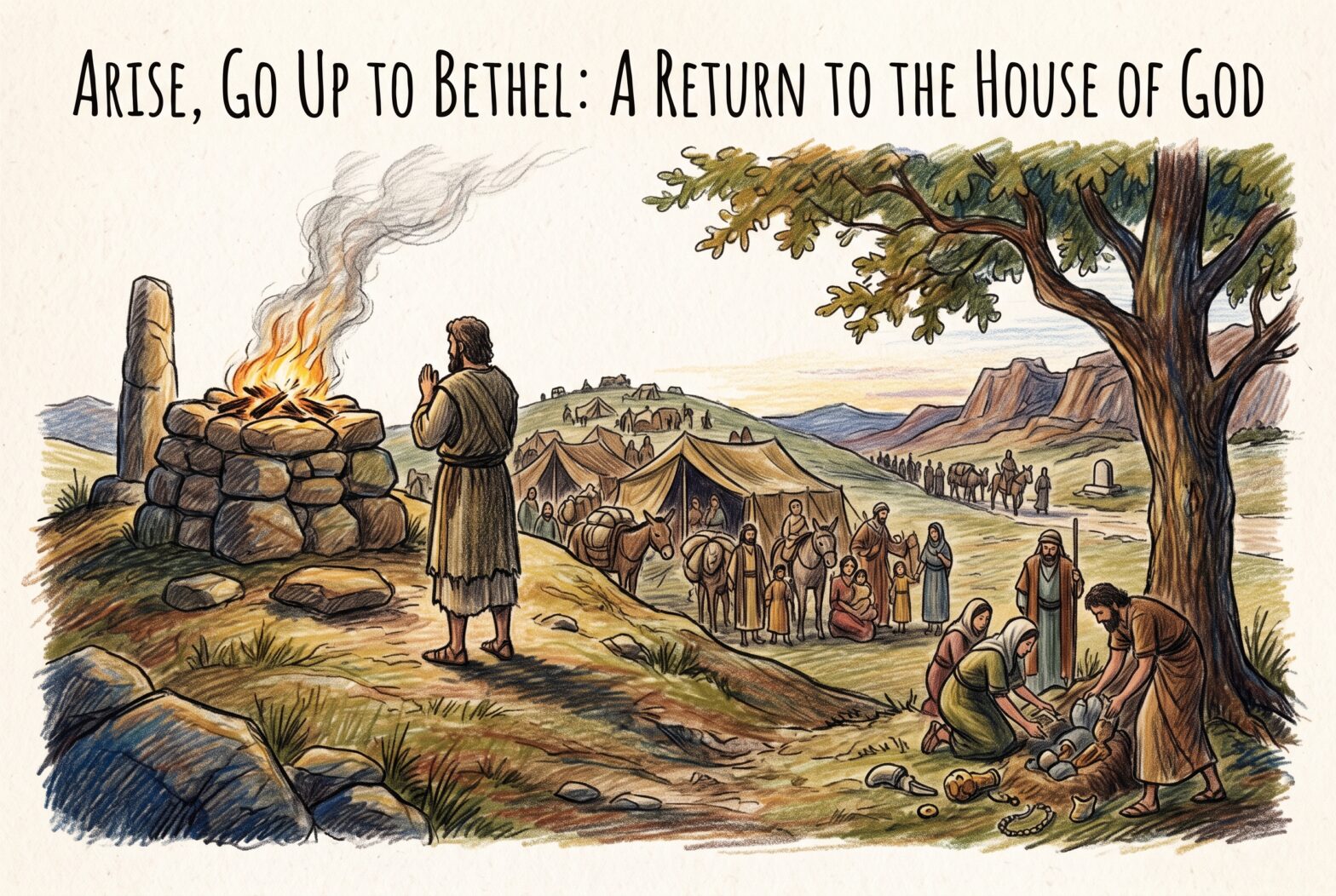
Lingering in spiritual compromise always produces sorrow. In Genesis 34, Jacob’s household suffered catastrophe outside the gates of Shechem because Jacob had settled short of the destination God had appointed for him. Instead of journeying thirty miles south to Bethel to fulfill the vow he had made as a penniless fugitive thirty years earlier (Gen. 28:20–22), he had bought land, pitched his tent, and allowed his family to settle into dangerous proximity with the Canaanite world.
Now, in Genesis 35, the silence of God is broken. Amid the terror, shame, and stench of Shechem, God gives Jacob a clear, imperative summons: “Arise, go up to Bethel and dwell there.”
What follows is a chapter of spiritual renewal, solemn purification, and poignant transition. It is marked by profound milestones: the burying of pagan idols, the reaffirmation of the name Israel, and the official roster of the twelve sons who will form the tribes of God’s people. Yet it is also a chapter shadowed by grief, recording three deaths, two memorial pillars, and a grievous moral scandal within Jacob’s immediate family. Through both triumph and sorrow, Genesis 35 demonstrates that while the patriarchs were frail, flawed, and constantly acquainted with grief, the God of Bethel remains unshakably faithful to His covenant.
Genesis 35 records God’s command for Jacob to return to Bethel, the household’s spiritual purification, the renewal of the Abrahamic covenant, the death of Rachel in giving birth to Benjamin, Reuben’s disgrace, the complete roster of the twelve sons, and the peaceful burial of Isaac by Jacob and Esau.
Verses 1–8
1 God said to Jacob, “Arise, go up to Bethel and dwell there. Make an altar there to the God who appeared to you when you fled from your brother Esau.” 2 So Jacob said to his household and to all who were with him, “Put away the foreign gods that are among you and purify yourselves and change your garments. 3 Then let us arise and go up to Bethel, so that I may make there an altar to the God who answers me in the day of my distress and has been with me wherever I have gone.” 4 So they gave to Jacob all the foreign gods that they had, and the rings that were in their ears. Jacob hid them under the terebinth tree that was near Shechem. 5 And as they journeyed, a terror from God fell upon the cities that were around them, so that they did not pursue the sons of Jacob. 6 And Jacob came to Luz (that is, Bethel), which is in the land of Canaan, he and all the people who were with him, 7 and there he built an altar and called the place El-bethel, because there God had revealed himself to him when he fled from his brother. 8 And Deborah, Rebekah’s nurse, died, and she was buried under an oak below Bethel. So he called its name Allon-bacuth.
Reformation, Purification, and Divine Protection
God initiates the revival. He commands Jacob to leave behind the wreckage of Shechem, proceed to Bethel, and build an altar to “the God who appeared to you when you fled from your brother Esau.” God gently reminds Jacob of his original vow and directs his gaze away from his earthly fears back to covenant worship.
Recognizing the holiness required in the presence of God, Jacob immediately calls for household reformation. He issues three specific demands:
- “Put away the foreign gods that are among you”: These included the teraphim Rachel had taken from Haran, as well as pagan idols plundered from the sacks of Shechem (Gen. 34:27–29).
- “Purify yourselves”: A ritual cleansing pointing forward to the ceremonial washings of the Mosaic Law, symbolizing inward repentance and cleansing from moral contamination.
- “Change your garments”: Putting off old, stained clothing and donning clean apparel as an outward sign of a renewed inward walk before Yahweh.
The household responds by handing over their foreign idols and the rings in their ears (which in ancient Near Eastern culture often served as superstitious amulets or charms associated with pagan deities). Jacob does not recycle the precious metal for financial gain; he buries them completely beneath the terebinth tree near Shechem, cutting ties with pagan superstition.
Jacob had terrified himself with the thought that the surrounding Canaanites would unite to destroy him (Gen. 34:30). But as they march south, God supernaturally intervenes: “a terror from God fell upon the cities that were around them, so that they did not pursue the sons of Jacob.” Divine dread paralyzed their enemies, proving that the security of God’s people rests not on military might or diplomatic alliances, but on the sovereign protection of Yahweh.
Jacob arrives safely at Bethel and builds an altar, calling it El-bethel (“The God of the House of God”). At first, thirty years earlier, Jacob was awed by the place itself (“How awesome is this place!“). Now, having matured through decades of trial, his focus is not merely on the sacred site, but on the God of the place.
The narrative pauses to note the death of Deborah, Rebekah’s beloved nurse who had accompanied Rebekah from Mesopotamia decades earlier (Gen. 24:59). She had evidently joined Jacob’s household, perhaps after Rebekah’s death. Her passing brings genuine mourning; she is buried under an oak named Allon-bacuth (“Oak of Weeping”), honoring a faithful, humble servant of the patriarchal line.
Verses 9–15
9 God appeared to Jacob again, when he came from Paddan-aram, and blessed him. 10 And God said to him, “Your name is Jacob; no longer shall your name be called Jacob, but Israel shall be your name.” So he called his name Israel. 11 And God said to him, “I am God Almighty: be fruitful and multiply. A nation and a company of nations shall come from you, and kings shall come from your own body. 12 The land that I gave to Abraham and Isaac I will give to you, and I will give the land to your offspring after you.” 13 Then God went up from him in the place where he had spoken with him. 14 And Jacob set up a pillar in the place where he had spoken with him, a pillar of stone. He poured out a drink offering on it and poured oil on it. 15 So Jacob called the name of the place where God had spoken with him Bethel.
The Covenant Reaffirmed at Bethel
At Bethel, God formally confirms the covenant with Jacob.
First, God reaffirms his new identity: “no longer shall your name be called Jacob, but Israel shall be your name.” While Jacob had received this name at the Jabbok during his midnight wrestling match (Gen. 32:28), God now officially seals it in the sacred sanctuary of Bethel. The old man of cunning manipulation is definitively replaced by the humbled prince of God.
Second, God reveals Himself as El Shaddai (“God Almighty”), the exact covenant title He revealed to Abraham when instituting circumcision (Gen. 17:1) and that Isaac invoked when blessing Jacob (Gen. 28:3). God promises:
- Prolific fruitfulness: A single chosen nation (Israel) and a broader “company of nations” (qahal goyim).
- Royal lineage: “Kings shall come from your own body“, a promise pointing forward to David, Solomon, and ultimately the King of Kings, Jesus Christ.
- The Land: The physical territory promised to Abraham and Isaac is formally deeded to Jacob and his seed.
In response, Jacob erects a stone pillar (matsebah). Marking a new development in patriarchal worship, Jacob pours out a drink offering (nesekh, a libation of wine) alongside oil upon the stone. This is the very first mention of a drink offering in the Bible, prefiguring the sacrificial libations later codified in Leviticus (Lev. 23:13; Num. 15:5) that signify joyous devotion, total dedication, and life poured out before God.
Verses 16–22a
16 Then they journeyed from Bethel. When they were still some distance from Ephrath, Rachel went into labor, and she had hard labor. 17 And when her labor was at its hardest, the midwife said to her, “Do not fear, for you have another son.” 18 And as her soul was departing (for she was dying), she called his name Ben-oni; but his father called him Benjamin. 19So Rachel died, and she was buried on the way to Ephrath (that is, Bethlehem), 20 and Jacob set up a pillar over her tomb. It is the pillar of Rachel’s tomb, which is there to this day. 21 Israel journeyed on and pitched his tent beyond the tower of Eder.
Sorrow, Death, and Scandal on the Road to Ephrath
From Bethel, the caravan heads southward toward Hebron. Near Ephrath (Bethlehem), joy and tragedy collide. Rachel goes into severe, agonizing labor. As she lies dying, the midwife comforts her with the news that she has borne another son, fulfilling the longing Rachel had expressed years earlier at Joseph’s birth: “The LORD shall add to me another son!” (Gen. 30:24).
With her dying breath, Rachel names the infant Ben-oni, meaning “Son of my sorrow” or “Son of my suffering.” But Jacob immediately intervenes and renames him Benjamin, meaning “Son of the right hand.”
In ancient culture, the right hand signified strength, honor, authority, and favor. Jacob acknowledges the immense grief of losing his beloved wife, yet refuses to saddle his newborn son with a lifelong badge of sorrow and doom. Instead, he names him with a prophetic declaration of dignity and blessing.
Rachel is buried along the road to Ephrath (Bethlehem), and Jacob marks her resting place with a funerary pillar that stood for generations (cf. 1 Sam. 10:2; Jer. 31:15; Matt. 2:18).
The caravan journeys further south, pitching camp past the tower of Eder (Migdal-eder, a watchtower for shepherds guarding flocks outside Bethlehem). Here, a fresh family tragedy strikes: “Reuben went and lay with Bilhah his father’s concubine. And Israel heard of it.”
In the ancient Near East, taking possession of a patriarch’s or monarch’s concubines was not merely an act of illicit sexual indulgence; it was a brazen political power grab, an attempt to usurp the headship of the family or throne (as seen later with Absalom in 2 Sam. 16:21–22 and Adonijah in 1 Kings 2:13–25). Reuben, Leah’s eldest, sought to assert his dominance over his aging father and preempt the sons of Rachel from securing preeminence.
The text records Jacob’s reaction with chilling brevity: “And Israel heard of it.” Jacob takes no immediate violent revenge, but Reuben’s treachery costs him dearly. Because he defiled his father’s bed, Reuben permanently forfeits his firstborn birthright and leadership of the clan, an outcome Jacob formally pronounces on his deathbed (Gen. 49:3–4; 1 Chron. 5:1–2). The leadership would pass to Judah, and the double inheritance portion to Joseph.
Verses 22b–29
23 The sons of Leah: Reuben (Jacob’s firstborn), Simeon, Levi, Judah, Issachar, and Zebulun. 24 The sons of Rachel: Joseph and Benjamin. 25 The sons of Bilhah, Rachel’s servant: Dan and Naphtali. 26 The sons of Zilpah, Leah’s servant: Gad and Asher. These were the sons of Jacob who were born to him in Paddan-aram. 27 And Jacob came to his father Isaac at Mamre, or Kiriath-arba (that is, Hebron), where Abraham and Isaac had sojourned. 28 Now the days of Isaac were 180 years. 29 And Isaac breathed his last, and he died and was gathered to his people, old and full of days. And his sons Esau and Jacob buried him.
The Twelve Sons and the Passing of Isaac
Immediately following Reuben’s disgrace, Scripture provides the first official, structured catalog of the twelve sons of Jacob.
Despite the messy polygamy, bitter sisterly rivalry, and moral failures of the sons, God’s promise to build a great nation stands intact. The twelve sons are grouped systematically by their mothers:
- Leah (6): Reuben, Simeon, Levi, Judah, Issachar, Zebulun
- Rachel (2): Joseph, Benjamin
- Bilhah (2): Dan, Naphtali
- Zilpah (2): Gad, Asher
The summary note that they were born in Paddan-aram is a general statement covering the season of Jacob’s exile, with Benjamin being the sole child born in the Promised Land.
Finally, Jacob arrives at Mamre (Hebron), completing his long journey and reuniting with his elderly father, Isaac. Decades earlier, Jacob had fled his father’s presence as a fearful runaway, never expecting to see Isaac alive again. Now, by God’s sustaining grace, Jacob returns as a wealthy father of twelve patriarchs.
At the ripe age of 180 years, Isaac breathes his last, “old and full of days,” and is gathered to his ancestors. In a tender echo of Abraham’s burial by Isaac and Ishmael (Gen. 25:9), “his sons Esau and Jacob buried him.” The two formerly estranged brothers stand side-by-side in peace, honoring their father and laying him to rest in the cave of Machpelah.
Conclusion
Genesis 35 represents a major turning point in the Book of Genesis. The era of the primary three patriarchs, Abraham, Isaac, and Jacob, is concluding, and the story broadens into the history of the twelve tribes of Israel.
It is a chapter marked by deep tension between human frailty and divine faithfulness. Jacob buries his mother’s faithful nurse, buries his beloved wife Rachel in the prime of her life, confronts the shameful incest of his firstborn son, and lays his aged father in the tomb.
Yet, amid the tears and tombstones, the covenant marches forward. God purifies His people, casts away their idols, establishes their true identity, and confirms His promises.
Ultimately, this passage points forward to Jesus Christ.
- Like Benjamin, who was born as Ben-oni (“Son of my sorrow”) but named by his father Benjamin (“Son of the right hand”), Jesus Christ is the ultimate Man of Sorrows, acquainted with deepest grief (Isa. 53:3), who through His death and resurrection has been exalted to the right hand of the Majesty on high (Heb. 1:3; Acts 2:33).
- It was on the road to Ephrath (Bethlehem) that Rachel wept over her son; centuries later, outside that same small town of Bethlehem, the true King of Israel would be born to bring comfort to all who mourn and redeem a broken world (Micah 5:2; Matt. 2:1–18).
Where human families fall into scandal, grief, and idolatry, the God of Bethel remains the faithful Redeemer who cleanses our sin, covers our shame, and leads His children home.
Key Terms
- El-bethel: Meaning “The God of the House of God” (Gen. 35:7). The name Jacob gave to the altar at Bethel, demonstrating a mature theological shift from being captivated by the sacred place itself to worshipping the God who sanctifies it.
- Terror from God (Hittat Elohim): A supernatural, paralyzing dread placed by God upon the surrounding Canaanite nations (Gen. 35:5), preventing them from pursuing or annihilating Jacob’s small family following the sack of Shechem.
- Earrings as Amulets: In the ancient Near East, ornamental earrings frequently bore pagan symbols, inscriptions, or protective talismans. Jacob buried them alongside the carved foreign idols as an act of thorough religious renunciation.
- Drink Offering (Nesekh): The biblical practice of pouring out wine before the Lord as a sacred libation (Gen. 35:14). It symbolizes total consecration, gratitude, and life poured out in worship.
- Ben-oni vs. Benjamin: Two names given to Jacob’s twelfth son. Ben-oni means “Son of my sorrow/affliction” (given by the dying Rachel); Benjamin means “Son of the right hand” (given by Jacob), signifying strength, honor, authority, and covenant favor.
- Allon-bacuth: Meaning “Oak of Weeping” (Gen. 35:8). The burial site of Deborah, Rebekah’s faithful childhood nurse, marking the deep affection and honor the covenant family had for her lifelong service.