In Chapter 4 of the Scots Confession, we saw the glorious dawn of redemptive history. Following the catastrophic fall of mankind, God broke into the darkness with a brilliant promise: the Seed of the woman would ultimately crush the head of the Serpent.
But a profound question immediately arises. How did that promise survive?
If you read the Old Testament, you will quickly discover that the history of humanity is a history of relentless rebellion, catastrophic wars, famine, and spiritual amnesia. How did the fragile line of the promised Seed endure thousands of years of human depravity and demonic assault?
In Chapter 5, the “Six Johns” provide a sweeping, panoramic view of Old Testament history to answer that exact question. They demonstrate that the church did not survive because of the faithfulness of men, but entirely because of the sovereign, relentless grip of God.
The Confession teaches that God has sovereignly preserved, disciplined, and restored His Church throughout all of Old Testament history, guaranteeing the survival of the promised Seed despite the relentless idolatry of the people and the fierce assaults of Satan.
V. The Continuance, Increase, and Preservation of the Kirk
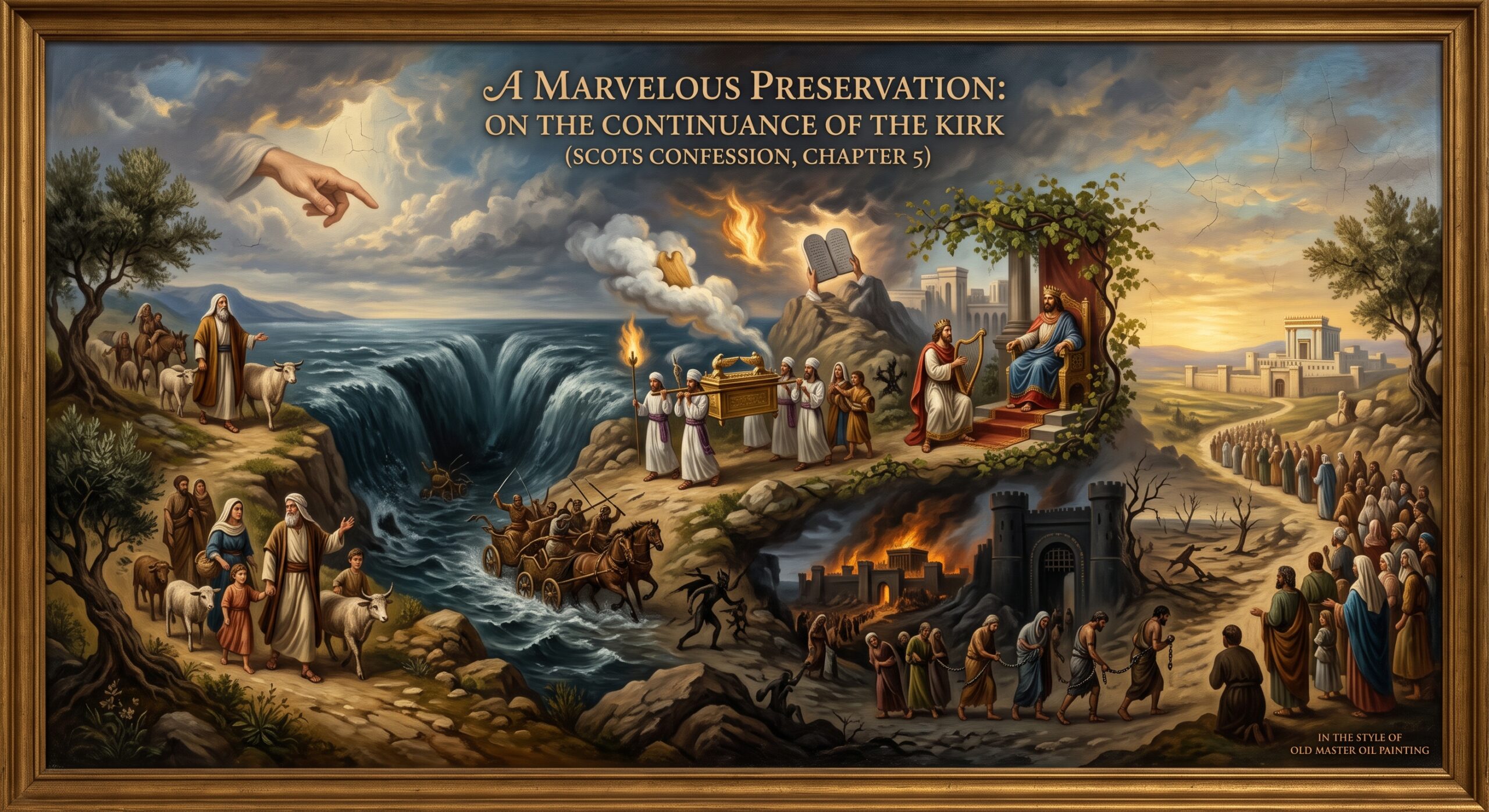
We most constantly believe that God preserved, instructed, multiplied, honored, adorned, and from death called to life His kirk in all ages from Adam till the coming of Christ Jesus in the flesh. For Abraham, He called from his father’s country, him He instructed, his seed He multiplied, the same He marvelously preserved and more marvelously delivered from the bondage and tyranny of Pharaoh. To them He gave His laws, constitutions, and ceremonies. Them He possessed in the land of Canaan: to them, after judges and after Saul, He gave David to be king, to whom He made promise that of the fruit of his loins should one sit forever upon His regal seat. To this same people, from time to time, He sent prophets to reduce them to the right way of their God, from which oftentimes they declined by idolatry. And albeit that for their stubborn contempt of justice, He was compelled to give them into the hands of their enemies, as before was threatened by the mouth of Moses, in so much that the holy city was destroyed, the temple burnt with fire, and the whole land left desolate the space of 70 years, yet of mercy did He lead them again to Jerusalem. Where the city and temple were rebuilt and they against all temptations and assaults of Satan did abide, till the Messiah came according to the promise.
The Sovereign Shepherd of History
The Reformers understood that history is not a random sequence of events. It is the theater of God’s redemptive glory. The opening sentence attributes an extraordinary sequence of active verbs to God: He “preserved, instructed, multiplied, honored, adorned, and from death called to life His kirk.”
The word kirk is simply the Scottish word for “church.” While modern Christians often think the church began in the New Testament book of Acts, Reformed theology recognizes that the church (the assembly of God’s covenant people) has existed in various administrative forms since the Garden of Eden.
The divines rapidly trace the major epochs of this ancient kirk. They note the sovereign calling of Abraham out of paganism. They highlight the marvelous preservation of his seed in Egypt and the miraculous deliverance from the tyranny of Pharaoh. They point to the giving of the Law, the conquest of Canaan, and the establishment of the Davidic monarchy.
At every step, the survival of the kirk was a divine miracle. Left to their own devices, the Israelites would have assimilated into the pagan nations, starved in the wilderness, or been annihilated by the surrounding Canaanite warlords. The church only exists because God refuses to let it die.
The Tragedy of Idolatry
However, this chapter is not a sanitized, romanticized view of biblical history. The Confession transitions from the heights of the Davidic kingdom to the tragic, frustrating reality of the divided monarchy.
God continually sent prophets to “reduce them to the right way of their God,” but the tragic refrain of the Old Testament is that the people “oftentimes declined by idolatry.”
To the Scottish Reformers of 1560, this was not just ancient history. It was a mirror. For centuries leading up to the Reformation, the medieval church had, in their view, radically declined into theological and practical idolatry. The worship of the Mass, the veneration of relics, and the tyranny of the papacy were seen as direct parallels to the idolatry of ancient Israel.
The Old Testament proves that having a glorious heritage does not make a church immune to corruption. The visible church can, and often does, fail spectacularly. But the unfaithfulness of the bride does not nullify the faithfulness of the Bridegroom.
The Severe Mercy of the Exile
Because God loves His kirk, He will not allow her to remain in unrepentant idolatry forever. He is a holy Father who disciplines the children He loves (Hebrews 12:6).
The Confession details the terrifying consequences of Israel’s “stubborn contempt of justice.” God kept the terrifying promises He made through Moses in Deuteronomy 28 and 29. He gave His people into the hands of their enemies. The holy city of Jerusalem was besieged and destroyed, the magnificent temple of Solomon was burned to the ground, and the land was left desolate for seventy years of Babylonian exile.
This is a profound theological truth: God is perfectly willing to destroy the physical institutions, the magnificent buildings, and the comfortable traditions of men in order to save the souls of His people. The exile felt like absolute death to the Israelites, but it was actually a severe mercy. It was a divine surgery designed to finally cut the cancer of blatant idolatry out of the nation’s heart.
Called From Death to Life
If the story ended in Babylon, the promise of Genesis 3 would have failed. But the Confession notes a glorious pivot: “yet of mercy did He lead them again to Jerusalem.”
God always preserves a remnant. After the seventy years of discipline, He called His kirk back from the grave. He orchestrated the geopolitical rise and fall of massive empires, using the Persian King Cyrus to send the Jewish people home to rebuild the city and the temple.
The chapter concludes with a triumphant summary of this preservation. The rebuilt kirk, battered but alive, stood firm “against all temptations and assaults of Satan” until the exact moment “the Messiah came according to the promise.” Satan did everything in his cosmic power to sever the lineage, corrupt the nation, and destroy the womb that would bear the Christ. But he failed.
Conclusion
Chapter 5 of the Scots Confession is a magnificent anchor for the anxious Christian. Today, we look around at the cultural landscape and often feel a deep sense of despair. The modern church frequently seems weak, compromised by worldly philosophies, and under constant assault from hostile secular forces. We wonder how the Christian faith can possibly survive the coming decades.
Looking backward enables us to look forward with hope. The God we serve is the same God who preserved a family through a global flood, parted the Red Sea for a nation of runaway slaves, and resurrected a dead nation from the ashes of Babylon. The survival of the kirk does not depend on our political savvy, our cultural influence, or our moral perfection. It depends entirely on the unbreakable promise of God. He has preserved His church through the darkest nights of human history, and He will undoubtedly preserve it until Christ returns.
Key Terms
- The Kirk: The historic Scottish word for the “church,” referring to the assembly of God’s covenant people across all ages, both in the Old and New Testaments.
- Idolatry: The worship of false gods, or the worship of the true God in a false, unbiblical manner. It was the primary sin that led to the exile of ancient Israel.
- The Remnant: The theological concept that even in times of massive national or ecclesiastical apostasy and judgment, God always preserves a faithful minority of true believers by His grace.
- The Exile: The seventy-year period where the southern kingdom of Judah was conquered by Babylon, Jerusalem was destroyed, and the people were deported as a divine judgment for their covenant rebellion.