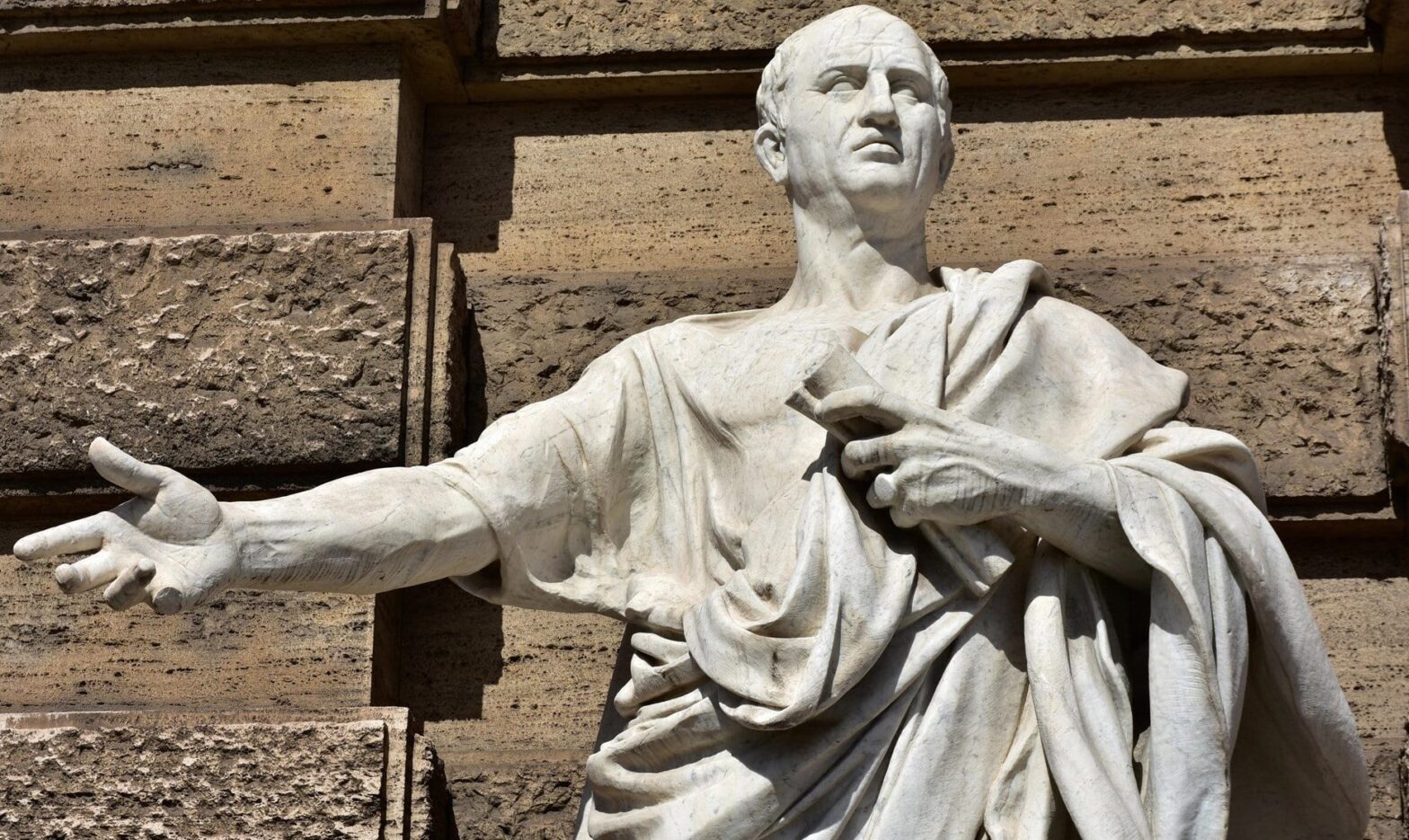
Before we step back to paint our final portrait of the Christian Stoic man, there is one last historical figure we must examine. He was not a Greek. He was not an Emperor. And technically, he was not even a strict Stoic.
He was a Roman lawyer, a politician, and the greatest orator of antiquity: Marcus Tullius Cicero (106–43 BC).
Why include a non-Stoic in a series on Christian Stoicism? Because without Cicero, the Christian West as we know it might not exist. While he aligned himself with the “Academic Skeptics” in his epistemology (how we know things), when it came to ethics and how a man ought to live, he leaned heavily on the Stoa. He took the profound, sometimes esoteric ideas of the Greek Stoics and translated them into the practical, blood-and-dirt reality of Roman politics.
Cicero served as the providential bridge between Greek philosophy and the Latin West, forging the moral vocabulary and the doctrine of Natural Law that the early Church would later use to articulate the ethics of the Christian faith.
The Great Translator
The early Church Fathers wrote in Greek, but the Western Church—the Church of Augustine, Calvin, and the Reformers—spoke Latin.
Greek is a language of soaring philosophy; Latin is a language of law, engineering, and war. When Cicero began writing philosophy, there were literally no Latin words for many Greek concepts. So, he invented them.
- When you use the word moral (from moralis), you are using a word Cicero invented.
- When you speak of quality (qualitas), humanity (humanitas), or essence (essentia), you are speaking Ciceronian Latin.
Cicero took the Greek Logos and gave it Latin clothes. By doing so, he prepared the linguistic soil of the Roman Empire to receive the seed of the Gospel. When the Apostle Paul wrote his letter to the Romans, the Roman mind was already primed to understand concepts of universal justice, virtue, and conscience—largely because Cicero had spent his life popularizing them.
De Officiis: The First Christian Ethics Manual?
Cicero’s most enduring contribution to practical ethics is his book De Officiis (“On Duties”). Written in the final year of his life, it is heavily based on the writings of the Greek Stoic Panaetius.
In it, Cicero outlines what it means to be a good man, a good citizen, and a good leader. He argues forcefully that the honorable (honestum) must always be chosen over the useful (utile). A man must never compromise his integrity for political or financial gain.
The early Christians loved De Officiis. It resonated so deeply with biblical ethics that in the 4th century, Saint Ambrose (the man who baptized Augustine) wrote a Christian version of it called De Officiis Ministrorum (“On the Duties of Ministers”). Ambrose took Cicero’s Stoic framework of the four cardinal virtues—Wisdom, Justice, Courage, and Temperance—and baptized them, showing how they find their ultimate fulfillment in Christ.
For centuries, if a young Christian man was being educated in the West, he read two things for his morals: the Book of Proverbs, and Cicero’s De Officiis.
The Doctrine of Natural Law
Perhaps Cicero’s greatest theological contribution to Christian Stoicism is his articulation of Natural Law (Lex Naturalis).
The Stoics believed that the universe was governed by reason. Cicero took this and framed it as a universal law binding on all men, at all times, in all places. In De Re Publica, he writes:
True law is right reason in agreement with nature; it is of universal application, unchanging and everlasting… We cannot be freed from its obligations by senate or people… And there will not be different laws at Rome and at Athens, or different laws now and in the future, but one eternal and unchangeable law will be valid for all nations and all times, and there will be one master and ruler, that is, God, over us all, for he is the author of this law…[1]
Read those words again. This is a pagan Roman writing a half-century before Christ was born!
This is the philosophical echo of what the Apostle Paul would later write in Romans 2:14-15: “For when Gentiles, who do not have the law, by nature do what the law requires… They show that the work of the law is written on their hearts.”
Cicero understood that morality is not invented by society; it is discovered in the fabric of the universe. The Christian Stoic leans heavily on this reality. We do not need a Bible verse to tell us that murder is wrong or that courage is good; God has inscribed this Natural Law upon the human conscience.
The Book that Roused a Saint
God not only used Cicero to prepare the Roman Empire; He used him to prepare one of His greatest theologians for salvation.
In his Confessions, Augustine describes himself as a worldly, lustful young man who cared only for rhetorical flair and worldly success. But at age nineteen, he was assigned to read a dialogue by Cicero called the Hortensius (now lost to history).
Augustine writes of the experience:
This book, in truth, changed my affections, and turned my prayers to Thyself, O Lord, and made me have other hopes and desires. Worthless suddenly became every vain hope to me; and, with an incredible warmth of heart, I yearned for an immortality of wisdom, and began now to arise that I might return to Thee.[2]
Cicero did not lead Augustine to Christ—Cicero had no Gospel to give. But God used Cicero’s majestic defense of truth to awaken Augustine from his spiritual coma. Cicero was the plow that broke up the hard soil of Augustine’s heart, preparing it for the seed of the Gospel. He is the ultimate example of Common Grace serving Special Grace.
Conclusion: The Hands of the Orator
Cicero’s life ended in tragedy. He tried to save the Roman Republic from the tyranny of Mark Antony and Octavian using only the power of his words and his Stoic ideals. He failed.
He was hunted down and assassinated. Mark Antony ordered Cicero’s head and hands—the hands that wrote the great defenses of liberty—to be severed and nailed to the Rostra in the Roman Forum as a warning.
Cicero proves that philosophy, no matter how noble, cannot save a dying nation. Natural Law can diagnose the rot, but it cannot resurrect the dead.
We read Cicero for his eloquence. We honor him for his defense of duty and law. We thank God for the vocabulary he gave us. But we do not put our hope in the Republic he tried to save.
Cicero’s Rome fell. But the City of God—built not on the eloquence of a Roman lawyer, but on the blood of a Jewish Carpenter—endures forever.
In our next and final article, we will synthesize this entire series thus far. We will step back and draw the definitive, practical portrait of the Christian Stoic Man.
Key Terms
- Academic Skepticism: The philosophical school to which Cicero formally belonged. They believed that absolute certainty was impossible, but that men should guide their lives by what is most probable. However, in ethics, Cicero heavily adopted Stoic doctrines.
- Natural Law (Lex Naturalis): The moral law that is woven into the fabric of creation and knowable by human reason, distinct from the positive law (laws made by governments). It is the basis for universal human rights and duties.
- De Officiis: (“On Duties”). Cicero’s highly influential manual on ethics, exploring the tension between what is morally right and what is advantageous, heavily based on Stoic thought.
- Honestum vs. Utile: The Ciceronian (and Stoic) debate between what is honorable/virtuous (honestum) and what is merely expedient/useful (utile). Cicero argued that the truly useful is always the honorable.
[1] Cicero, On the Republic, trans. CW Keyes, 1928, http://attalus.org/info/republic.html, 3.33.
[2] Augustine of Hippo, “The Confessions of St. Augustin,” in Nicene and Post-Nicene Fathers, ed. Philip Schaff, trans. J G Pilkington, vol. 1 of 1 (Christian Literature Company, 1886), 3.5.7.