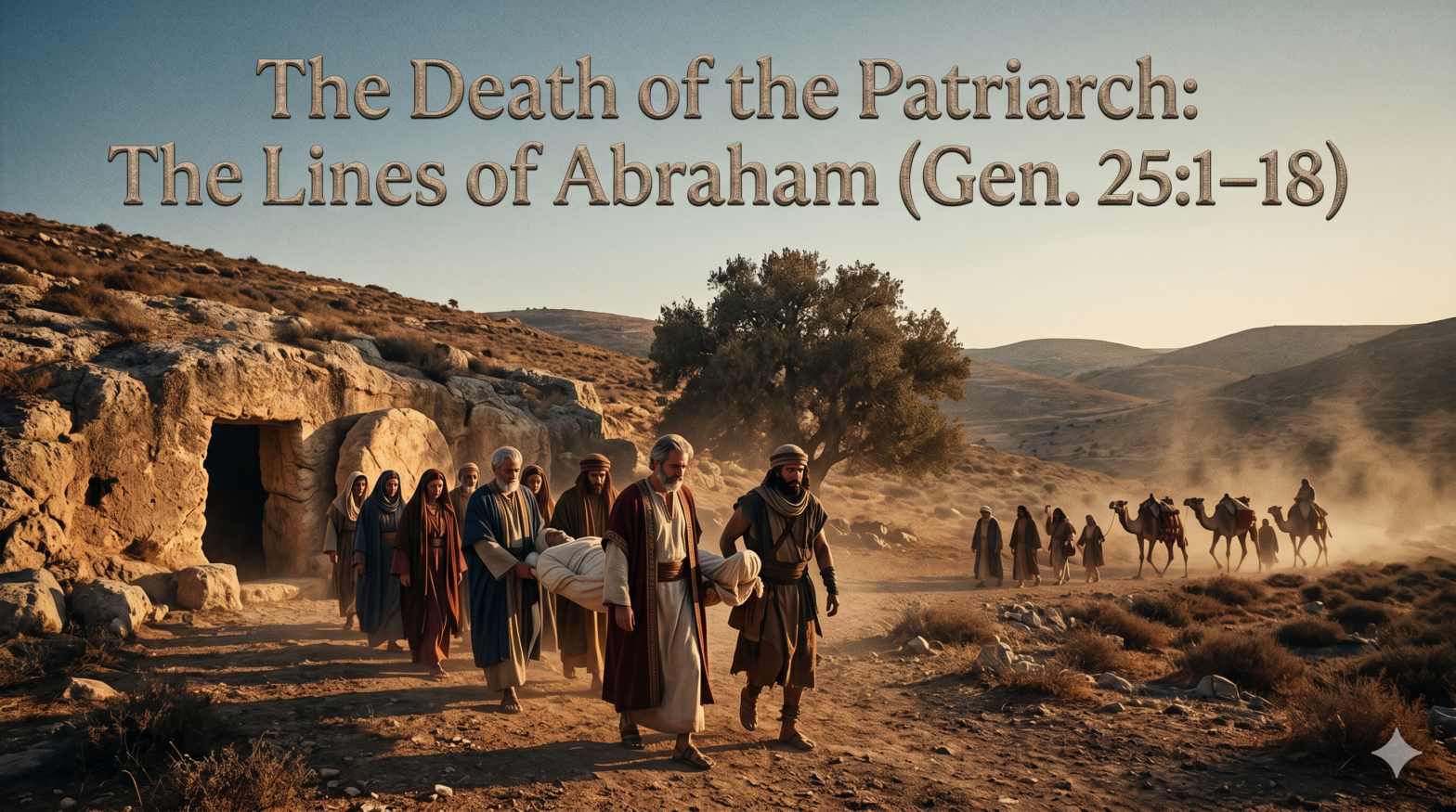
Loved ones, all great stories eventually reach an end, and the earthly life of Abraham is no exception. For fourteen chapters, we have followed this man out of the pagan darkness of Ur, through famines, wars, agonizing delays, and the staggering test on Mount Moriah. He is the father of all who believe (Rom. 4:11), the friend of God (James 2:23), and the human fountainhead from which the entire Old Testament redemptive plan flows.
Yet, in Genesis 25, the grand, sweeping narrative quiets down for a series of genealogies and a burial. The torch must be passed. But before Abraham breathes his last, he has unfinished business. Even in his final days, his primary concern is not his own legacy, but the absolute security of the covenant promise. He must ensure that Isaac—and Isaac alone—stands uncontested as the sole heir of God’s redemptive plan.
Genesis 25:1-18 records the final years of Abraham, his decisive actions to secure Isaac’s unique inheritance, his peaceful death, and God’s faithfulness in fulfilling His promises to both the chosen line and the line of Ishmael.
Verses 1–6
1 Abraham took another wife, whose name was Keturah. 2 She bore him Zimran, Jokshan, Medan, Midian, Ishbak, and Shuah. 3 Jokshan fathered Sheba and Dedan. The sons of Dedan were Asshurim, Letushim, and Leummim. 4 The sons of Midian were Ephah, Epher, Hanoch, Abida, and Eldaah. All these were the children of Keturah. 5 Abraham gave all he had to Isaac. 6 But to the sons of his concubines Abraham gave gifts, and while he was still living he sent them away from his son Isaac, eastward to the east country.
The Uncontested Heir
Many readers are surprised to find that after Sarah’s death, Abraham married again. Keturah is called a “wife” here, but in 1 Chronicles 1:32 (and later in verse 6 of this chapter), she is referred to as a concubine. Abraham goes on to father six more sons. One of these sons, Midian, would become the father of the Midianites, a nation that would later interact heavily with Moses (Exodus 2) but also become a bitter enemy of Israel (Judges 6).
Why are these new sons mentioned? To highlight a crucial theological and practical point. Abraham has many sons, but he only has one heir of the promise.
Look at the stark contrast in verses 5 and 6. “Abraham gave all he had to Isaac.” Isaac receives the wealth, the land, the covenant blessing, and the spiritual headship of the family. But what about the other sons? “Abraham gave gifts, and while he was still living he sent them away from his son Isaac, eastward.”
Abraham loves his other sons, and he provides for them generously. But he knows human nature, and he knows the promises of God. He remembers the bitter conflict between Sarah and Hagar, and the mocking of Ishmael. He will not leave a messy estate to be fought over after his death. He actively, deliberately separates Keturah’s sons from Isaac to ensure that the covenant line remains pure, distinct, and uncontested in the Promised Land.
Verses 7–11
7 These are the days of the years of Abraham’s life, 175 years. 8 Abraham breathed his last and died in a good old age, an old man and full of years, and was gathered to his people. 9 Isaac and Ishmael his sons buried him in the cave of Machpelah, in the field of Ephron the son of Zohar the Hittite, east of Mamre, 10 the field that Abraham purchased from the Hittites. There Abraham was buried, with Sarah his wife. 11 After the death of Abraham, God blessed Isaac his son. And Isaac settled at Beer-lahai-roi.
Gathered to His People
Abraham lives to be 175 years old, meaning he lived for 100 years after stepping out in faith from Haran (Gen. 12:4), and he lived to see his grandsons, Esau and Jacob, reach fifteen years of age (Gen. 25:26).
His death is described with profound peace: “a good old age, an old man and full of years.” This phrase isn’t just about longevity; it implies a life that has been completely satisfied, a soul that has finished its race well. The text adds a beautiful phrase: he “was gathered to his people.” This is not a reference to burial—his ancestors were buried hundreds of miles away in Mesopotamia. This is an early, quiet Old Testament hint at the afterlife. His body went into the cave, but his soul was gathered to the righteous who had gone before him.
At his funeral, we see a remarkable, temporary reunion: “Isaac and Ishmael his sons buried him.” Ishmael, now nearly 90 years old, returns from the wilderness to honor his father. They lay Abraham to rest in the Cave of Machpelah, the only piece of the Promised Land he ever actually owned.
The most important transition happens in verse 11: “After the death of Abraham, God blessed Isaac his son.” The patriarch is dead, but the promise is not. The covenant blessing does not depend on the life of Abraham; it depends on the faithfulness of God. The baton is successfully passed.
Verses 12–18
12 These are the generations of Ishmael, Abraham’s son, whom Hagar the Egyptian, Sarah’s servant, bore to Abraham. 13These are the names of the sons of Ishmael, named in the order of their birth: Nebaioth, the firstborn of Ishmael; and Kedar, Adbeel, Mibsam, 14 Mishma, Dumah, Massa, 15 Hadad, Tema, Jetur, Naphish, and Kedemah. 16 These are the sons of Ishmael and these are their names, by their villages and by their encampments, twelve princes according to their tribes. 17 (These are the years of the life of Ishmael: 137 years. He breathed his last and died, and was gathered to his people.) 18They settled from Havilah to Shur, which is opposite Egypt in the direction of Assyria. He settled over against all his kinsmen.
The Faithfulness of God to the Outcast
Before the narrative fully turns to Isaac, Moses pauses to record the lineage of Ishmael. Why? Because decades earlier, God had made a specific promise to Abraham regarding the son of the slave woman: “I will bless him and make him fruitful and multiply him greatly. He shall father twelve princes, and I will make him into a great nation” (Gen. 17:20).
Verses 12-18 serve as a giant, historical checkmark. God did exactly what He said He would do. Ishmael fathers exactly “twelve princes.” They settle in the Arabian Peninsula. God is faithful to His word, even to those who are outside the primary line of the Messianic covenant.
The section concludes with a haunting note: “He settled over against all his kinsmen.” This fulfills the prophecy given to Hagar before his birth that he would be a “wild donkey of a man” and “dwell over against all his kinsmen” (Gen. 16:12). The descendants of Ishmael would live in perpetual, restless tension with the descendants of Isaac.
Conclusion
The death of Abraham teaches us a vital lesson about the kingdom of God: God’s plans are always bigger than any single individual. Abraham was a giant of the faith, but he was ultimately just a steward of a promise that existed before him and would continue long after him.
When Abraham died, the promise didn’t die with him. The blessing fell immediately upon Isaac. This should bring immense comfort to us. The church does not depend on the survival of great pastors, brilliant theologians, or faithful parents. The kingdom of God marches forward because the God of the covenant never dies.
Ultimately, Abraham died “full of years,” satisfied because he was looking forward. As Hebrews 11:10 tells us, “He was looking forward to the city that has foundations, whose designer and builder is God.” Abraham’s journey ended in a cave in Hebron, but his faith rested in a heavenly city that will never be shaken. Because of the true and final Heir, Jesus Christ, that same heavenly city is the eternal destination for all who share the faith of Abraham.
Key Terms
- Keturah: Abraham’s concubine (secondary wife) taken after Sarah’s death. Her offspring, including Midian, populated the regions east of the Promised Land but were intentionally separated from the covenant inheritance.
- Full of Years: A Hebrew idiom indicating not just a long life, but a life that is complete, satisfied, and lacking nothing. It describes the peace of a believer who has finished their God-given race.
- Gathered to His People: An Old Testament phrase pointing to a belief in an existence after physical death, where the soul joins the community of the righteous who have previously died.
- The Blessing Passed Down: The transfer of God’s covenant promises (land, seed, and blessing to the nations) from Abraham to Isaac, demonstrating that God’s redemptive plan transcends human mortality.
- Twelve Princes (Ishmael): The fulfillment of God’s specific promise in Gen. 17:20 to bless Ishmael with great numerical multiplication and tribal leadership, highlighting God’s faithfulness even outside the Messianic line.