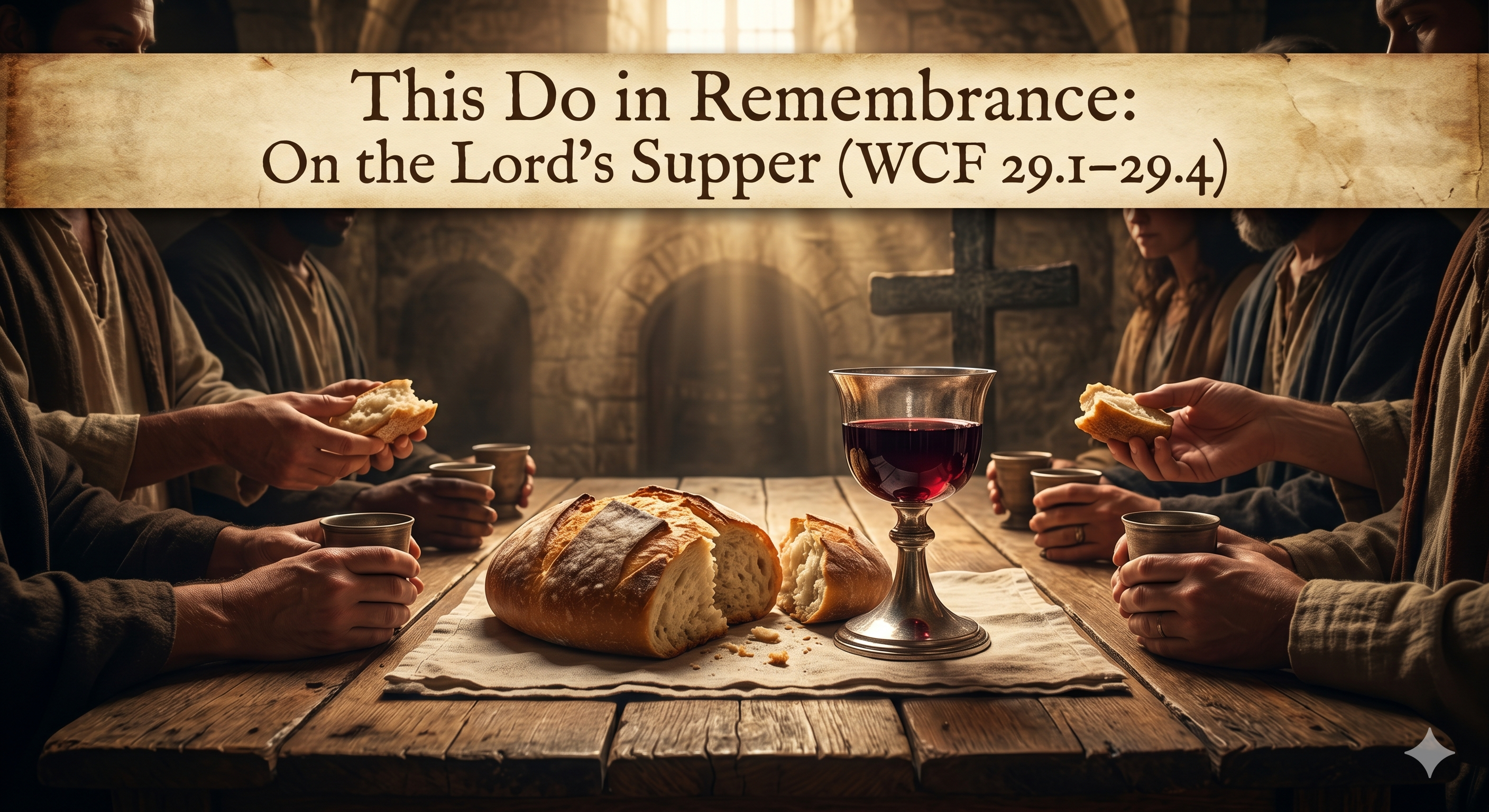
If you were to walk into many modern evangelical churches on a Sunday morning, you might find the Lord’s Supper treated as an afterthought—a tiny cracker and a plastic cup of juice quickly consumed while a soft worship song plays in the background, primarily serving as a private moment for individuals to close their eyes and think about Jesus.
For the Westminster divines, however, the Lord’s Supper was no mere afterthought, nor was it a private, individualistic meditation. It was the crowning jewel of corporate Christian worship, a profound spiritual feast, and a battleground for the very heart of the Gospel.
The Confession teaches that the Lord’s Supper was instituted by Christ for the perpetual remembrance of His sacrifice, the spiritual nourishment of His people, and a bond of their communion; that it is a commemoration of praise rather than a repeating sacrifice for sins; that it must be administered by lawful ministers to a gathered congregation; and that medieval corruptions such as the Catholic Mass, private communion, and the worship of the elements must be fiercely rejected.
The Purpose of the Feast (WCF 29.1)
“On the night wherein He was betrayed,” Jesus did not leave His disciples with a philosophical lecture; He left them with a meal. The Confession outlines five distinct purposes for this ongoing sacrament:
- Perpetual Remembrance: We partake to remember “the sacrifice of Himself in His death.” This is not merely mental recall (like remembering a historical fact), but a covenantal remembrance where we actively bring to mind the bloody price of our redemption.
- Sealing of Benefits: As we established in Chapter 27, this physical act visibly stamps and guarantees the promises of the Gospel upon the hearts of “true believers.”
- Spiritual Nourishment: The Supper is not an empty symbol; it is actual food for the soul. Believers experience “spiritual nourishment and growth in Him.”
- Engagement to Duty: Just as a soldier renews his oath, coming to the Table is a “further engagement in and to all duties which they owe unto Him.” We are publicly recommitting ourselves to our King.
- A Bond of Communion: The Supper is intensely corporate. It is a pledge of our communion “with Him, and with each other, as members of His mystical body.” You cannot be right with God while harboring bitter, unrepentant hatred toward the brother sitting next to you at the Table.
A Commemoration, Not a Sacrifice (WCF 29.2)
If paragraph 1 establishes what the Supper is, paragraph 2 establishes what it is not. Here, the divines level a devastating theological critique against the Roman Catholic doctrine of the Mass.
Rome teaches that during the Mass, the priest offers Jesus Christ up to the Father as a “real sacrifice” to make atonement for the sins of the living (“the quick”) and those currently suffering in purgatory (“the dead”).
The Confession violently rejects this: “Christ is not offered up to His Father; nor any real sacrifice made at all.” Why? Because the book of Hebrews explicitly teaches that Christ offered Himself “once for all” (Heb. 10:10). To claim that Jesus must be continually sacrificed on an altar every Sunday is to declare that His bloody death on the cross was insufficient. Therefore, the divines conclude that the popish Mass is “most abominably injurious to Christ’s one, only sacrifice.”
If there is any “sacrifice” happening at the Lord’s Supper, it is only a “spiritual oblation of all possible praise unto God.” (The Greek word eucharistia simply means “thanksgiving”). We are not offering Christ to God for our sins; we are offering our praise to God for Christ.
The Anatomy of the Table (WCF 29.3)
How exactly is this ordinance to be conducted? The Confession gives a precise, biblical order of operations for the minister:
- Declare the Word of Institution: Reading Christ’s command (e.g., 1 Cor. 11:23-26).
- Pray and Bless the Elements: This is crucial. The prayer does not physically transform the molecules of the bread and wine, but it does “set them apart from a common to an holy use.”
- Take, Break, and Give: The minister breaks the bread and gives the elements to the communicants, partaking himself as well.
Furthermore, the Confession adds a vital boundary: the elements are to be given “to none who are not then present in the congregation.” Because the Supper is fundamentally a “bond and pledge of their communion… with each other,” it cannot be taken alone.
Guarding the Elements (WCF 29.4)
Because the medieval church had so deeply fundamentally misunderstood the nature of the Supper, they invented a host of unbiblical, superstitious practices surrounding the physical bread and wine. The Confession systematically rejects them all as “contrary to the nature of this sacrament”:
- Private Masses: A priest taking communion by himself, or a lone individual taking it without the gathered body, destroys the corporate nature of the sacrament.
- Denial of the Cup to the People: For centuries, Rome only allowed the priest to drink the wine, fearing the common people might spill the “literal blood” of Christ. The Confession rejects this, noting that Jesus commanded, “Drink of it, all of you” (Matt. 26:27).
- Worshipping the Elements: Because Rome believed the bread literally became God (Transubstantiation), they would elevate the host to be worshipped, and parade it through the streets for adoration. The Reformed recognize this as literal idolatry—bowing down to a piece of baked dough.
- Reserving the Elements: Storing the “consecrated” bread in a box (a tabernacle) for religious use or magical protection. The bread is meant to be eaten, not hoarded or worshipped.
Conclusion
The Lord’s Supper is a spectacular gift to a weary church. By stripping away centuries of medieval superstition, the Reformed tradition recovered the true glory of the Table. We do not approach the front of the church to perform a magic ritual or to offer a sacrifice for our own sins. We come with empty hands to a family table, where our Father feeds us with the memory, the promises, and the spiritual reality of His Son’s once-for-all sacrifice.
Key Terms
- Commemoration: A memorial act of actively remembering and celebrating a past event. The Lord’s Supper commemorates Christ’s death; it does not repeat it.
- Spiritual Oblation: A sacrifice of praise and thanksgiving offered to God, as opposed to a propitiatory sacrifice for sin.
- The Mass: The Roman Catholic service of the Eucharist, which teaches that Christ is truly and literally offered as a propitiatory sacrifice for the sins of the living and the dead.
- Elements: The physical bread and wine used in the sacrament. When blessed, they are set apart from common use to holy use.
- Communion Under One Kind: The rejected Roman Catholic practice of giving the congregation only the bread while withholding the cup (wine).