Loved ones, when you put two master manipulators in the same tent, conflict is inevitable. For fourteen long years, Jacob the Supplanter has been living under the thumb of an even greater deceiver: his uncle, Laban.
Jacob has fulfilled his contractual obligations for his wives. He is older, he has a large family, and he is ready to return to the land of promise. But leaving Laban’s estate proves to be incredibly difficult. What follows in the second half of Genesis 30 is a fascinating, high-stakes battle of wits. It features a seemingly foolish contract, a blatant act of theft, and some very unusual ancient farming practices involving peeled sticks.
Yet, if we read this story carefully, and allow the rest of Scripture to interpret it, we discover that the true source of prosperity in this chapter is not Jacob’s methods or human ingenuity. The hero is the sovereign God of the covenant, who overrides human treachery and blesses His children according to His unbreakable promises.
Genesis 30:25-43 records Jacob’s request to return home, his unusual negotiation with Laban over the flocks, Laban’s immediate treachery, and God’s miraculous multiplication of Jacob’s wealth.
Verses 25–30
25 As soon as Rachel had borne Joseph, Jacob said to Laban, “Send me away, that I may go to my own home and country. 26 Give me my wives and my children for whom I have served you, that I may go, for you know the service that I have given you.” 27 But Laban said to him, “If I have found favor in your sight, I have learned by divination that the Lord has blessed me because of you. 28 Name your wages, and I will give it.” 29 Jacob said to him, “You yourself know how I have served you, and how your livestock has fared with me. 30 For you had little before I came, and it has increased abundantly, and the Lord has blessed you wherever I turned. But now when shall I provide for my own household also?”
The Undeniable Blessing
With the birth of Joseph, Jacob’s fourteen years of indentured servitude for Leah and Rachel are finally complete. He rightfully requests to take his family and return to his “own home and country” in Canaan.
Laban immediately panics. He has grown tremendously wealthy off the free labor of his nephew. Laban makes a striking confession: “I have learned by divination that the LORD has blessed me because of you.”
The Hebrew verb translated here as “learned by divination” (nachash) can refer to seeking omens or practicing divination, but it can also simply mean to observe diligently, perceive, or learn by experience. Whether Laban reached this conclusion through local superstitious customs or simply through observant experience over the past fourteen years, the core point remains: even Laban acknowledges that Yahweh, the God of Jacob, is the true source of this booming estate.
Laban offers Jacob a blank check: “Name your wages.” But Jacob points out the painful reality. He has made Laban exceptionally rich, but after fourteen years of grueling labor, Jacob is penniless. He asks a deeply valid question: “But now when shall I provide for my own household also?”
Verses 31–36
31 He said, “What shall I give you?” Jacob said, “You shall not give me anything. If you will do this for me, I will again pasture your flock and keep it: 32 let me pass through all your flock today, removing from it every speckled and spotted sheep and every black lamb, and the spotted and speckled among the goats, and they shall be my wages. 33 So my honesty will answer for me later, when you come to look into my wages with you. Every one that is not speckled and spotted among the goats and black among the lambs, if found with me, shall be counted stolen.” 34 Laban said, “Good! Let it be as you have said.” 35 But that day Laban removed the male goats that were striped and spotted, and all the female goats that were speckled and spotted, every one that had white on it, and every lamb that was black, and put them in the charge of his sons. 36 And he set a distance of three days’ journey between himself and Jacob, and Jacob pastured the rest of Laban’s flock.
The Foolish Contract and the Treacherous Uncle
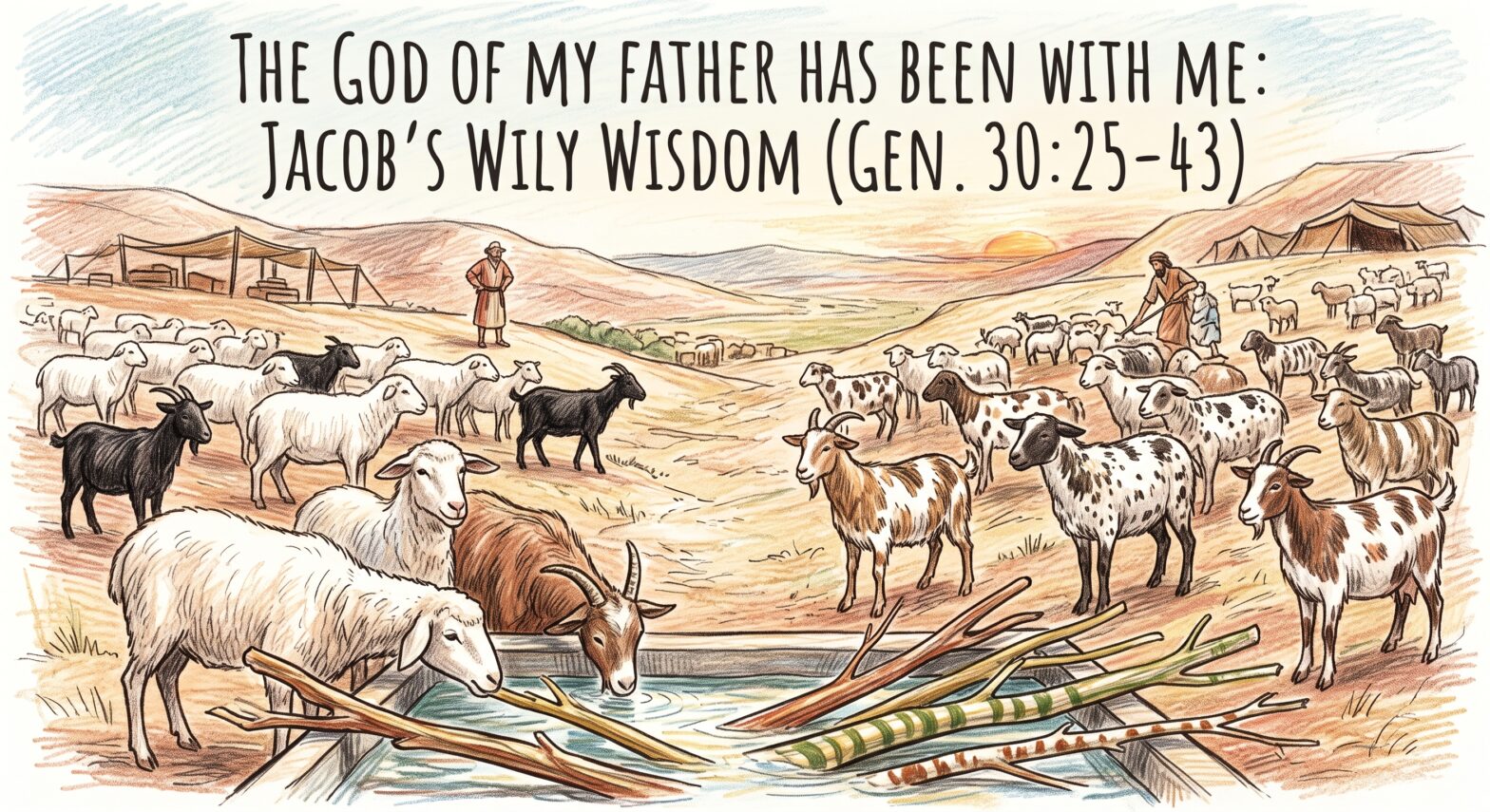
Jacob proposes a deal that sounds like terrible business for himself. In the ancient Near East, the vast majority of sheep were solid white, and the vast majority of goats were solid black or dark brown. Spotted, speckled, and striped animals were rare genetic anomalies. Jacob tells Laban to keep all the normal, solid-colored animals. Jacob will only take the rare, multi-colored animals as his wages moving forward.
This deal ensures complete honesty. If a solid white sheep ends up in Jacob’s pen, it is obviously stolen. Laban enthusiastically agrees: “Good! Let it be as you have said.”
But notice what Laban does that exact same day. Before Jacob can even go through the flocks to claim his starting wages, Laban secretly removes every single striped, spotted, and speckled animal from the flock! He gives them to his own sons and moves them a three-days’ journey away.
This is breathtaking treachery. Laban has robbed Jacob of the “seed” stock. He leaves Jacob with a flock of completely solid-colored animals, expecting him to somehow breed speckled offspring out of them. Humanly and genetically speaking, Jacob’s chances of success appear minimal. Laban believes he has secured Jacob as free labor for the rest of his life.
Verses 37–43
37 Then Jacob took fresh sticks of poplar and almond and plane trees, and peeled white streaks in them, exposing the white of the sticks. 38 He set the sticks that he had peeled in front of the flocks in the troughs, that is, the watering places, where the flocks came to drink. And since they bred when they came to drink, 39 the flocks bred in front of the sticks and so the flocks brought forth striped, speckled, and spotted. 40 And Jacob separated the lambs and set the faces of the flocks toward the striped and all the black in the flock of Laban. He put his own droves apart and did not put them with Laban’s flock. 41 Whenever the stronger of the flock were breeding, Jacob would lay the sticks in the troughs before the eyes of the flock, that they might breed among the sticks, 42 but for the feebler of the flock he would not lay them there. So the feebler would be Laban’s, and the stronger Jacob’s. 43 Thus the man increased greatly and had large flocks, female servants and male servants, and camels and donkeys.
Peeled Sticks and the Providence of God
Faced with a daunting situation, Jacob attempts to apply natural husbandry practices to increase his yields. He takes branches, peels the bark to make them look striped and spotted, and places them in the watering troughs where the animals breed. This technique reflected a widespread ancient understanding of biology, specifically, the belief that environmental factors or visual stimuli during mating could directly influence or alter the physical traits passed down to offspring. In essence, Jacob was attempting standard selective breeding according to the agricultural theories of his day.
And astoundingly… the flocks flourish! The solid-colored animals give birth to striped, speckled, and spotted young. Jacob strategically applies his methods only when the strongest, healthiest animals are breeding, ensuring his new flock is remarkably robust. Jacob rapidly becomes exceedingly wealthy.
But here is the vital theological question: Did the peeled sticks actually cause the genetic shift?
Modern genetics clarifies that visual stimuli during conception do not alter mammalian DNA. While Jacob likely believed he was simply employing standard agricultural techniques, Scripture later reveals the true cause behind the outcome. In Genesis 31:9-12, Jacob himself testifies to his wives: “Thus God has taken away the livestock of your father and given them to me.” Jacob then reveals that the Angel of God appeared to him in a dream, showing him that God was sovereignly controlling the genetics of the flocks in order to bring judgment upon Laban’s oppression.
While Jacob was acting on the natural husbandry theories of his era, God’s invisible, sovereign hand was orchestrating the genetic outcomes to fulfill the covenant promise He made to Jacob at Bethel: “I am with you and will keep you wherever you go.”
Conclusion
This passage is a beautiful reminder of the lengths to which God will go to protect and bless His people. Laban tried to exploit Jacob, change his wages, and literally steal his future. But no human treachery can thwart the promises of God. As Proverbs 21:30 declares, “No wisdom, no understanding, no counsel can avail against the LORD.”
We can also find profound comfort in this: God blessed Jacob despite the limitations of his knowledge and methods. Jacob was utilizing an imperfect theory of animal husbandry to build his flocks, but God looked past his natural limitations and honored the covenant.
Loved ones, how often do we do something similar? We work diligently, applying our best plans, strategies, and understandings to secure our households. Yet ultimately, our provision and inheritance are never secured merely by our own practical savvy. They are secured entirely by the grace of God. Just as God sustained Jacob out of sheer covenant grace, God has given us the infinite riches of Christ’s righteousness. We receive it simply because the God of the covenant is faithful.
Key Terms
- Divination (Nachash): The Hebrew term used in verse 27 can refer to practicing divination or seeking omens, but it can also be translated as “to learn by experience” or “diligently observe.” Whether Laban used superstitious practices or simply noted the practical evidence of Jacob’s presence, he was forced to acknowledge Yahweh’s hand in Jacob’s success.
- Speckled and Spotted: A natural genetic minority in ancient Near Eastern flocks, where sheep were predominantly solid white and goats were predominantly solid black or dark brown.
- Folk Husbandry (Prenatal Imprinting): An ancient understanding of breeding that assumed environmental factors or visual stimuli present during conception could alter or determine the inherited traits of offspring. Jacob used this as a natural breeding strategy based on the common theories of his culture.
- Providence: God’s sovereign, unseen orchestration of all events, including the biological reproduction of livestock, to accomplish His will, protect His people, and fulfill His promises.