As I have studied of historical theology, I have observed a tendency among modern Reformed men to view our confessional documents in a highly sanitized, academic light. We look at the leather-bound volumes on our shelves and subconsciously imagine that they were handed down from heaven, or at least drafted in comfortable, oak-paneled libraries by men who had nothing but time and tea at their disposal.
When we look at the Westminster Confession of Faith, that image is not entirely inaccurate; it was drafted in a relatively stable environment by men summoned by Parliament for careful, prolonged, and protected deliberation. But the Scots Confession of 1560 is an entirely different animal. It was written by men who had recently been hunted, imprisoned, and exiled. John Knox, the primary architect of the document, spent nineteen agonizing months as a French galley slave, chained to an oar under the whip of Catholic captors. When these men sat down to write, the smell of the stake and the sweat of the galleys still clung to their garments.
This dramatic difference in context immediately shapes the tone of the document. Before delving into the specific systematic articles of faith, the “Six Johns” (Knox, Winram, Spottiswoode, Willock, Douglas, and Row) penned a powerful Preamble. As a fellow learner navigating the complexities of our own cultural moment, I find this Preamble to be a masterclass in pastoral theology. It serves as a theological declaration of independence, a pastoral defense of their motives, and a solemn vow of fidelity to the Gospel of Jesus Christ.
The Preamble to the Scots Confession declares the Reformers’ long-standing desire to clarify their orthodox doctrine against slander, states their intention to comfort weak believers and silence blasphemers, commits to correcting any error proven by Scripture, and solemnly vows to suffer all worldly danger rather than deny Christ.
The Confession of Faith
Professed and believed by the Protestants within the realm of Scotland. Published by them in Parliament and by the estates thereof. Ratified and approved, as wholesome and sound doctrine grounded upon the infallible truth of God’s Word.
Matthew 24
And these glad tidings of the kingdom will be preached through the whole world for a witness unto all nations: And then will the end come.
The Estates of Scotland, with the inhabitants of the same, professing Christ Jesus, His holy gospel, to their natural countrymen and to all other realms and nations professing the same Lord Jesus with them, wish grace, mercy, and peace from God the Father of our Lord Jesus Christ, with the spirit of righteous judgment, for salvation.
Long have we thirsted, dear brethren, to have notified unto the world the sum of that doctrine which we profess and for which we have sustained infamy and danger. But such has been the rage of Satan against us and against Christ Jesus His eternal verity, lately borne among us that to this day no time has been granted unto us to clear our consciences, as most gladly we would have done. For how we have been tossed heretofore, the most part of Europe (as we suppose) does understand. But seeing that of the infinite goodness of our God (which never suffers His afflicted utterly to be confounded) above expectation, we have obtained some rest and liberty, [and] we could not but set forth this brief and plain confession of such doctrine as is propounded unto us, and as we believe and profess, partly for satisfaction of our brethren, whose hearts we doubt not have been and yet are wounded by the despiteful railing of such as yet have not learned to speak well: and partly for stopping the mouths of the impudent blasphemers, which boldly damn that which they have neither heard nor yet understood. Not that we judge that the cankered malice of such is able to be cured by this our simple confession. No, we know that the sweet savor of the gospel is and will be death to the sons of perdition. But we have chief respect to our weak and infirm brethren, to whom we would communicate the bottom of our hearts, lest they be troubled or carried away by [the] diversity of rumors which Satan spreads contrary to us, to the defacing of this our most godly enterprise. Protesting that if any man will note in this our confession any article or sentence repugnant to God’s holy Word, that it would please him, of his gentleness and for Christian charity’s sake, to admonish us of the same in writing. And we on our honor and fidelity do promise unto him satisfaction from the mouth of God (that is, from His Holy Scriptures) or else reformation of that which he will prove to be amiss. For God we take to record in our conscience, that from our hearts we abhor all sects of heresy and all teachers of erroneous doctrine, and that with all humility we embrace the purity of Christ’s gospel, which is the only food of our souls—and, therefore, so precious unto us, that we are determined to suffer the extremity of worldly danger, rather than that we will suffer our selves to be defrauded of the same. For hereof we are most certainly persuaded, that whosoever denies Christ Jesus or is ashamed of Him in the presence of men, will be denied before the Father, and before His holy angels. And, therefore, by the assistance of the mighty Spirit of the same our Lord Jesus, we firmly purpose to abide to the end in the confession of this our faith, as by the following articles.
The Crucible of the Scottish Reformation
To understand the theology of the Preamble, we must first understand the intense historical pressure cooker in which it was forged. The Scottish Reformation arrived late and was bathed in blood.
Thirsting in the Midst of Rage
The Preamble opens with a striking, visceral admission: the Reformers had “long thirsted” to publish a summary of their doctrine, but the “rage of Satan” and the intense persecution they suffered prevented them from doing so until now. They openly acknowledge the “infamy and danger” they had sustained under Catholic rule for decades.
This was not hyperbole. From the burning of Patrick Hamilton in 1528 to the martyrdom of George Wishart in 1546, identifying as a Protestant in Scotland meant placing your life in immediate, physical jeopardy.
The House of Guise and the successive Catholic queens named Mary maintained a suffocating hegemony over the realm, utilizing the sword of the state to enforce the dogmas of Rome. For years, the Scottish Protestants were a persecuted underground church, lacking the political and social bandwidth to formally publish a comprehensive systematic theology. They were too busy trying to survive.
The Providence of Rest and Liberty
Yet, the Reformers attribute their survival not to their own political cunning or physical strength, but to the sovereign preservation of God. They write of the “infinite goodness of our God (which never suffers His afflicted utterly to be confounded).”
The geopolitical landscape shifted violently and providentially in early 1560. Following the Treaty of Berwick and the timely death of the Queen Regent, Mary of Guise, the English fleet secured the Firth of Forth, breaking French Catholic dominance. Suddenly, the Protestant Lords of the Congregation found themselves in power. Having finally obtained “some rest and liberty” above all their expectations, they seized the providential moment. In a blistering four days, the six ministers drafted the Confession to clear their consciences and formally present their orthodox faith to the world and to Parliament.
A Tale of Two Audiences
Why write a confession at all? In the modern era, we often view confessions merely as boundary markers for church membership or ordination exams. But the Reformers outline two primary, deeply relational audiences for this document… one polemical, and the other profoundly pastoral.
Stopping the Mouths of Blasphemers
First, the Confession was written for a polemical and apologetic purpose: “Stopping the mouths of impudent blasphemers.”
For decades, the Roman Catholic establishment had spread vicious, bad-faith rumors about the Protestant movement. They accused the Reformers of being anarchists, heretics, and schismatics, condemning their doctrines without even granting them a fair hearing. The Confession served as a public, systematic defense against this “despiteful railing.”
However, we must note the profound theological realism of the authors. They explicitly state that they do not expect this document to cure the “cankered malice” of their hardened enemies. They possessed a robust doctrine of reprobation, recognizing that “the sweet savor of the gospel is and will be death to the sons of perdition” (2 Corinthians 2:15-16). They were not naive optimists who believed that if they just formulated the perfect theological argument, the Pope would suddenly convert. They wrote the truth to vindicate the honor of Christ, knowing full well that haters of God would continue to hate the truth.
Chief Respect to Our Weak Brethren
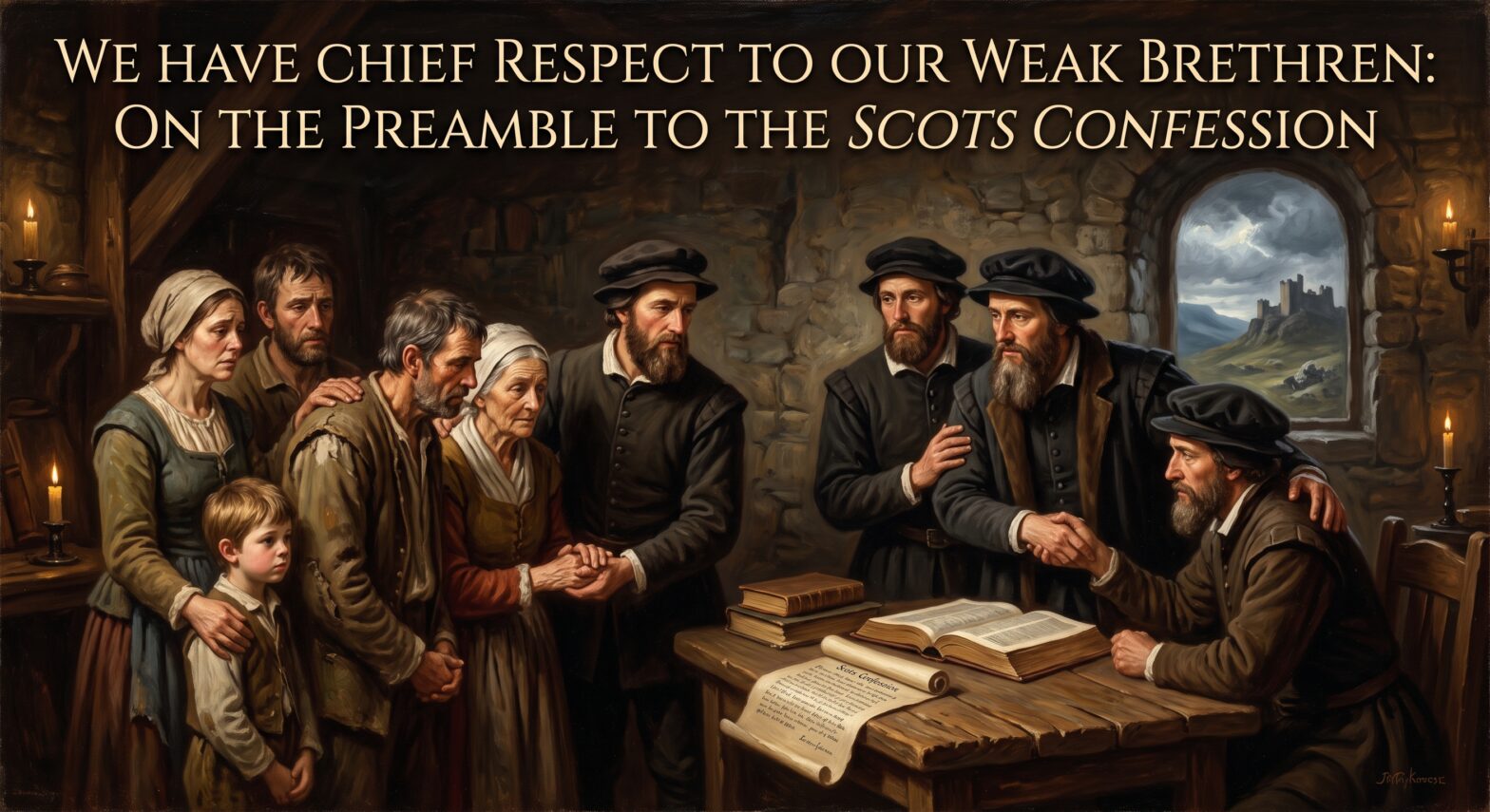
While the polemical defense was necessary, it was not their primary motivation. The true heartbeat of the Preamble is found in this magnificent phrase: “But we have chief respect to our weak and infirm brethren.”
Loved ones, we must pause and examine our own hearts here. In our current theological landscape, it is incredibly easy for young, zealous Reformed men to wield theology exclusively as a broadsword. We love the debate. We love the polemics. We love to crush the arguments of the “impudent blasphemers” on social media or in theological debates. But if our theology does not ultimately serve to comfort, bind up, and protect the weak sheep in our congregations, we have entirely missed the spirit of the Reformation.
The Scottish Reformers had survived the galleys and the fires, yet their primary concern was for the fragile believers whose hearts were wounded by Catholic slander and who might be “carried away by the diversity of rumors.” They wrote this robust theological document to “communicate the bottom of our hearts” to the weak, assuring the flock that their “most godly enterprise” was rooted entirely in the solid rock of God’s Word. True, rigorous systematic theology is never meant to puff up the strong; it is meant to anchor the weak.
The Epistemological Foundation: Sola Scriptura
In perhaps the most stunning and defining paragraph of the Preamble, the authors establish their epistemological foundation. They make a solemn promise to the reader, placing their own work firmly beneath the supreme authority of the Bible.
An Invitation to Correction
They issue an open invitation: “Protesting that if any man will note in this our confession any article or sentence repugnant to God’s holy Word, that it would please him, of his gentleness and for Christian charity’s sake, to admonish us of the same in writing.”
If someone can prove an error using Scripture, the Reformers vow, on their “honor and fidelity,” to provide either “satisfaction from the mouth of God (that is, from His Holy Scriptures) or else reformation of that which he will prove to be amiss.”
This is the very essence of the Protestant doctrine of Sola Scriptura. They are entirely rejecting the Roman Catholic paradigm of papal infallibility and unassailable church tradition. They recognize that, as fallible men, their theological formulations are subject to error. I have observed in some of our own Reformed circles a subtle, dangerous tendency to elevate our confessional documents almost to the level of Scripture itself, treating them as if they are beyond questioning. The authors of the Scots Confession would have abhorred such a view. They demanded that their Confession be tested, weighed, and corrected by the only infallible rule of faith: the Holy Scriptures.
The Purity of the Gospel as Soul Food
Why were they so rigorously committed to the Scriptures? Because they understood that “the purity of Christ’s gospel… is the only food of our souls.”
They declare that they “abhor all sects of heresy and all teachers of erroneous doctrine.” False teaching is not merely an academic misstep; it is spiritual poison. If the Gospel is the only food that can sustain the soul unto eternal life, then doctrinal purity is a matter of life and death. This is why we must engage in rigorous theological study, not to win trivia contests, but to ensure that the food we are feeding our families and our churches is pure, unadulterated, and capable of sustaining them in the evil day.
A Covenantal Vow unto Death
The Preamble concludes not with careful theological nuance, but with the terrifying, glorious resolve of martyrs. We must remember that the geopolitical rest they were experiencing in August 1560 was incredibly fragile. Mary Queen of Scots, a staunch and powerful Catholic, would soon return from France to claim her throne, bringing with her a renewed threat to the Protestant cause.
The Threat of Denial
Knowing that the political situation was volatile, the Reformers declare that the Gospel is so precious to them that they are determined to “suffer the extremity of worldly danger, rather than that we will suffer our selves to be defrauded of the same.”
They anchor this resolve in the chilling warning of Jesus Christ: “For hereof we are most certainly persuaded, that whosoever denies Christ Jesus or is ashamed of Him in the presence of men, will be denied before the Father, and before His holy angels” (Matthew 10:32-33).
This was not a theoretical Bible study for them. The men who wrote these words had friends who had been burned alive for refusing to attend the Catholic Mass. They understood that subscribing to this Confession might eventually cost them their property, their freedom, or their heads. They recognized that a theology that costs you nothing is ultimately worth nothing.
The Assistance of the Mighty Spirit
Yet, they did not rely on their own bravado or Scottish stubbornness to see them through the coming trials. The Preamble closes with a declaration of total dependence: “And, therefore, by the assistance of the mighty Spirit of the same our Lord Jesus, we firmly purpose to abide to the end in the confession of this our faith.”
They knew that human willpower shatters under the pressure of the rack and the flame. The only way any believer can abide in orthodox faith unto the end is through the ongoing, sustaining assistance of the Holy Spirit.
Conclusion
As we prepare to dive into the specific, systematic articles of the Scots Confession in the coming weeks, we must keep the tone and context of this Preamble at the forefront of our minds. The theology contained in the following chapters was not produced for casual debate over cigars and craft beer. It is a battle cry written by men who were fully prepared to bleed for every word they penned.
It challenges us to ask ourselves: Is our theology a mere hobby, or is it the very food of our souls? Are we using our doctrinal precision to bludgeon our enemies, or to tenderly care for our weak and infirm brethren? And most importantly, if the cultural winds shift and the cost of orthodoxy rises from social mockery to physical danger, are we relying on the mighty Spirit of Jesus to help us abide in the truth unto the end? We must learn from the courage of the Six Johns, submitting our minds to the Scriptures and our lives to the King.
Key Terms
- Polemical Theology: The branch of theology dedicated to the defense of orthodox doctrine and the systematic refutation of false teachings, heresies, and competing religious systems.
- Reprobation: The eternal, sovereign decree of God whereby He chooses to pass over certain individuals, leaving them to the just consequences of their sins, and ordaining them to dishonor and wrath for their sin, to the praise of His glorious justice. (Evident in the Confession’s reference to the “sons of perdition”).
- Sola Scriptura: The foundational Protestant principle that the Holy Scriptures of the Old and New Testaments are the sole infallible rule of faith and practice, and that all church councils, traditions, and confessions must be subordinate to and judged by the Word of God.
- Confessionalism: The conviction that the Christian faith is best summarized, guarded, and transmitted through the adoption of formal, systematic statements of belief (confessions) which, while subordinate to Scripture, act as binding standards for the church’s teaching and practice.