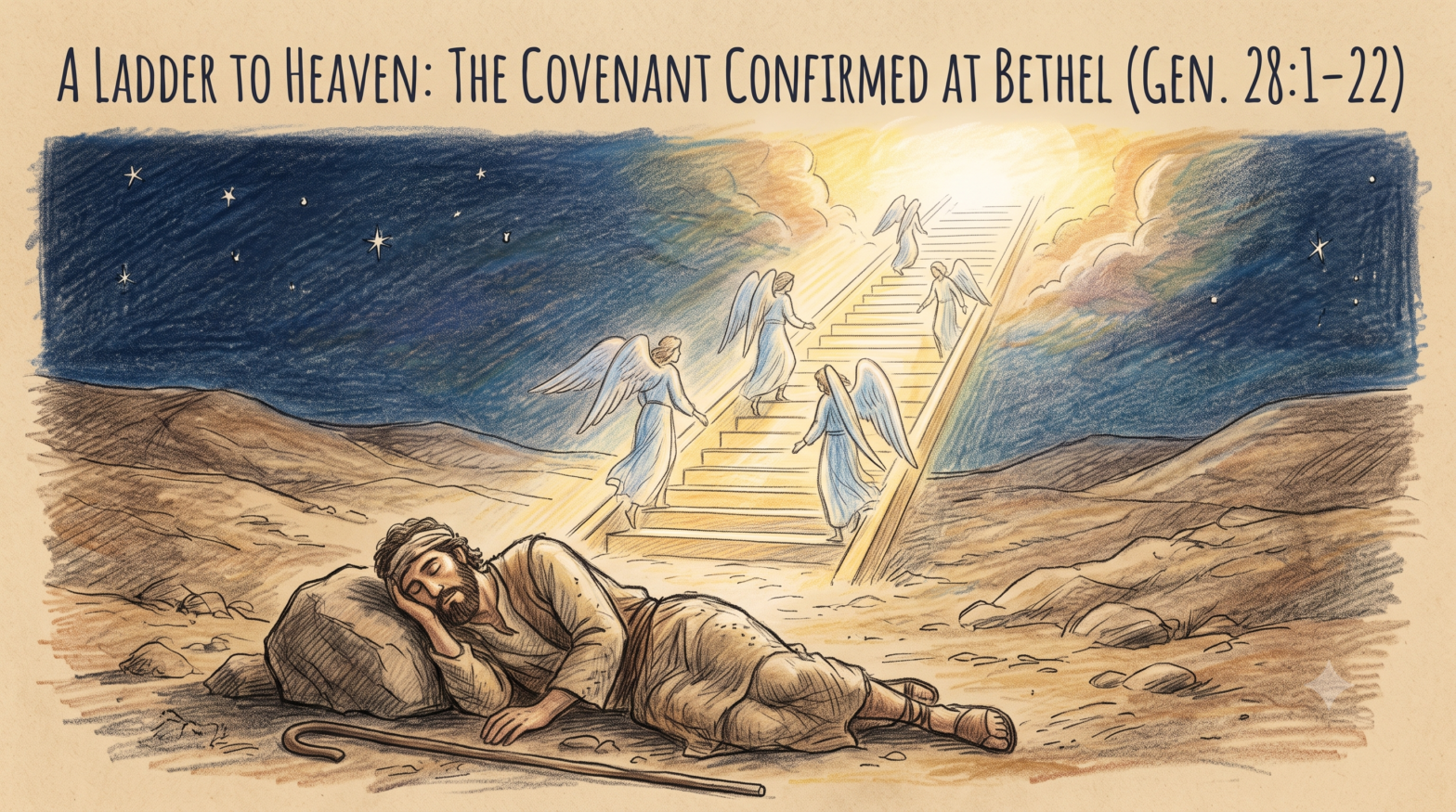
Loved ones, when we last saw Jacob, he was a deceitful son fleeing for his life. Having stolen his brother’s blessing, he shattered his family and was forced to leave behind the wealth, the comfort, and the mother he so dearly loved. As Genesis 28 opens, Jacob is a solitary fugitive. He has nothing but a staff in his hand and the clothes on his back.
If human logic dictated the story, we would expect God to abandon Jacob or severely punish him in the wilderness. But our God is a God of stunning, unmerited grace. When Jacob is at his absolute lowest, sleeping in the dirt with a stone for a pillow, heaven opens. God does not meet Jacob with a crushing rebuke; He meets him with a spectacular vision and an unconditional promise.
Genesis 28:1-22 records Isaac’s intentional blessing of Jacob, Esau’s fleshly attempt to win favor, God’s majestic revelation to Jacob through the dream of the ladder, and Jacob’s awe-struck worship at Bethel.
Verses 1–9
1 Then Isaac called Jacob and blessed him and directed him, “You must not take a wife from the Canaanite women. 2Arise, go to Paddan-aram to the house of Bethuel your mother’s father, and take as your wife from there one of the daughters of Laban your mother’s brother. 3 God Almighty bless you and make you fruitful and multiply you, that you may become a company of peoples. 4 May he give the blessing of Abraham to you and to your offspring with you, that you may take possession of the land of your sojournings that God gave to Abraham!” 5 Thus Isaac sent Jacob away. And he went to Paddan-aram, to Laban, the son of Bethuel the Aramean, the brother of Rebekah, Jacob’s and Esau’s mother. 6Now Esau saw that Isaac had blessed Jacob and sent him away to Paddan-aram to take a wife from there, and that as he blessed him he directed him, “You must not take a wife from the Canaanite women,” 7 and that Jacob had obeyed his father and his mother and gone to Paddan-aram. 8 So when Esau saw that the Canaanite women did not please Isaac his father, 9 Esau went to Ishmael and took as his wife, besides the wives he had, Mahalath the daughter of Ishmael, Abraham’s son, the sister of Nebaioth.
The Abrahamic Blessing
Before Jacob flees, something vital happens. In chapter 27, Isaac blessed Jacob by mistake, giving him a blessing of agricultural wealth and political supremacy. But here in chapter 28, Isaac blesses Jacob intentionally, and he gives him something far greater: “the blessing of Abraham.”
Isaac’s spiritual eyes are now wide open. He invokes the name El Shaddai (God Almighty) and officially passes the baton of the covenant, the promise of multiplication, the land, and the holy seed, to Jacob. He also commands Jacob not to marry a Canaanite, ensuring the spiritual purity of the line, just as Abraham had done for him.
Meanwhile, Esau observes this and realizes his Hittite wives displease his parents. In a tragic, misguided attempt to win back his father’s favor, Esau goes and marries a daughter of Ishmael. Esau is still acting in the flesh. He thinks he can fix a spiritual problem (profaning the covenant) with a pragmatic, religious-looking compromise. But marrying into another rejected line does not bring him into the promise.
Verses 10–15
10 Jacob left Beersheba and went toward Haran. 11 And he came to a certain place and stayed there that night, because the sun had set. Taking one of the stones of the place, he put it under his head and lay down in that place to sleep. 12 And he dreamed, and behold, there was a ladder set up on the earth, and the top of it reached to heaven. And behold, the angels of God were ascending and descending on it! 13 And behold, the Lord stood above it and said, “I am the Lord, the God of Abraham your father and the God of Isaac. The land on which you lie I will give to you and to your offspring. 14 Your offspring shall be like the dust of the earth, and you shall spread abroad to the west and to the east and to the north and to the south, and in you and your offspring shall all the families of the earth be blessed. 15 Behold, I am with you and will keep you wherever you go, and will bring you back to this land. For I will not leave you until I have done what I have promised you.”
The Ladder and the Lord
Jacob travels about 50 miles north of Beersheba and stops for the night. He is isolated, vulnerable, and using a rock for a pillow.
In the ancient Near East, people built massive, stepped towers called ziggurats to try and reach the gods. Humanity is always trying to build ladders to heaven through religion, morality, or achievement. But as Jacob sleeps, God shows him the true reality: the ladder is not built from earth to heaven; it is let down from heaven to earth.
God reveals a stairway bridging the chasm between the divine and the human, with angels acting as ministering messengers. Most importantly, “the LORD stood above it” (or beside him, as the Hebrew can also be translated). God speaks directly to Jacob for the very first time.
What does God say? Does He demand an apology for the deception? Does He give Jacob a list of rules to earn His favor? No. He gives him pure grace. God officially establishes the Abrahamic covenant directly with Jacob.
Then, God adds a deeply personal promise tailored exactly to the terrified fugitive’s needs: “I am with you and will keep you wherever you go, and will bring you back… I will not leave you.” God promises His presence, His protection, and His preservation. Jacob the heel-grabber is now securely held by God.
Verses 16–22
16 Then Jacob awoke from his sleep and said, “Surely the Lord is in this place, and I did not know it.” 17 And he was afraid and said, “How awesome is this place! This is none other than the house of God, and this is the gate of heaven.” 18So early in the morning Jacob took the stone that he had put under his head and set it up for a pillar and poured oil on the top of it. 19 He called the name of that place Bethel, but the name of the city was Luz at the first. 20 Then Jacob made a vow, saying, “If God will be with me and will keep me in this way that I go, and will give me bread to eat and clothing to wear, 21 so that I come again to my father’s house in peace, then the Lord shall be my God, 22 and this stone, which I have set up for a pillar, shall be God’s house. And of all that you give me I will give a full tenth to you.”
The Vow at Bethel
Jacob wakes up trembling with holy fear. He realizes he is not alone in the wilderness; he has been sleeping in the very antechamber of heaven. He sets up his stone pillow as a memorial pillar, consecrates it with oil, and names the place Bethel, meaning “House of God.”
Then, Jacob makes a vow. If we read it closely, it sounds a bit like a business negotiation: “If God will be with me… then the LORD shall be my God.” Jacob’s faith is real, but it is still immature. He is still the bargainer, trying to set terms. But the beauty of this passage is that God accepts him where he is. God will spend the next twenty years refining Jacob’s faith until the “if” becomes a certainty.
Jacob also promises to give a “full tenth” (a tithe) of all God gives him. Like Abraham before him, Jacob recognizes that true worship involves honoring God with our material wealth.
Conclusion
The dream of the ladder is one of the most famous images in the Old Testament, but it was never meant to remain just a dream. It was a prophecy.
Centuries later, Jesus stood before Nathanael and said, “Truly, truly, I say to you, you will see heaven opened, and the angels of God ascending and descending on the Son of Man” (John 1:51). Jesus explicitly claims to be the ladder!
Because of our sin, we are like Jacob… fugitives in a barren world, separated from God. We cannot build a ladder tall enough to reach heaven by our own good works. So, God in His infinite grace let the ladder down to us. Jesus Christ is the bridge between heaven and earth. Through His incarnation, death, and resurrection, He has forever connected us to the Father. Through Christ, the glorious promise given to Jacob belongs to us: God is with us, He will keep us, and He will never leave us.
Key Terms
- El Shaddai: Translated “God Almighty.” A majestic name for God emphasizing His absolute, all-sufficient power to fulfill His covenant promises, regardless of human weakness or impossibility.
- The Ladder (Sullam): Often translated as “stairway” or “flight of steps” (similar to a ziggurat). It symbolizes unbroken access and mediation between heaven and earth, ultimately fulfilled in the person of Jesus Christ (John 1:51).
- Bethel: Meaning “House of God.” It becomes one of the most prominent, sacred geographical locations in Israel’s history, second only to Jerusalem in biblical significance.
- Pillar (Matsebah): A standing stone set up as a monument to memorialize a significant event, a divine encounter, or a solemn vow. Jacob consecrating it with oil marked it as holy.
- Tithe: A tenth part of one’s income or property. Jacob’s vow to give a tenth to God demonstrates that the principle of tithing existed long before the formal Mosaic Law was given.