We live in an age that is deeply allergic to precision. Modern public discourse, heavily shaped by the rapid, emotional landscape of social media, values the hot take over the disciplined thought. We communicate in slogans, judge systems by their aesthetic appeal, and mistake emotional intensity for theological depth. In the contemporary church, this manifests as a vague, sentimental approach to doctrine where clear definitions are often viewed with suspicion, as if arriving at absolute logical clarity is somehow antithetical to a vibrant, warm piety.
When young men discover the Reformed faith, they are often captivated by its robust intellectual architecture. Yet, we frequently fight our theological battles using the very weapons of the culture we critique. We enter into fierce online debates over massive doctrines… the extent of the atonement, the nature of the covenants, or the dynamics of justification… using imprecise language, sloppy definitions, and knee-jerk reactions. We throw around historical labels like weapons without mastering the fine-grained distinctions that those labels represent.
The result is a chaotic theological subculture that produces a great deal of heat but very little light.
To rescue our theological recovery from this reactionary sloppiness, we must recover the primary academic engine that gave the historic Reformed confessions their enduring, razor-sharp accuracy. We must look backward to a period of church history that the modern world has deeply misunderstood, slandered, and discarded: the era of Protestant Scholasticism.
True theological maturity and pastoral clarity require us to look past modern caricatures and reclaim the historic Protestant scholastic method, not as an icy, rationalistic philosophy, but as a disciplined, pedagogical tool of rigorous distinction, precise definition, and structural clarity designed to defend and apply the truths of Holy Scripture.
The Caricature vs. The Reality of Scholasticism
Before we can employ the scholastic method, we must clear away centuries of historical revisionism. For the average Christian today, the word “scholastic” conjures up images of dusty, mediaeval monks locked away in ivory towers, wasting their lives debating absurd, speculative trivialities. Protestant Scholasticism is frequently caricatured as a tragic slide away from the warm, Christ-centered piety of the early Reformers (like Martin Luther and John Calvin) into a cold, Aristotelian rationalism that dryly intellectualized the gospel.
But this “decline thesis” has been thoroughly dismantled by modern historical scholarship. To understand the scholastic era, we must distinguish between theological content and academic method.
A Method of Teaching, Not a Philosophy
Scholasticism is not a system of philosophy or a set of specific doctrines. It is a method of academic instruction and organization. Derived from the Latin word scholasticus (meaning “pertaining to the school”), scholasticism was simply the formal academic method used in universities and seminaries to teach, test, and systematize data.
When the early Reformers died, the next generations faced a completely new historical challenge. Luther and Calvin had been prophetic, frontline reformers breaking down corrupted mediaeval structures. Their successors had to institutionalize those insights. They had to build seminaries, train pastors, defend the confessions against highly sophisticated Roman Catholic Counter-Reformation polemics, and ensure that the church’s teaching could be clearly transmitted to the next generation.
To do this, they adopted the scholastic method. It was a method characterized by structural order, the tracking of logical arguments, clear definitions, and the deployment of precise distinctions. The content was thoroughly biblical and confessional; the method was academic and precise. Far from killing the spirit of the Reformation, Protestant Scholasticism was the armor that preserved it.
The Anatomy of Precision: The Scholastic Toolkit
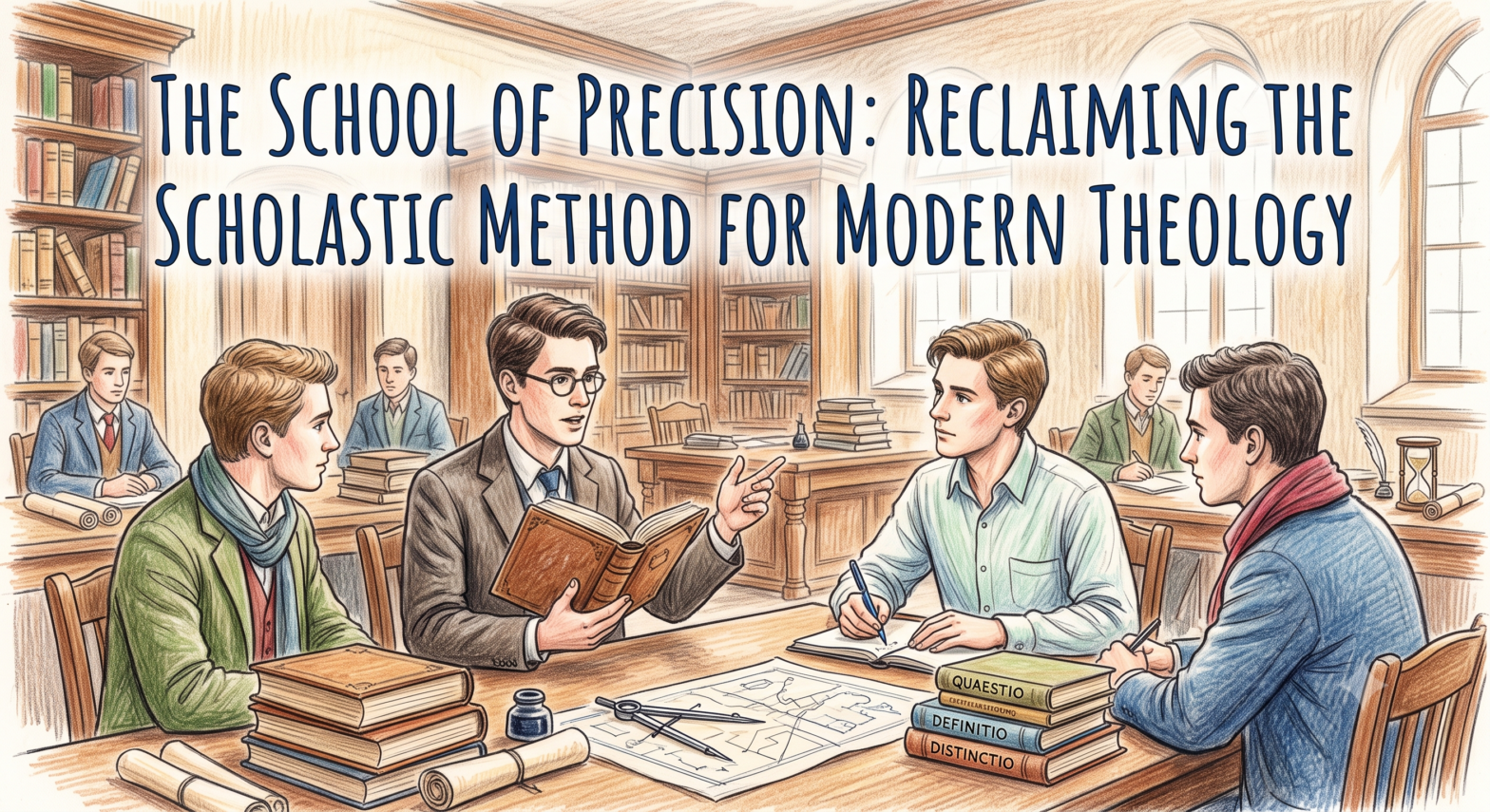
The scholastic method is built upon three foundational intellectual exercises that are desperately missing from modern theological discourse: the quaestio (the question), the definitio (the definition), and the distinctio (the distinction).
1. The Quaestio (The Question)
Scholastic learning did not begin with a monologue, but with a highly structured question or debate. The professor would state a thesis, outline the best possible arguments against it, present the scriptural evidence for it, and then systematically answer every single objection. This forced theologians to thoroughly understand their opponents’ views before trying to refute them. It prevented the construction of cheap strawmen.
2. The Definitio (The Definition)
In a scholastic debate, you were not allowed to use a term until you had explicitly defined its boundaries. If you were discussing “grace,” “justification,” or “faith,” you had to state exactly what the term included and what it excluded. This simple discipline instantly eliminates ninety percent of the semantic confusion that plagues modern theological discussions, where two parties often scream at each other for hours simply because they are using the same word to mean two completely different things.
3. The Distinctio (The Distinction)
This is the true crown jewel of the scholastic method. The scholastics recognized that truth is rarely found in blunt, undifferentiated assertions. To understand a deep reality, you must learn to make careful, logical distinctions.
When a scholastic theologian encountered a difficult theological problem, he did not launch a reactionary emotional attack. He calmly stated: “Distinguo” or “I distinguish.”
Consider how this tool functions in the classical Reformed defense of the gospel. When standard Roman Catholic polemicists argued that the Protestant doctrine of justification by faith alone (sola fide) naturally leads to lawless living (antinomianism), the Reformed scholastics did not panic. They used a distinction. They argued that while faith is entirely alone in the act of justification, it is never alone in the person justified; it is always accompanied by the fruit of sanctification. They distinguished between the ground of our right standing before God (Christ’s imputed righteousness) and the fruit of our union with Christ (evangelical good works).
Through these careful structural alignments, they protected the absolute freeness of grace while fiercely upholding the absolute necessity of holiness.
The Example: In Ratio vs. In Res
To demonstrate the staggering practical necessity of this scholastic precision, we can look ahead to a major distinction that will govern our upcoming articles in Theology Proper: the distinction between things existing in ratio (in our minds/reason) and things existing in res (in reality/the thing itself).
When we study the living God, we encounter a massive challenge. Scripture reveals that God possesses numerous, distinct attributes: He is loving, He is holy, He is just, He is sovereign, He is wise. To the flat, modern mind, these attributes look like separate parts that are added together to make up the divine being, as if God is a cosmic recipe composed of thirty-percent love, thirty-percent justice, and forty-percent power.
But classical orthodoxy rejects this mechanical view through the doctrine of divine simplicity (which teaches that God is not composed of parts; He is His essence). If God is simple and uncompounded, then His love is His justice, and His justice is His power. He is entirely and simply everything that He is.
How do we reconcile this with the fact that Scripture speaks of His love and justice as different things? The scholastics resolved this with perfect precision: they noted that the distinctions we make between God’s attributes exist in ratio (in our finite, conceptual minds as we process His multifaceted revelation) rather than in res (as separate, competing realities within the divine essence itself).
Without this technical scholastic tool, you will inevitably fall into one of two disastrous theological ditches: you will either slice God up into separate, competing parts (destroying His simplicity), or you will flatten His attributes entirely, erasing the genuine, biblical distinctions between His holy wrath and His merciful love. Precision is not an academic luxury; it is the ultimate guardian of orthodoxy.
The Pastoral Target: Reclaiming Precision for the Digital Age
Loved ones, let’s drop the academic shield and speak frankly. The recovery of historic Reformed theology is currently being severely hindered by an epidemic of intellectual sloppiness, particularly in online spaces.
It is incredibly easy to scroll through digital feeds, pick up a handful of technical slogans, and weaponize them to win arguments. We watch young men who have read a single popular-level book on covenant theology or divine sovereignty handle massive, holy mysteries with a shocking lack of care. They launch public, online attacks against other believers, tossing around devastating charges of “heresy,” “semi-Pelagianism,” or “antinomianism” because they lack the basic, disciplined theological training to recognize that the person they are attacking is simply using a different, valid historical distinction.
This is a dangerous form of pride. When we handle the holy things of God with sloppy minds and reactionary hearts, we are violating the third commandment; we are taking the name of the Lord our God in vain.
Reclaiming the scholastic method means repenting of this digital recklessness. It requires you to submit your intellect to a rigorous, painful discipline.
It means that before you attack an opponent’s view, you must force yourself to undergo the discipline of the quaestio, articulating their arguments so clearly and fairly that they would agree with your summary. It means that before you use a heavy theological term, you must have the humility to construct a clear, historical definitio. It means that when you are confronted with a difficult, multi-layered doctrine, you must restrain your emotional reactions and do the hard intellectual work of tracing out the necessary distinctio.
Precision is an act of deep, brotherly charity. When you take the time to define your terms and distinguish your concepts, you protect the peace of the church. You prevent useless, divisive linguistic controversies (2 Timothy 2:14). Precise theology does not stifle the heart; it anchors it. It ensures that the God we are passionately worshiping is the God who has actually revealed Himself in His Word, rather than a vague idol constructed out of our own emotional preferences.
Conclusion
The scholastic method is not a cold grave where piety goes to die. It is the architectural blueprint that keeps the temple of truth from collapsing.
As we bring our foundational Prolegomena section toward its climax and prepare to examine the ultimate principles of our knowledge… God as our source and Scripture as our standard… let us commit to doing so with scholastic precision. Let us lay aside the lazy, emotive habits of our digital age. Let us enter the school of precision, sharpening our minds so that we may accurately handle the word of truth (2 Timothy 2:15), and holding fast to that perfect, historic baseline: that the ultimate end of all intellectual distinction is the unclouded, passionate worship of the one true God.
Key Terms
- Protestant Scholasticism: An era of intense academic, confessional, and institutional development within Protestantism (ca. 1560–1725). It is characterized by the use of a rigorous, pedagogical method to clarify, systemize, and defend the doctrines of the Reformation confessions.
- Distinctio (Distinction): The scholastic tool of separating a concept or term into its component logical parts to resolve apparent contradictions, clarify meaning, and isolate specific truths. It operates on the principle that to distinguish is not to separate realities, but to clarify concepts.
- Definitio (Definition): The formal theological process of establishing the precise semantic and conceptual boundaries of a term, stating exactly what it includes and what it excludes.
- In Ratio: A Latin scholastic phrase meaning “in the mind” or “according to reason.” It refers to conceptual distinctions that exist within human intellect as it processes reality, rather than representing separate parts in the object being studied.
- In Res: A Latin scholastic phrase meaning “in the thing itself” or “in reality.” It refers to objective, ontological distinctions that exist as separate, physical, or metaphysical realities independent of human thought.