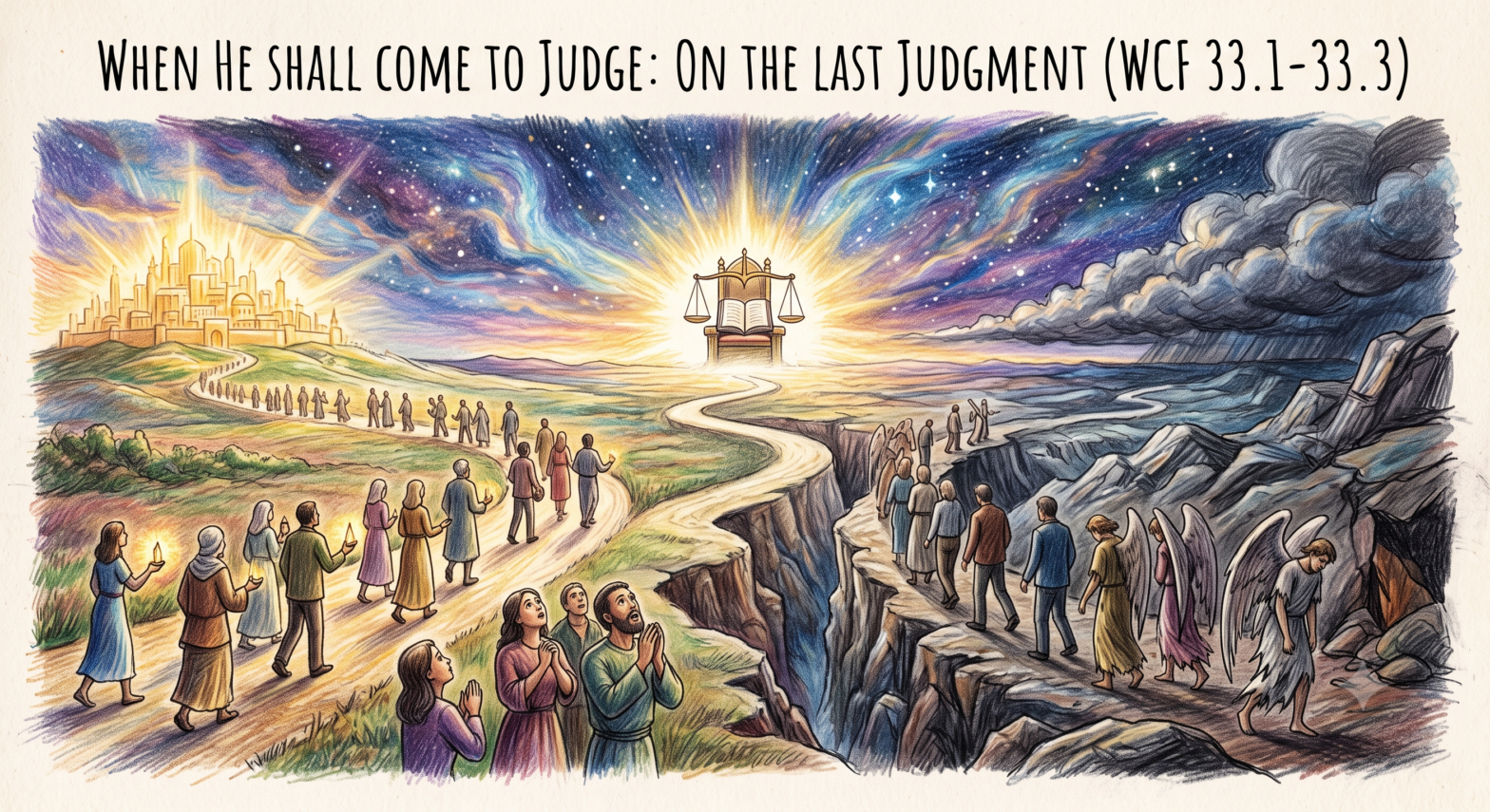
We have reached the majestic and solemn conclusion of the Westminster Confession of Faith. From the opening chapter on the necessity of Holy Scripture, through the eternal decrees of God, the fall of man, the covenant of grace, the work of Christ, and the establishment of His Church, all of human history is driving toward a single, unavoidable focal point.
The Christian worldview is not cyclical; it is profoundly linear. It has a definitive beginning in Genesis 1, and it has a definitive, physical conclusion. The Confession closes by fixing our eyes on the horizon, reminding us that the story of redemption ends with the public vindication of Jesus Christ and the final resolution of all things.
The Confession teaches that God has appointed a final day of judgment, overseen by Jesus Christ, wherein all angels and men will give an account of their lives; the purpose of this day is the public manifestation of God’s mercy and justice, leading to eternal joy for the elect and everlasting destruction for the wicked; and the timing is kept hidden to promote holy watchfulness.
The Appointed Day and the Sovereign Judge (WCF 33.1)
The world will not end by a random cosmic accident, a nuclear winter, or a slow fizzling out of energy. The Confession opens this chapter with a resounding declaration of divine sovereignty: “God hath appointed a day, wherein He will judge the world.”
Crucially, the Father has entrusted all power and judgment to the Son (John 5:22). The same Jesus who was mocked, beaten, and crucified by human tribunals will return as the Supreme Magistrate of the universe. Every knee that refused to bow in grace will be forced to bow in judgment.
This judgment will be absolutely comprehensive:
- The Scope: It includes not only all humans who have ever lived upon the earth, but also the “apostate angels” (demons).
- The Standard: It will not merely be a judgment of public actions. Men will give an account of their “thoughts, words, and deeds.” Every hidden motive, every whispered slander, and every secret act will be dragged into the blazing light of Christ’s tribunal (Eccl. 12:14).
The Purpose: The Manifestation of Glory (WCF 33.2)
A common theological question arises: If believers are already justified, and if the souls of the wicked are already in hell (as WCF 32 teaches), why is there a need for a final, public Day of Judgment? Is God going to re-evaluate His decisions?
The Confession clarifies that the Last Judgment is not a fact-finding mission. God does not need a trial to figure out who belongs to Him. Rather, the end of God appointing this day is for the “manifestation” of His glory. It is a public, physical, and cosmic vindication of His character before all creation.
God’s glory will be manifested in two distinct ways:
- The Glory of His Mercy: The eternal salvation of the elect will put the staggering grace of God on public display. The righteous will not survive the judgment because of their own perfection, but because they are clothed in the righteousness of Christ. They will receive the “fulness of joy and refreshing” in the physical presence of the Lord forever.
- The Glory of His Justice: The damnation of the reprobate will publicly vindicate God’s perfect holiness.
In this section, the Westminster divines utterly reject modern theological errors like Universalism (the idea that everyone will eventually be saved) and Annihilationism (the idea that the wicked simply cease to exist). Drawing on the explicit words of Jesus in Matthew 25:46, the Confession affirms that the wicked shall be cast into “eternal torments” and punished with “everlasting destruction.” It is a heavy, terrifying reality that must compel the Church to urgent evangelism.
The Pastoral Comfort of the Unknown Hour (WCF 33.3)
Why has God not given us the date of Christ’s return? Throughout history, misguided teachers have tried to crack biblical codes to predict the exact day of the rapture or the final judgment, despite Christ’s explicit warning that “concerning that day and hour no one knows” (Matt. 24:36).
The Confession explains that God has kept the timing a secret for a deeply pastoral reason. He wants us to be certain that the day is coming, but ignorant of exactly when it will arrive. This serves a twofold purpose:
- To Shake Off Carnal Security: If we knew Christ was returning in a hundred years, we would be tempted to live in spiritual apathy and unrepentant sin (“carnal security”), planning to repent at the last minute. Because He could return at any moment, we are forced to be “always watchful.”
- To Console the Godly: For the Christian suffering under unjust governments, cruel bosses, or violent persecution, the certainty of the Last Judgment is a profound comfort. It means the believer does not need to seek personal vengeance. We can entrust ourselves to the Judge of all the earth, knowing that every wrong will eventually be made right.
The Westminster Confession of Faith ends not with a cold, academic proposition, but with the fervent, beating heart of a bride longing for her bridegroom. It closes by placing the final words of the Book of Revelation onto the lips of every believer: Come, Lord Jesus, come quickly. Amen.
Key Terms
- The Last Judgment: The final, historical, and physical event at the end of the age wherein Jesus Christ will publicly judge all men and angels.
- Apostate Angels: Satan and the demons who rebelled against God, currently reserved for the final judgment.
- The Elect: Those whom God, by His grace, chose from eternity past to save and redeem through Jesus Christ, whose mercy will be publicly manifested on the Last Day.
- The Reprobate: Those who are passed over by God’s saving grace and left to the just consequences of their own willful sin and disobedience.
- Carnal Security: A false, fleshly sense of spiritual safety that leads to apathy, laziness, and unrepentant sin; the opposite of holy watchfulness.