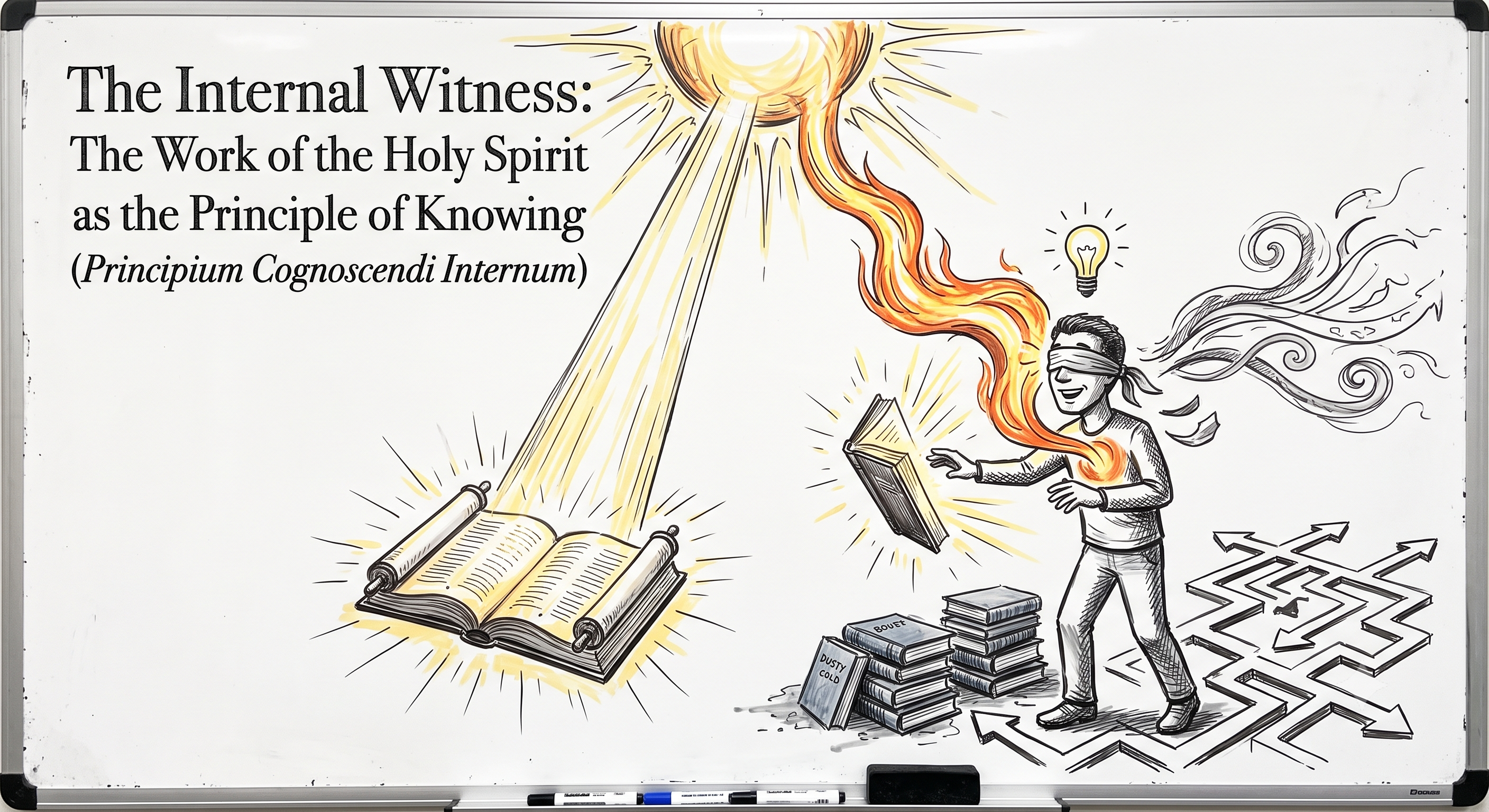
We can possess the most flawless, mathematically precise theological library in the world and remain completely dead in our sins. We can memorize the historic confessions, master the nuances of Latin terminology, construct airtight defenses of biblical inerrancy, and win every online debate we enter, while our hearts remain as cold and lifeless as marble statues.
In our previous studies, we established that God Himself is the uncreated foundation of all existence (Principium Essendi) and that Holy Scripture is the infallible, self-attesting external standard of divine truth (Principium Cognoscendi Externum). Yet a critical problem remains. If the divine Sun is shining brightly in the sky of Holy Scripture, but the eyes of our human hearts are utterly blind because of the noetic effects of the Fall, how can we ever come to truly know, trust, and love the living God?
An objective light outside of us is useless unless we possess an internal capacity to perceive it.
To complete the foundational triad of classical Reformed prolegomena, we must turn from the objective Word spoken by God to the subjective, supernatural work wrought within us: the work of the Holy Spirit through faith as the Principium Cognoscendi Internum… the Internal Principle of Knowing.
Because fallen human beings are spiritually blind and hostile to divine revelation, objective Holy Scripture can only produce true, saving faith and unshakeable spiritual certainty through the supernatural work of the Holy Spirit, who inwardly illuminates the intellect and persuades the heart through His internal witness (testimonium Spiritus Sancti internum).
Completing the Triad: The Architecture of Divine Knowledge
To understand why the internal work of the Spirit is strictly necessary, we must review the organic structure of the three foundational principles (principia) of Reformed dogmatics:
- Principium Essendi (The Essential Principle): God Himself, the ultimate, self-existent, ontological ground of all reality and truth.
- Principium Cognoscendi Externum (The External Principle of Knowing): Holy Scripture, the objective, written self-revelation through which God authoritatively speaks to creatures.
- Principium Cognoscendi Internum (The Internal Principle of Knowing): The internal work of the Holy Spirit applying truth through faith, the subjective, interior illumination by which the human soul receives, understands, and embraces divine truth.
Notice how these three principles fit together in divine harmony. At the sovereign apex stands the Principium Essendi… the Triune God who is the ultimate Source of all being and revelation. From Him flow two complementary streams of divine self-disclosure: the objective standard of Holy Scripture and the subjective work of the Holy Spirit. God is the sovereign Source who speaks; Scripture is the objective standard through which He speaks; and the supernatural work of the Holy Spirit is the internal illumination that opens our eyes to hear and believe what is spoken.
If we remove the Principium Essendi, our theology descends into human speculation. If we remove the Principium Cognoscendi Externum, our theology descends into subjective mysticism. And if we remove the Principium Cognoscendi Internum, our theology descends into dead, rationalistic intellectualism.
The Testimonium Spiritus Sancti Internum: How Certainty Is Born
How does a believer come to possess an unshakeable, personal conviction that the Bible is truly the Word of God? Is it through the authoritative decree of the church? Is it through the overwhelming force of historical evidence and logical arguments?
As we noted in our study of Scripture’s self-attestation (autopistia), external arguments and historical proofs can produce a high degree of human probability or intellectual agreement. But they can never produce saving faith or absolute divine certainty (fides divina).
True certainty is produced by the internal testimony of the Holy Spirit (testimonium Spiritus Sancti internum).
Because the Holy Spirit is the divine Author who inspired the Scriptures, His work alone possesses the supreme power to seal those Scriptures upon the human heart. As John Calvin famously wrote in his Institutes of the Christian Religion:
For as God alone is a fit witness of himself in his Word, so also the Word will not find acceptance in men’s hearts before it is sealed by the inward testimony of the Spirit. The same Spirit, therefore, who has spoken through the mouths of the prophets must penetrate into our hearts to persuade us that they faithfully proclaimed what had been divinely commanded.[1]
This internal witness is not a logical argument added to the text, nor is it a secondary voice whispering new facts into our ears. Rather, it is a work of supernatural illumination (illuminatio).
Just as a man born blind cannot appreciate the glory of a sunset no matter how brilliantly it is described to him until his eyes are opened, so the fallen sinner cannot perceive the divine beauty and authority of Holy Scripture until the Holy Spirit removes the veil from his heart (2 Corinthians 3:14–16, 4:4–6). When the Spirit performs this work, we do not see a new text; we see the divine glory that was inherently present in the written text all along.
This doctrine is beautifully summarized in the Westminster Confession of Faith:
our full persuasion and assurance of the infallible truth and divine authority thereof, is from the inward work of the Holy Spirit bearing witness by and with the Word in our hearts.[2]
Illumination vs. New Revelation: Guiding Between Two Ditches
To keep our feet firmly planted on the biblical path, we must carefully define what the Principium Cognoscendi Internum is and what it is not. Throughout church history, Satan has sought to corrupt this doctrine by driving believers into one of two deadly errors: Rationalism or Enthusiasm.
The Ditch of Cold Rationalism
Rationalism attempts to study Scripture purely as a historical document, relying on autonomous human intellect, logical mastery, or empirical investigation. In doing so, it bypasses the internal work of the Spirit entirely and relies solely on human reason. It treats the Bible as a textbook to be decoded through sheer brainpower, bypassing the necessity of prayer, spiritual regeneration, and the ongoing illumination of the Holy Spirit. Rationalism produces dry orthodoxy… a dead orthodoxy that can analyze the mechanics of grace without ever tasting the sweetness of the Savior.
The Ditch of Mystical Enthusiasm (Subjective Mysticism)
At the opposite extreme lies Enthusiasm (from the Greek entheos, meaning “god-within”). Enthusiasm separates the work of the Spirit from the written Word of God, effectively bypassing the sacred text. It encourages believers to hunt for ongoing, private revelations, intuitive impressions, or interior “voices of God” that operate independently of, or even contrary to, Holy Scripture.
Classical Reformed orthodoxy stands firmly between these two ditches by affirming Sola Scriptura with the Spirit. The internal work of the Holy Spirit is the Principium Cognoscendi Internum, and His work is strictly illuminative, not revelatory.
The Spirit does not give new content; He opens our minds to understand and receive the old content already given in the closed canon of Holy Scripture. The Spirit works cum et sub verbo, with and under the Word. As Francis Turretin asserted, the Word and the Spirit are joined together by an indissoluble bond: the Word is the objective instrument, and the internal operation of the Spirit is the efficient cause.[3]
To seek the Spirit apart from the Word is to invite fanatical delusion; to read the Word apart from the internal work of the Spirit is to remain locked in spiritual death.
Resting in the Spirit-Illuminated Word
Loved ones, let us bring this foundational triad to bear upon the quiet, personal struggles of our Christian walk.
How often do you find yourself trapped in spiritual anxiety, agonizing over the state of your soul? You read your Bible, but it feels like dry bronze. You attend public worship, but your heart feels heavy and distracted. You wonder why you cannot manufacture the emotional intensity or pristine certainty that you see in others.
When this spiritual dryness comes, the temptation of our age is to do one of two destructive things: either we double down on frantic intellectualism (buying more books, debating more doctrines online, trying to think our way into assurance), or we plunge into subjective emotionalism (hunting for a spiritual experience, a fresh sign, or a mystical feeling to prove God is real).
Both approaches are broken because both look inward to the self rather than outward to God through His Spirit-illuminated Word.
Recognizing the internal work of the Holy Spirit as your Principium Cognoscendi Internum brings profound spiritual rest.
It reminds you that genuine faith is not an achievement of your intelligence, nor is it a manufactured emotional state. Faith is a sovereign gift wrought through the work of the Holy Spirit (Ephesians 2:8–9). You cannot force the Sun to shine, but you can stand in its light.
When you sit down to read Scripture, lay aside your intellectual pride and your anxious striving. Approach the Bible with the docility of a child and the desperate prayer of the Psalmist: “Open my eyes, that I may behold wondrous things out of your law” (Psalm 119:18).
Trust that the same Spirit who spoke through prophets and apostles is faithfully at work within you… softening your heart, illuminating your mind, and sealing the promises of Jesus Christ upon your conscience. Your certainty does not rest on the strength of your own intellect, but on the unshakeable witness of the Spirit speaking in the Word.
Standing at the Threshold
With this study of the work of the Holy Spirit, we bring our foundational section on Prolegomena to its glorious completion.
Look back at the terrain we have crossed together:
- We learned that theology is taught by God (Theologia a Deo docetur), teaches of God (Deum docet), and leads back to God (Ad Deum ducit).
- We stood before the infinite gulf of the Creator-Creature Distinction and recognized our limits under the noetic effects of the Fall.
- We anchored our labor in the local church as Church Dogmatics, committing ourselves to the scholastic discipline of precision, definitions, and distinctions.
- And we mapped out the three unshakeable foundations of our faith: God Himself as our essential source (Principium Essendi), Holy Scripture as our external standard (Principium Cognoscendi Externum), and the internal work of the Holy Spirit as our guide (Principium Cognoscendi Internum).
We have laid the foundation. We have built the scaffolding. We have sharpened our tools.
Now, with humble minds, illuminated hearts, and bowed knees, we are finally prepared to cross the threshold out of Prolegomena and step into the holy of holies of systematic theology: Theology Proper, the Doctrine of God Himself.
May the Triune God, Father, Son, and Holy Spirit, grant us His grace as we gaze upon His uncreated majesty, giving Him all the glory, honor, and praise forever and ever. Amen.
Key Terms
- Principium Cognoscendi Internum (Internal Principle of Knowing): The subjective, internal foundation of theological knowledge, consisting of the supernatural work of the Holy Spirit, specifically His illumination and internal testimony, operating through faith to enable human minds to receive and embrace God’s Word.
- Testimonium Spiritus Sancti Internum (Internal Testimony of the Holy Spirit): The doctrine that the Holy Spirit inwardly persuades and assures the believer’s heart of the divine authority and truth of Holy Scripture.
- Illuminatio (Illumination): The supernatural work of the Holy Spirit by which He enlightens the darkness of the fallen human intellect, enabling a person to understand, appreciate, and spiritually discern the truth already revealed in Scripture.
- Cum et Sub Verbo (With and Under the Word): The classical Reformed axiom affirming that the Holy Spirit operates in inseparable connection with Holy Scripture, working through the written text rather than through extra-biblical revelations.
- Enthusiasm / Fanaticism: The historical-theological error that separates the Holy Spirit from the written Word, claiming direct, ongoing, private divine revelations or spiritual guidance independent of Holy Scripture.
[1] John Calvin, Institutes of the Christian Religion, ed. John McNeill, trans. Ford Battles (Westminster John Knox Press, 2011), 1.7.4
[2] WCF 1.5
[3] Francis Turretin, Institutes of Elenctic Theology, ed. James Jr Dennison, trans. George Giger, vol. 1 (P&R Publishing, 1992), 2.6.5.
You da man Tony . Lean not to the right or the left
Great Job Tony