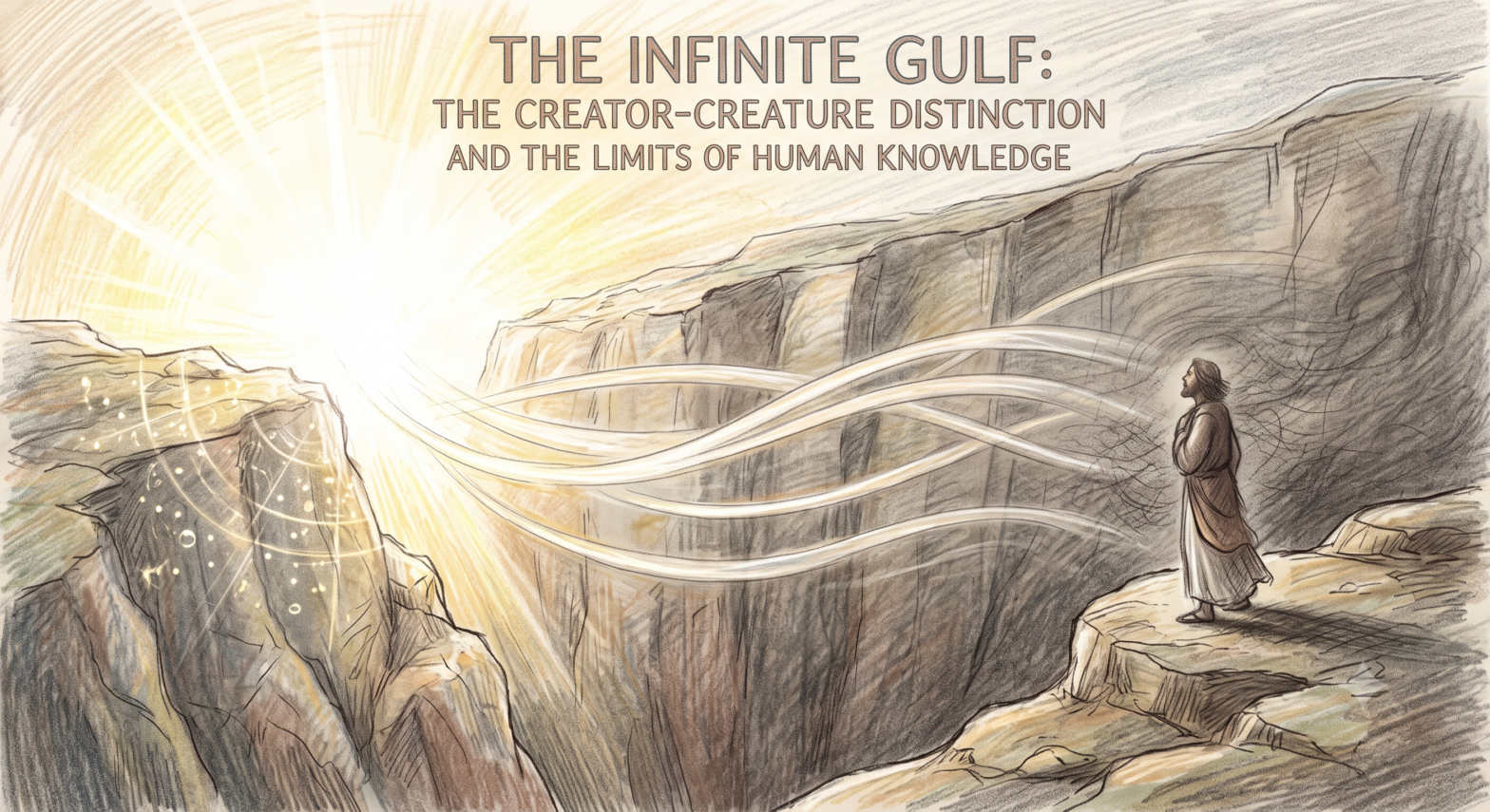
We live in an age that hates boundaries. Modern philosophy, secular psychology, and even much of contemporary Christian spirituality are deeply committed to flattening the cosmos. We are told that the divine is a force we can tap into, that the universe is an extension of our own consciousness, or that God is essentially a larger, smarter, more loving version of ourselves. This subtle heresy creeps into our theology whenever we assume that God’s thoughts are just like our thoughts, only slightly more advanced or comprehensive.
When intellectually ambitious men discover the Reformed faith, we often bring this flattening impulse with us without even realizing it. We treat the doctrines of grace, the covenant structures, and the decrees of God as if they are a giant, logical system that we can totally master and map out with mathematical precision. There is, perhaps, a supreme irony in the fact that our standard three-year seminary credential is literally called a Master of Divinity…as if the infinite, self-existent Creator of the cosmos could be mastered in ninety credit hours. We assume that if we can define a term or sketch a theological chart, we have captured the reality of who God is.
But the moment we think we have fully wrapped our minds around God, we have ceased to worship the God of the Bible.
To guard against this intellectual idolatry, we must begin our systematic exploration of Christian doctrine by establishing the absolute boundary of all reality. This is not a boundary between nations or even between different parts of creation, but the absolute ontological chasm that separates the Creator from the creature.
To think biblically and historically about the Christian faith, we must first bow before the infinite, insurmountable gulf that separates the self-existent Creator from His dependent, finite creation, a divide further complicated by our fallen cognitive faculties, recognizing that our theology can only ever be a mercifully accommodated, ectypal reflection of His own exhaustive self-knowledge.
The Ontological Divide: The Creator-Creature Distinction
At the very heart of classical Reformed theology lies the most foundational truth of existence: God is God, and you are not. There are not many kinds of existence in the universe; there are only two. There is uncreated existence, which belongs to God alone, and there is created existence, which belongs to everything else.
The False Divide: Material vs. Immaterial
For the modern mind, the universe is typically split along a horizontal axis: the material versus the immaterial, the physical versus the spiritual, the concrete versus the ethereal. We categorize things we can touch, measure, and verify in a laboratory as “real” or “secular,” while relegating the spiritual, the ethical, and the theoretical to the realm of the subjective, the emotional, or the ethereal. Even as Christians, we often unconsciously swallow this dualism, treating our physical, Monday-to-Saturday lives as somehow less holy or less theological than our spiritual, Sunday-morning devotions.
But this physical-spiritual dichotomy is entirely foreign to the biblical writers. In Holy Scripture, the primary, all-encompassing ontological line is not drawn between the physical and the spiritual, but between the Creator and the creature.
A rock, an atom, an archangel, and a human soul all sit on the exact same side of this ontological line: they are all equally creatures, utterly dependent on the self-existent Creator for their being. Conversely, God stands alone on the other side of the line.
Retrieving this biblical division solves many of the paralyzing dualisms we face as modern Christians and radically reorients how we view the world. No longer is the physical world a neutral, “secular” space devoid of theological meaning. The physical cosmos is the theater of God’s glory, created by Him and sustained by Him. When we recover the Creator-creature distinction, we realize that our bodily labor, our marriages, our scientific discoveries, and our artistic endeavors are not “lesser” or “unspiritual” activities; they are holy, creaturely actions performed in the presence of the Creator, to whom all things belong and for whom all things exist. There is God, and there is what God has created for His own glory.
Aseity vs. Dependence
The technical theological term for God’s self-existence is aseity (from the Latin a se, meaning “from Himself”). God does not derive His life, His power, His wisdom, or His goodness from anyone or anything else. He is entirely self-sufficient, self-existent, and independent (Psalm 50:10-12, Acts 17:24-25).
We, on the other hand, are characterized by absolute dependence. We did not bring ourselves into being, and we cannot sustain our own existence for a single millisecond. We are dependent upon Him for “life and breath and everything” (Acts 17:25).
This means that God and man do not exist on the same continuum. God is not simply at the top of the chain of being, possessing a million times, or even an infinite times, more existence than we do. Rather, His existence is of a completely different order. He is the infinite Source; we are the finite receivers.
The Necessity of Voluntary Condescension
Because this ontological gulf is infinite, there is no natural way for the finite mind to reach up and grasp the infinite God. As the Westminster Confession of Faith beautifully and precisely puts it:
The distance between God and the creature is so great, that although reasonable creatures do owe obedience unto Him as their Creator, yet they could never have any fruition of Him as their blessedness and reward, but by some voluntary condescension on God’s part, which He hath been pleased to express by way of covenant. (WCF 7.1)
If God does not cross the gulf through covenantal condescension, we remain locked in our finitude, completely unable to know Him. Our theology, therefore, is never an act of human discovery; it is always the result of divine self-disclosure. God must “lisp” or speak “baby-talk” to us, as John Calvin famously noted, adapting His infinite truth to our finite capacities.[1]
The Ultimate Crossing: The Paradox of the Incarnation
Yet, while voluntary covenantal condescension is the general way God bridges this infinite gulf to speak to us, there is a singular, history-dividing moment where He did not merely reach across the divide, but permanently bridged the two sides in personal union. This is the mystery of the incarnation of our Lord Jesus Christ.
In the person of the eternal Word made flesh, the Creator-creature distinction is both perfectly preserved and paradoxically spanned. Jesus Christ is not a hybrid, semi-divine entity—a pagan demigod who is fifty-percent Creator and fifty-percent creature. Rather, in the mystery of the hypostatic union, He is one undivided divine person possessing two distinct, unconfused natures. He stands as one who is simultaneously the almighty Creator according to His divine nature (qua divinity), and a dependent creature according to His human nature (qua humanity).
Consider the staggering weight of this reality, loved ones. The One who holds the oceans in the hollow of His hand (Isaiah 40:12) had to nurse at the breast of a young Jewish virgin. The One who is the self-existent Source of all life drew breath from an atmosphere He created, felt the weariness of creaturely limitations, and shed real, human blood on a Roman cross.
In Christ, the infinite qualitative difference between God and man is not obliterated; the divine and human natures remain distinct, without confusion, without change, without division, without separation. Yet, because the Son of God assumed a true human nature, He has bridged the ontological chasm in His own person. He stands as the ultimate point of contact for our theological knowledge. To know Jesus is to know the Father (John 14:9). In the face of Jesus Christ, the ectypal knowledge of the pilgrim meets the shining, archetypal light of the living God.
The Epistemological Gulf: Archetypal vs. Ectypal Theology
Because there is an ontological divide between God and man, there is also an epistemological divide. In other words, because God and man exist differently, they also know differently. To bring order to this reality, Reformed orthodox theologians utilized a distinction that is absolutely critical for anyone wanting to study systematic theology with intellectual humility: the distinction between theologia archetypa and theologia ectypa.
Archetypal Theology: God’s Self-Knowledge
Theologia archetypa (archetypal theology) is the infinite, perfect, and exhaustive knowledge that God has of Himself. Because God is infinite, only an infinite mind can fully comprehend Him (1 Corinthians 2:10-11). God’s knowledge of Himself has no limits, no progress, no shadow, and no analogy. It is the original, uncreated pattern of all truth.
Ectypal Theology: Our Accommodated Knowledge
Theologia ectypa (ectypal theology) is the finite, created, and accommodated copy of that knowledge which God graciously reveals to us. Just as an “ectype” in printing is a copy or an impression of an original “archetype,” so our theology is, or at least we hope it is, a faithful, finite copy of God’s infinite self-knowledge.
Ectypal theology is true, reliable, and entirely sufficient for our salvation and godliness. But it is not exhaustive. We do not know God the way God knows God. We know Him in a creaturely way, according to our finite capacity. As the great Dutch theologian Herman Bavinck wrote in his Reformed Dogmatics, because we are creatures, ” God’s self-consciousness is archetypal; our knowledge of God, drawn from his Word, is ectypal.”[2]
The Analogical Nature of Our Knowledge
This means that our knowledge of God is never univocal (meaning we know things in the exact same way God does) nor is it equivocal (meaning our words about God have no real connection to reality). Instead, our theological knowledge is analogical.
Herein lies a profound and beautiful paradox: although there is an infinite qualitative difference between what it means for God to be good and for a creature to be good, there must also be a genuine point of contact—a point of real identity—between the two. If there were no such point of identity, our language about God would descend into complete equivocation, rendering our words meaningless. Classical theology resolves this tension by distinguishing between the res significata (the thing signified) and the modus significandi (the mode of signifying).
When we say “God is good,” the thing signified—goodness itself—has a real, objective point of identity in both God and the creature, because we are made in His image. However, the mode of signifying is infinitely different. In us, goodness is an accidental quality, but in God—because of divine simplicity—Goodness simply is what God is, entirely and simply (a reality we will discuss in depth at a later point in this series). Thus, our language points to a real and true analogy that communicates genuine, objective truth, while always leaving room for the ultimate incomprehensibility of the divine essence (Job 11:7-9, Romans 11:33).
Darkness in the Mind: The Noetic Effects of the Fall
If the ontological gulf between the Creator and the creature were our only challenge, our study of theology would still require immense humility. But our situation is far more desperate. We are not merely finite creatures; we are fallen creatures.
The historic Reformed tradition has always maintained the doctrine of total depravity. This does not mean that every human being is as wicked as they could possibly be, but rather that every single part of human nature has been corrupted by the Fall—including our cognitive faculties. Theologians refer to this reality as the noetic effects of the Fall (from the Greek word nous, meaning “mind”).
The Fractured Intellect
When Adam rebelled against God in the Garden of Genesis, the human intellect was plunged into darkness. The Apostle Paul describes the natural state of the fallen human mind with chilling precision: “They are darkened in their understanding, alienated from the life of God because of the ignorance that is in them, due to their hardness of heart” (Ephesians 4:18). In his letter to the Romans, Paul writes that fallen humanity has “become futile in their thinking, and their foolish hearts were darkened” (Romans 1:21).
Sin does not make human beings stupid. We can still build bridges, write symphonies, and discover the laws of thermodynamics. But sin makes us spiritually blind. It distorts our ability to interpret the world and its Creator rightly. Left to ourselves, our intellects do not lead us to God; they lead us to construct sophisticated idols that justify our rebellion.
The Residual Blindness of the Regenerate
When the Holy Spirit regenerates a man, He begins the glorious work of renewing his mind (Romans 12:2, Colossians 3:10). But loved ones, we must speak a hard, sobering truth to ourselves: regeneration does not instantly grant us an infallible, perfectly sanctified intellect, and even when we are glorified in the final state, our knowledge of God will remain forever creaturely, limited, and accommodated.
It is far too easy to assume that glorification will finally bridge this qualitative divide, instantly graduating us from ectypal to archetypal theology. But this is a severe category mistake. Glorification cures us of our sin, but it does not cure us of our finitude. When we are ushered into the final state and see Him face to face, we will still only see Him as creatures beholding the Divine. We will see Him finitely, even as He remains infinite. In that glorious consummation, God will still be accommodating His uncreated majesty to our finite, creaturely capacities. Our eternal worship will not be a mystical dissolving of the self into the infinite ocean of His essence, but a perfect, everlasting communion—the finite creature safely dwelling in the presence of the infinite Father.
But until that day comes, we must contend with our residual blindness. It is incredibly easy for intellectually gifted young men in the Reformed world to assume that because they have embraced the “doctrines of grace,” their minds are now perfectly objective, clear, and immune to bias.
There is a biting theological irony at play here. The proud assumption that our theological minds can operate as perfectly neutral, uncorrupted, and objective evaluation instruments is not actually Reformed. In fact, this functional denial of the noetic effects of the Fall aligns far more closely with Roman Catholic anthropology than with historic Reformed orthodoxy. Roman Catholic theology has historically maintained that while the Fall stripped humanity of supernatural grace (the donum superadditum), our natural faculties—specifically human reason and the intellect—remain fundamentally uncorrupted, merely weakened or wounded (vulneratus in naturalibus). When we treat our theological processing as a pristine, objective machine that needs no ongoing, humble purification by the Spirit, we are functionally adopting a papist anthropology while waving a Reformed flag. We are acting as though our reason escaped the Fall.
We look down on others who disagree with our theological systems, assuming that their errors are due to a lack of intelligence or a lack of submissiveness to the text, while we harbor the prideful assumption that our own systematic formulations are pure, unadulterated truth.
But this is a dangerous self-delusion.
Even as regenerated believers, we carry the residual effects of the Fall into our study of theology. Our motives are often mixed. We are still tempted to use theology to elevate our status, to win arguments, or to protect our personal comfort. Our minds are still susceptible to cognitive biases, cultural blind spots, and intellectual pride.
If we do not consciously acknowledge the noetic effects of the Fall in our own lives, we will inevitably treat our own theological opinions as if they are the infallible Word of God itself. We will mistake our systematic models for the divine original.
The Guardrails of Intellectual Humility
Recognizing the Creator-creature distinction and the noetic effects of the Fall is not meant to paralyze us or make us theological skeptics. God has spoken truly in His Word, and by His Spirit, we can know Him truly. But these realities are meant to establish vital guardrails for our study of doctrine.
First, this must produce an attitude of constant repentance. Our theological study should not be a cold, clinical exercise, but a deeply spiritual search that exposes our residual ignorance and pride. When we discover that our theological categories are insufficient, or when we are confronted with the vastness of God’s mystery, our response should be to fall on our faces in repentance and worship.
Second, this must foster a profound charity toward other believers. When we realize how vast the epistemological gulf is, and how easily our fallen minds can slip into error, we should be far less hasty to condemn and far more eager to learn from the global and historic church. We must hold our systematic structures with a firm commitment to Scripture, but with a humble recognition of our own finitude.
Finally, this must lead us to depend entirely on the Holy Spirit. If our minds are naturally darkened, and if we are entirely dependent on accommodated revelation, then we cannot understand a single spiritual truth apart from the illumination of the Spirit (1 Corinthians 2:14). Our study of theology must be bathed in prayer, acknowledging that we are blind beggars who need the Spirit to open our eyes every time we open our books.
Conclusion
The study of systematic theology is a glorious, high-stakes privilege. But we must never forget that we are stepping onto holy ground.
As we prepare to transition into the household of faith and examine how theology is done within the Reformed confessional tradition, we must carry this absolute baseline with us: God is the infinite, independent Creator; we are finite, dependent, and fallen creatures.
He has crossed the infinite gulf of existence to speak to us in words we can understand. He has accommodated His infinite light to our weak, creaturely eyes. Let’s receive His ectypal revelation with trembling gratitude, laying aside our intellectual arrogance, and remembering that the goal of all true theology is not to master God, but to be masterfully captured by Him.
Key Terms
- Aseity (Aseitas): The attribute of God by which He is entirely self-existent, self-sufficient, and independent of all creation. God does not derive His existence, power, or glory from anyone or anything outside of Himself.
- Creator-Creature Distinction: The primary ontological and biblical boundary of reality, separating the self-existent Creator (uncreated being) from everything else He has made (created being, both material and immaterial). It rejects modern dualisms by affirming that all created things exist codependently under God’s lordship to display His glory.
- Hypostatic Union: The systematic formulation of the union of Christ’s divine and human natures in one indivisible person. In the incarnate Christ, the uncreated divine nature (Creator) and the created human nature (creature) coexist in a personal unity “without confusion, without change, without division, without separation.”
- Theologia Archetypa (Archetypal Theology): The infinite, perfect, and exhaustive self-knowledge that God has of Himself. It is the uncreated, ultimate pattern of all truth, accessible in its fullness only to the triune Godhead.
- Theologia Ectypa (Ectypal Theology): The finite, created, and accommodated reflection of God’s self-knowledge that He graciously reveals to creatures. It is true, reliable, and sufficient for salvation, but is limited by the finite capacity of the creature.
- Noetic Effects of the Fall: The intellectual and cognitive consequences of human sin, resulting in the darkening of the human understanding, spiritual blindness, and the distortion of our reasoning faculties in relation to spiritual truth.
- Analogical Knowledge: The classical understanding that our knowledge of God is based on real, true analogies revealed by God, rather than being identical to God’s knowledge (univocal) or entirely disconnected from it (equivocal).
[1] John Calvin, Institutes of the Christian Religion, ed. John McNeill, trans. Ford Battles (Westminster John Knox Press, 2011), 1.13.1.
[2] Herman Bavinck, Reformed Dogmatics, ed. John Bolt, trans. John Vriend, vol. 2 (Baker, 2004), 107.