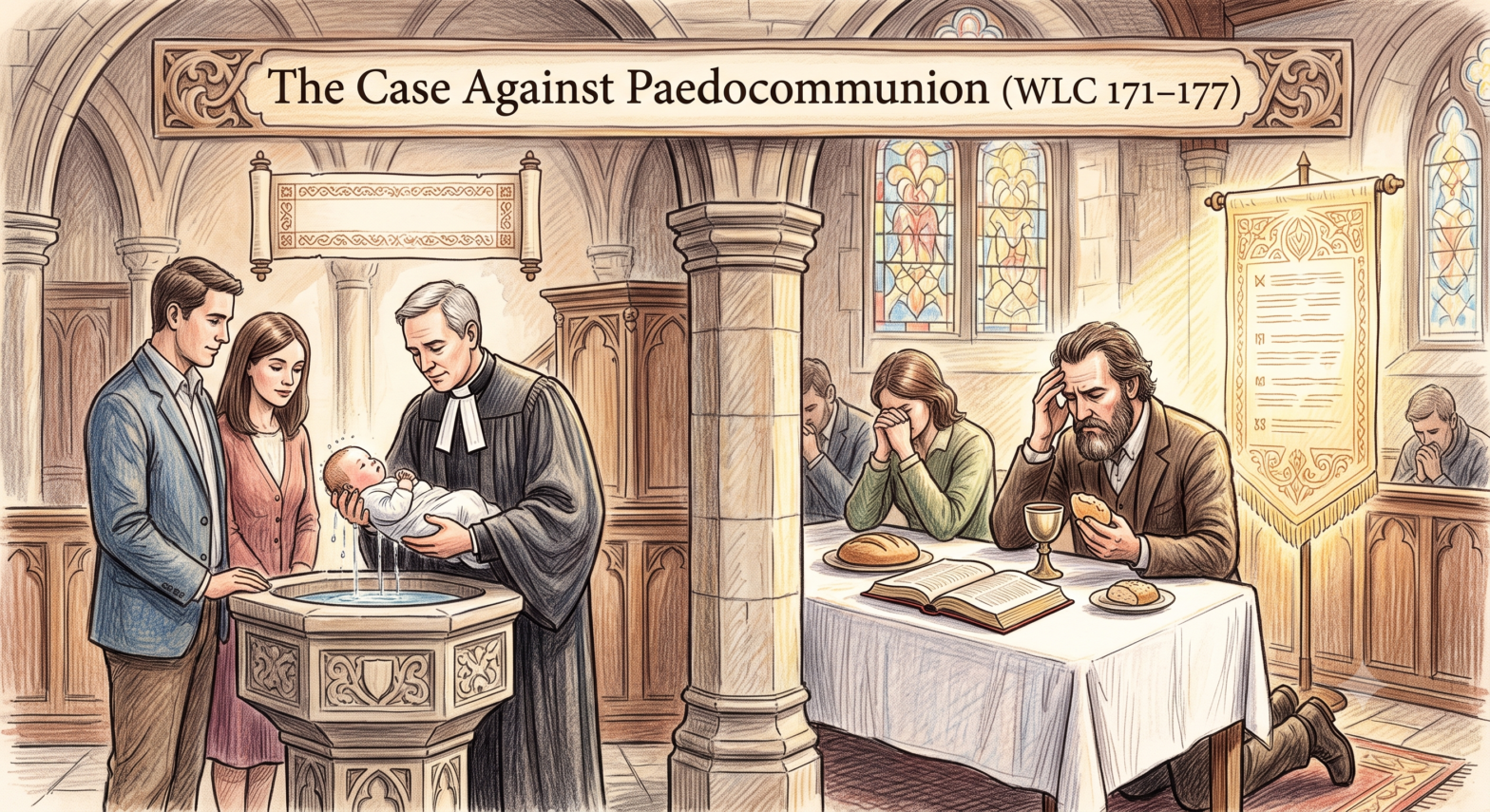
Because the Reformed tradition vigorously defends the baptism of infants (paedobaptism), a natural question often arises: If we baptize our children, why do we not also give them the Lord’s Supper? In recent decades, a minority within the Reformed camp (often associated with the Federal Vision movement) has advocated for Paedocommunion—the practice of serving the bread and wine to infants and young children. They argue for “covenantal symmetry.” Their logic suggests that if infants belong to the covenant community, they have a right to all the covenant meals, just as children partook of the Passover in the Old Testament.
Lest anyone assume that conservative NAPARC (North American Presbyterian and Reformed Council) bodies are immune to this danger, it remains a very live issue today. Just recently, at the PCA’s (Presbyterian Church in America) General Assembly, proposals were brought forth to make paedocommunion an acceptable practice. While this was thankfully defeated, it serves as a stark reminder that we must remain vigilant, aware of this theology, and prepared to confront it with our Confessional standards.
However, the Westminster divines vehemently rejected this practice. To understand why, we must turn to the Westminster Larger Catechism (WLC), which outlines the rigorous, active, and highly cognitive requirements for coming to the Lord’s Table—requirements that infants are entirely incapable of fulfilling.
The Larger Catechism teaches that while baptism is a passive sacrament of initiation administered even to infants, the Lord’s Supper is an active sacrament of nourishment reserved strictly for those who are of years and ability to examine themselves, discern the Lord’s body, and actively exercise faith and repentance.
The Crucial Asymmetry (WLC 177)
The most direct refutation of paedocommunion is found in WLC 177, which asks, “Wherein do the sacraments of baptism and the Lord’s supper differ?”
The divines explicitly reject the idea of absolute “covenantal symmetry” between the two sacraments. While both are seals of the same covenant, they have different functions and different requirements for the recipient.
The Catechism states that baptism is to be administered “but once, with water, to be a sign and seal of our regeneration and ingrafting into Christ, and that even to infants.”
However, the Lord’s Supper is to be administered “often, in the elements of bread and wine, to represent and exhibit Christ as spiritual nourishment to the soul, and to confirm our continuance and growth in him, and that only to such as are of years and ability to examine themselves.“
Baptism is the sacrament of birth into the visible church; it can be passively received. The Lord’s Supper is the sacrament of growth and nourishment; it must be actively received by faith. You can bathe an infant who does nothing but cry, but you cannot feed a steak to a newborn.
The Duty of Preparation (WLC 171–173)
Why must the recipient be “of years and ability”? Because the Lord’s Supper requires rigorous preparation. Drawing upon the Apostle Paul’s command in 1 Corinthians 11:28 (“Let a person examine himself, then, and so eat of the bread and drink of the cup”), the divines lay out strict requirements for partaking.
WLC 171 commands that those receiving the sacrament must prepare themselves by examining their hearts. They must examine themselves of:
- Their being in Christ.
- Their sins and wants.
- The truth and measure of their knowledge, faith, and repentance.
- Their love to God and the brethren.
- Their forgiving of those who have wronged them.
An infant or toddler is completely incapable of performing this kind of spiritual inventory.
Furthermore, WLC 173 asks if anyone who desires the Supper can be kept from it. The answer is yes: “Such as are found to be ignorant or scandalous” must be kept away until they receive instruction and manifest repentance. While infants are certainly not “scandalous,” they are, by nature of their age, cognitively “ignorant” of the Gospel. They cannot articulate the faith or demonstrate the requisite knowledge to approach the Table safely.
(Note: WLC 172 offers beautiful pastoral comfort to those who “doubt of their being in Christ,” reminding us that perfection is not required to come to the Table. But even a doubting Christian is exercising cognitive faculties of belief, desire, and repentance—faculties an infant cannot yet exercise).
The Active Duties of Partaking (WLC 174)
The case against paedocommunion is cemented by the duties required during the actual administration of the sacrament. Coming to the Table is not a passive reception of grace; it is a highly active spiritual work.
According to WLC 174, in the very moment of receiving the bread and wine, communicants must:
- “Heedfully wait upon God in that ordinance.”
- “Diligently observe the sacramental elements and actions.”
- “Affectionately meditate on his death and sufferings.”
- “Discern the Lord’s body.”
- “Judge themselves, and sorrow for sin.”
- “Earnestly hunger and thirst after Christ.”
When an infant receives baptism, they do not need to “discern” the water or “sorrow for sin.” God is sovereignly placing His mark upon them while they remain entirely passive. But the Lord’s Supper demands that the participant actively feed upon Christ by faith (WCF 29.7). Faith is the mouth of the soul. Because an infant cannot yet actively exercise faith, discern the Lord’s body, or sorrow for their sin, they cannot truly participate in the Supper. To give them the physical elements when they are incapable of the spiritual realities is to give them an empty symbol.
Conclusion
The Reformed rejection of paedocommunion is not rooted in a low view of children or a low view of the covenant. Rather, it is rooted in a highly biblical view of the Lord’s Supper.
By demanding that participants be capable of self-examination and active faith, the Westminster Standards protect the holiness of the Table and the souls of the communicants. Baptism declares that God’s grace precedes our understanding, marking infants as members of the visible family. But the Lord’s Supper is the family feast, reserved for those who have grown to the point where they can knowingly sit at the table, confess their sins, and joyfully proclaim the Lord’s death until He comes.
Key Terms
- Paedocommunion: The unbiblical practice of serving the Lord’s Supper to infants and small children who are not yet capable of self-examination.
- Covenantal Symmetry: The flawed argument that because infants receive the covenant sign of baptism, they must automatically receive the covenant sign of the Lord’s Supper, ignoring the distinct biblical requirements of each.
- Self-Examination: The biblical command (1 Cor. 11:28) and spiritual duty required of all communicants before coming to the Table, rendering infants incapable of lawful participation.