Loved ones, one of the most sobering realities of parenting is seeing your own flaws mirrored in your children. We pass down our eye color and our physical traits, but all too often, we also pass down our anxieties, our coping mechanisms, and our sins.
Genesis 26 is the only chapter in the Bible dedicated almost entirely to the active, adult life of Isaac. And as we read it, we might feel an overwhelming sense of déjà vu. Isaac’s life looks incredibly like a rerun of Abraham’s. He faces a famine. He meets a Philistine king holding the title of Abimelech. He struggles over water rights. He makes a peace treaty. But most tragically, when faced with fear, he resorts to the exact same cowardly lie his father used decades earlier: “She is my sister.”
Yet, Genesis 26 is not just a story of inherited failure. It is a brilliant display of inherited grace. Despite Isaac’s stumbling, God stubbornly insists on keeping His covenant.
Genesis 26:1-35 records God’s reaffirmation of the covenant with Isaac, Isaac’s fearful deception regarding Rebekah, God’s unmerited blessing in the midst of Philistine hostility, and the quiet faith of a man who refused to stop digging wells.
Verses 1–5
1 Now there was a famine in the land, besides the former famine that was in the days of Abraham. And Isaac went to Gerar to Abimelech king of the Philistines. 2 And the Lord appeared to him and said, “Do not go down to Egypt; dwell in the land of which I shall tell you. 3 Sojourn in this land, and I will be with you and will bless you, for to you and to your offspring I will give all these lands, and I will establish the oath that I swore to Abraham your father. 4 I will multiply your offspring as the stars of heaven and will give to your offspring all these lands. And in your offspring all the nations of the earth shall be blessed, 5 because Abraham obeyed my voice and kept my charge, my commandments, my statutes, and my laws.”
The Covenant Reaffirmed in Famine
Just as in the days of his father, a severe famine strikes the Promised Land, forcing Isaac to journey to Gerar. It is here that he meets “Abimelech king of the Philistines.” Many critical scholars point to this repeated name as evidence that Genesis 26 is just a “doublet”—a recycled, copied myth of Abraham’s encounter in Genesis 20. But the name “Abimelech” literally translates to “My father is king.” It is not a personal name, but a dynastic royal title, much like Pharaoh in Egypt or Caesar in Rome. Isaac is not repeating a myth; he is dealing with the historical successor to the king his father met decades earlier.
The natural human instinct in a famine is to flee to Egypt, where the Nile River provides a constant, reliable source of water and food. Egypt, in Scripture, constantly represents worldly security and reliance on the flesh.
But God appears to Isaac and explicitly commands him: “Do not go down to Egypt.” God calls Isaac to stay in the very land where the famine is raging and trust in divine provision rather than Egyptian security.
To anchor Isaac’s faith, God officially transfers the Abrahamic covenant to him. He promises His presence, the land, the multiplication of offspring, and the ultimate blessing to all nations. Notice that God bases this ongoing blessing on the historical obedience of Abraham (v. 5). The promises of God are secure, resting on the finished faithfulness of the covenant head.
Verses 6–11
6 So Isaac settled in Gerar. 7 When the men of the place asked him about his wife, he said, “She is my sister,” for he feared to say, “My wife,” thinking, “lest the men of the place should kill me because of Rebekah,” because she was attractive in appearance. 8 When he had been there a long time, Abimelech king of the Philistines looked out of a window and saw Isaac laughing with Rebekah his wife. 9 So Abimelech called Isaac and said, “Behold, she is your wife. How then could you say, ‘She is my sister’?” Isaac said to him, “Because I thought, ‘Lest I die because of her.’ ” 10 Abimelech said, “What is this you have done to us? One of the people might easily have lain with your wife, and you would have brought guilt upon us.” 11 So Abimelech warned all the people, saying, “Whoever touches this man or his wife shall surely be put to death.”
The Sins of the Father
Isaac obeys God and stays in the land of the Philistines. But obedience in one area does not guarantee immunity from sin in another. When the local men notice Rebekah’s beauty, Isaac is seized by the exact same fear that gripped Abraham in Genesis 12 and 20. He thinks, “Lest the men of the place should kill me.”
To save his own skin, Isaac tells a blatant lie: “She is my sister.” (Unlike Abraham’s lie, which was a technical half-truth, Isaac’s is a complete fabrication). He willingly places his wife’s purity, and the entire future of the Messianic lineage, in extreme jeopardy.
His deception holds up until King Abimelech looks out a window and sees Isaac “laughing with Rebekah.” (This is a Hebrew pun on Isaac’s name, Yitzchaq, implying intimate, marital affection—they were doing things a brother and sister certainly would not do).
For the third time in Genesis, a pagan king has to rebuke a patriarch of God for lying. It is a humiliating moment. Isaac’s fear of man had completely eclipsed his fear of God.
Verses 12–22
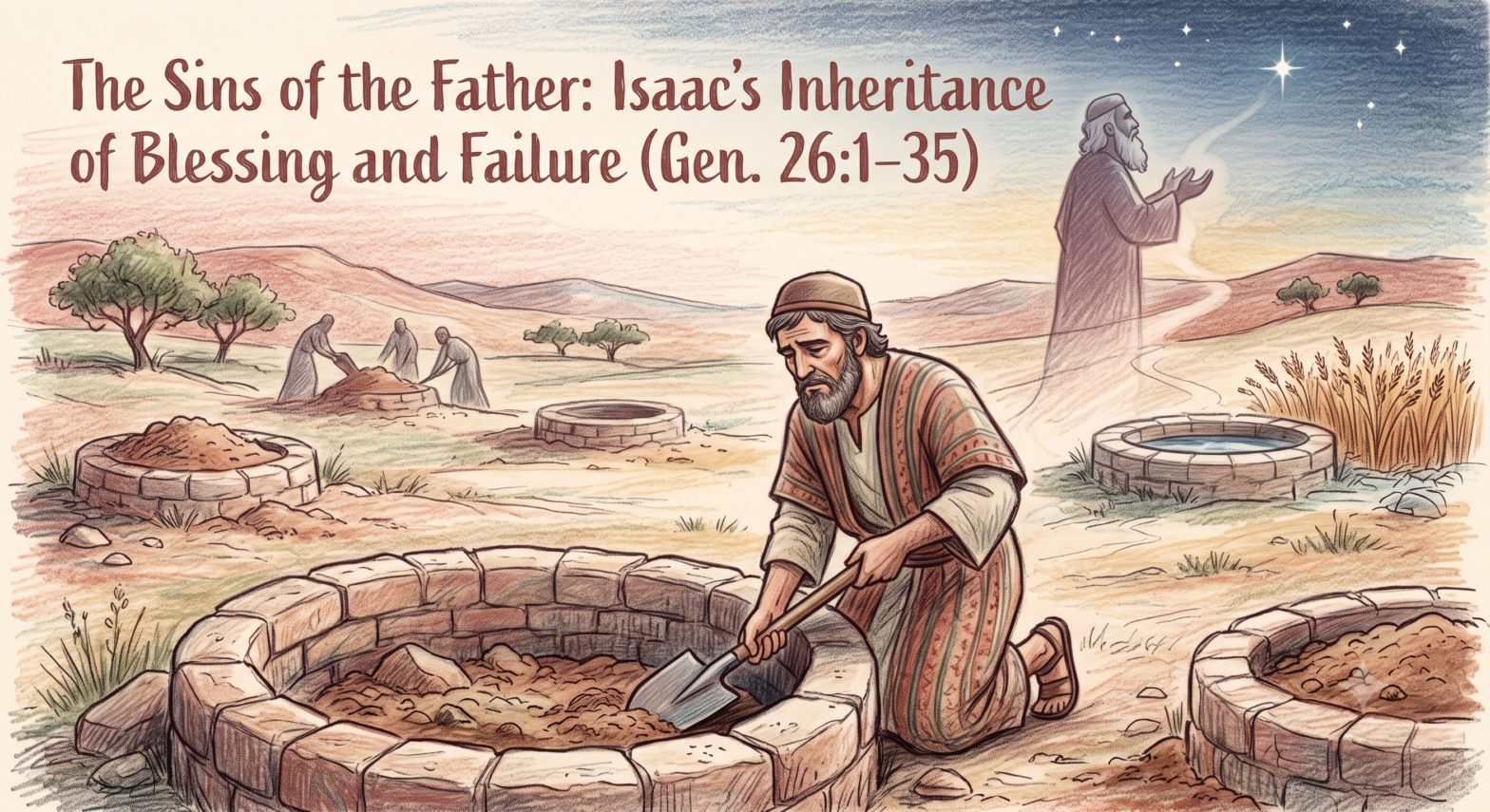
12 And Isaac sowed in that land and reaped in the same year a hundredfold. The Lord blessed him, 13 and the man became rich, and gained more and more until he became very wealthy. 14 He had possessions of flocks and herds and many servants, so that the Philistines envied him. 15 (Now the Philistines had stopped and filled with earth all the wells that his father’s servants had dug in the days of Abraham his father.) 16 And Abimelech said to Isaac, “Go away from us, for you are much mightier than we.” 17 So Isaac departed from there and encamped in the Valley of Gerar and settled there. 18And Isaac dug again the wells of water that had been dug in the days of Abraham his father, which the Philistines had stopped after the death of Abraham. And he gave them the names that his father had given them. 19 But when Isaac’s servants dug in the valley and found there a well of spring water, 20 the herdsmen of Gerar quarreled with Isaac’s herdsmen, saying, “The water is ours.” So he called the name of the well Esek, because they contended with him. 21 Then they dug another well, and they quarreled over that also, so he called its name Sitnah. 22 And he moved from there and dug another well, and they did not quarrel over it. So he called its name Rehoboth, saying, “For now the Lord has made room for us, and we shall be fruitful in the land.”
The Patient Faith of Digging Wells
How does God respond to Isaac’s cowardly, faithless lie? Breathtakingly, God responds with overwhelming, unmerited grace. In a year of severe famine, Isaac plants crops and reaps “a hundredfold.” A hundredfold return is a miraculous, staggering yield. God blesses Isaac so immensely that he becomes a massive economic threat to the Philistines, sparking deep envy.
To drive Isaac away, the Philistines use a common ancient tactic of economic warfare: they fill his wells with dirt. Water is life in the desert. Without it, Isaac’s vast flocks will die. King Abimelech finally asks Isaac to leave.
Here we see the unique strength of Isaac’s character. Isaac is far wealthier and stronger than the locals (v. 16). He could have easily started a bloody war. Instead, he yields. He moves. He embodies the meekness that Jesus would later preach: “Blessed are the meek, for they shall inherit the earth” (Matt. 5:5).
Isaac begins the tedious, unglamorous work of re-digging his father’s wells. The locals quarrel over the first well (Esek = Contention) and the second well (Sitnah = Enmity). Isaac refuses to retaliate. He simply moves again and digs a third well. Finally, there is peace. He names it Rehoboth (Broad places), trusting that God, not his own military might, has made room for him in the land.
Verses 23–35
23 From there he went up to Beersheba. 24 And the Lord appeared to him the same night and said, “I am the God of Abraham your father. Fear not, for I am with you and will bless you and multiply your offspring for my servant Abraham’s sake.” 25 So he built an altar there and called upon the name of the Lord and pitched his tent there. And there Isaac’s servants dug a well. 26 When Abimelech went to him from Gerar with Ahuzzath his adviser and Phicol the commander of his army, 27 Isaac said to them, “Why have you come to me, seeing that you hate me and have sent me away from you?” 28 They said, “We see plainly that the Lord has been with you. So we said, let there be a sworn pact between us, between you and us, and let us make a covenant with you, 29 that you will do us no harm, just as we have not touched you and have done to you nothing but good and have sent you away in peace. You are now the blessed of the Lord.” 30 So he made them a feast, and they ate and drank. 31 In the morning they rose early and exchanged oaths. And Isaac sent them on their way, and they departed from him in peace. 32 That same day Isaac’s servants came and told him about the well that they had dug and said to him, “We have found water.” 33 He called it Shibah; therefore the name of the city is Beersheba to this day. 34 When Esau was forty years old, he took Judith the daughter of Beeri the Hittite to be his wife, and Basemath the daughter of Elon the Hittite, 35 and they made life bitter for Isaac and Rebekah.
Worship, Treaties, and Bitter Marriages
Isaac moves to Beersheba, and God immediately meets him there, reassuring him: “Fear not.” For the first time in his life, we see Isaac independently build an altar to worship the Lord.
The testimony of Isaac’s peaceful, non-retaliatory life is so powerful that King Abimelech travels to Beersheba to make a peace treaty. The king makes a stunning confession: “We see plainly that the LORD has been with you.” Even the world can recognize the undeniable blessing of God on a life marked by meekness and grace.
However, the chapter ends on a dark, ominous note. Esau, now forty years old, marries two Hittite (Canaanite) women. By marrying into the cursed, pagan nations of Canaan, Esau openly demonstrates his utter disregard for the spiritual purity of the Abrahamic covenant. He previously sold his birthright; now he pollutes the family line. This causes deep bitterness for Isaac and Rebekah, setting the stage for the family explosion in the very next chapter.
Conclusion
Isaac was a deeply flawed man. He lied to protect himself, placing his wife in danger and dragging the name of God through the mud before a pagan king. If our salvation depended on our perfect performance, Isaac would have been cast out of the covenant in Gerar.
But God does not save us or keep us based on our flawless performance; He saves us based on His unbreakable promises. God protected Rebekah. God blessed Isaac’s crops. God made room for him at Rehoboth.
Isaac’s failure points us, by contrast, to the only perfectly faithful Son. When Jesus Christ faced the hostility of the world, He did not lie to save His own skin. He did not say, “She is just my sister” to protect Himself from the cross. Instead, Christ boldly declared His identity, allowing Himself to be condemned so that His Bride—the Church—would be eternally saved.
And like Isaac, Jesus offers us water. The world will always try to stop up the wells of our joy with dirt and conflict. But Jesus said, “The water that I will give him will become in him a spring of water welling up to eternal life” (John 4:14). No enemy can fill that well.
Key Terms
- Abimelech: Meaning “My father is king,” this is a Philistine royal title (much like “Pharaoh” in Egypt or “Caesar” in Rome) rather than a personal name. This is a crucial detail for defending the text against critical scholars who argue that Genesis 26 is merely a “doublet” (a mythologically copied or repeated story) of Abraham’s encounter decades earlier. Instead, it proves this is a distinct, actual historical account of Isaac interacting with a successive Philistine ruler holding the same royal title.
- Hundredfold: An agricultural yield that is vastly disproportionate to natural expectations, serving as a miraculous sign of God’s unmerited favor and blessing upon Isaac.
- Esek, Sitnah, and Rehoboth: The names of Isaac’s wells, tracing his journey from conflict. Esek means “Contention,” Sitnah means “Enmity,” and Rehoboth means “Broad places” or “Room.”
- Meekness: The strength to endure injury with patience and without resentment. Isaac’s refusal to fight over the wells is a powerful Old Testament example of this virtue.
- Hittite Wives: Esau’s marriage to Canaanite women, explicitly violating the covenant command of his grandfather Abraham (Gen. 24:3). It physically proves Esau’s profane, unspiritual nature.