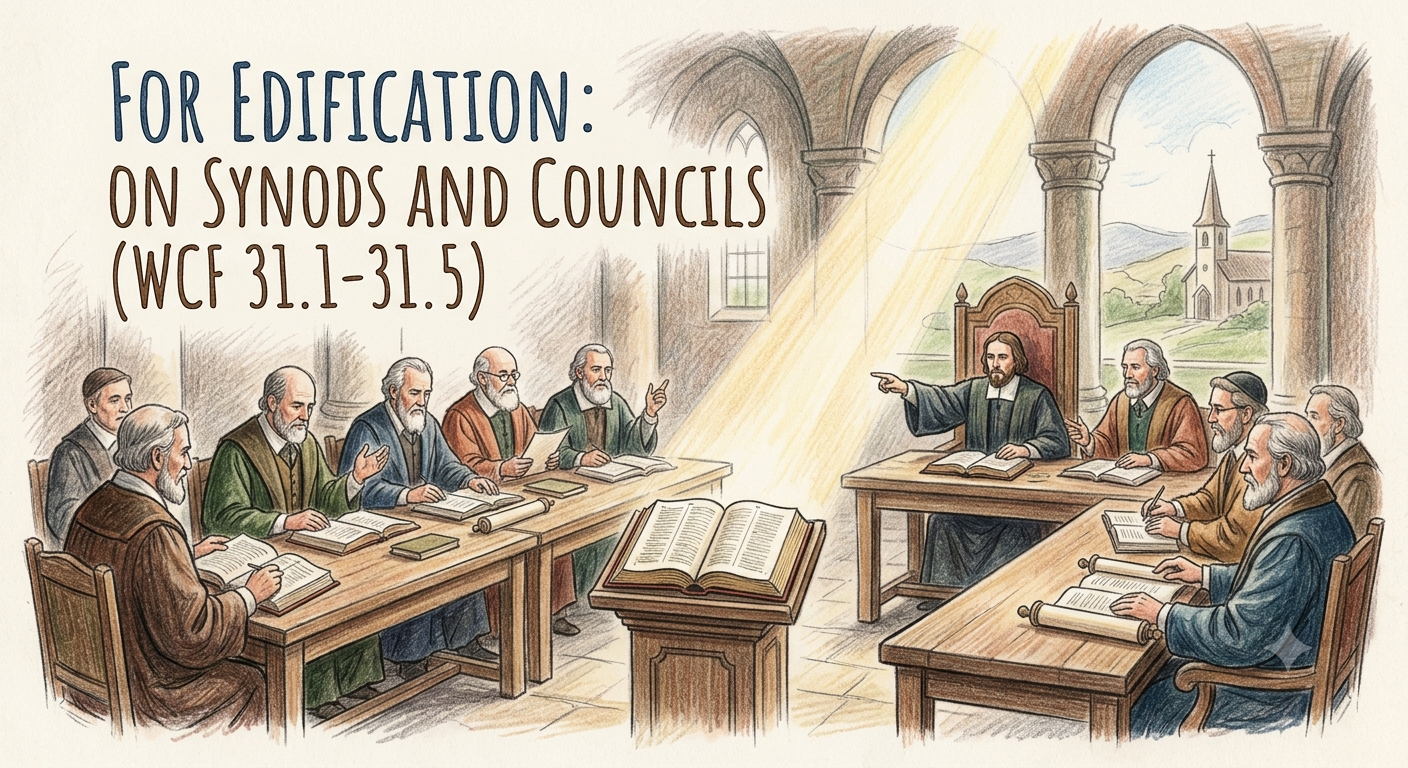
In the previous chapter, we saw that Christ has appointed a government for His Church, placed in the hands of church officers. But how far does that government extend? Does a local congregation operate entirely on its own, completely independent of all other churches? Or is it part of a broader, connected body?
In Chapter 31, the Westminster Confession articulates the Presbyterian form of church government. The word “Presbyterian” simply comes from the Greek word for “elder” (presbuteros). But crucially, Presbyterianism is not just about having a plurality of elders in a single local church; it is about the interconnectedness of those elders across multiple churches.
The Confession teaches that for the edification of the Church, there ought to be regional and broader assemblies (synods and councils); that these assemblies have real, ministerial authority to settle controversies and receive appeals; that they are fallible and therefore not the ultimate rule of faith; and that they must restrict themselves to ecclesiastical matters, never usurping the power of the civil state.
The Necessity of Broader Assemblies (WCF 31.1–31.2)
The Confession begins with a simple, foundational statement: “For the better government, and further edification of the Church, there ought to be such assemblies as are commonly called Synods or Councils.”
Why? Because the church is one body. When a major theological controversy arises, or when a local Session acts tyrannically, a single congregation cannot solve the problem alone. The biblical model for this is found in Acts 15 (the Jerusalem Council). When a massive dispute broke out in Antioch regarding circumcision, the local church did not just figure it out themselves. They sent Paul and Barnabas to Jerusalem to meet with “the apostles and elders” to debate the issue and issue a binding decree for all the churches.
(Note on WCF 31.2: As we saw in Chapter 23, the original 1646 text allowed the civil magistrate to call these synods. The 1788 American revision removed this power from the state entirely. In the American version, church officers assemble “of themselves, by virtue of their office,” completely independent of the government’s permission or summons.)
Ministerial Authority and Appeals (WCF 31.3)
When a Presbytery or General Assembly meets, what kind of authority do they have? Are they just an advisory board offering helpful suggestions? No. The Confession states that these councils have authority “ministerially to determine controversies of faith, and cases of conscience.”
Their authority is ministerial—meaning they do not invent new laws, but simply declare and apply the laws already found in God’s Word. But it is real authority. They are empowered to:
- Settle Controversies: Resolve theological disputes that threaten the peace and purity of the church.
- Order Public Worship: Set down rules for government and the right administration of worship.
- Receive Complaints: This is a crucial feature of Presbyterianism. If a church member feels they have been unjustly excommunicated by their local Session, they have the right of appeal. They can bring their case to the Presbytery (the regional body of elders). If the Presbytery agrees the local Session acted in “maladministration,” they can “authoritatively” overturn the local decision. This provides a massive safeguard against local pastoral tyranny.
When a synod makes a lawful decree that is “consonant to the Word of God,” believers are bound to submit to it. Why? Not just because it happens to agree with the Bible, but “also for the power whereby they are made, as being an ordinance of God appointed thereunto in His Word.” God actually commands us to submit to the lawful government He has established.
Fallibility and the Ultimate Standard (WCF 31.4)
If synods have real authority, does that mean they are infallible? The Roman Catholic Church teaches that when ecumenical councils (like the Council of Trent) speak, their words are essentially equal to Scripture.
The Westminster divines, however, firmly recognized human depravity and the sole authority of Scripture (Sola Scriptura). They declare, with profound historical realism, that “All synods or councils, since the Apostles’ times, whether general or particular, may err; and many have erred.”
Because they are composed of fallible, sinful men, the decrees of church councils are “not to be made the rule of faith, or practice.” They are incredibly useful “helps,” and we should treat their decisions with deep respect and submission, but our ultimate loyalty belongs to the Word of God alone. If a synod commands something contrary to Scripture, the believer is duty-bound to obey God rather than men.
Staying in Their Lane: The Spiritual Boundary (WCF 31.5)
Finally, the Confession establishes a strict boundary line between the church and the state. Just as the civil magistrate cannot preach the Word or administer the sacraments (Chapter 23), the church councils cannot wield the sword or govern the nation.
Synods are “to handle, or conclude, nothing, but that which is ecclesiastical.” They are forbidden to “intermeddle with civil affairs.”
This means a General Assembly has no authority to issue decrees on tax policy, foreign trade agreements, or zoning laws. Their jurisdiction is entirely spiritual. The only exceptions are if they are petitioning the government in “cases extraordinary” (such as pleading for the state to stop persecuting Christians), or if the civil magistrate explicitly asks the church for moral “advice” for the “satisfaction of conscience.”
This doctrine—often called the Spirituality of the Church—protects the church from becoming a political action committee, ensuring that she remains focused on her true mission: preaching the Gospel, administering the sacraments, and shepherding the souls of men.
However, this does not mean that the Church must remain silent on political issues, only that the Church is not a political entity. The Church can, and must, speak prophetically to any situation (political or otherwise) that the Scriptures speak about. She faithfully declares God’s moral law to the magistrate and the culture, even while she refrains from executing public policy.
Conclusion
Presbyterian church government is a beautiful balance between authority and liberty. It rejects the tyranny of the Pope, who claims infallible authority over the whole church. It also rejects the chaos of radical independency, where local churches are unaccountable islands. By establishing broader assemblies of elders with real, but fallible and strictly spiritual authority, the Confession provides a system designed to protect the flock, maintain the truth, and preserve the peace of Christ’s kingdom.
Key Terms
- Synod / Council: Broader assemblies of church officers gathered to govern multiple congregations. In modern Presbyterianism, these are typically structured as regional Presbyteries and a national General Assembly.
- Ministerial Authority: The authority of church councils to declare and apply the Word of God, rather than the power to invent new laws or doctrines.
- Right of Appeal: The ability of a church member to take a grievance against a local Session to a higher church court (like a Presbytery) to seek justice and overturn maladministration.
- The Spirituality of the Church: The doctrine that the church’s mission and jurisdiction are entirely spiritual and ecclesiastical, forbidding it from intermeddling in the civil and political affairs of the state, while still maintaining her prophetic voice to declare the Word of God to all spheres of life.