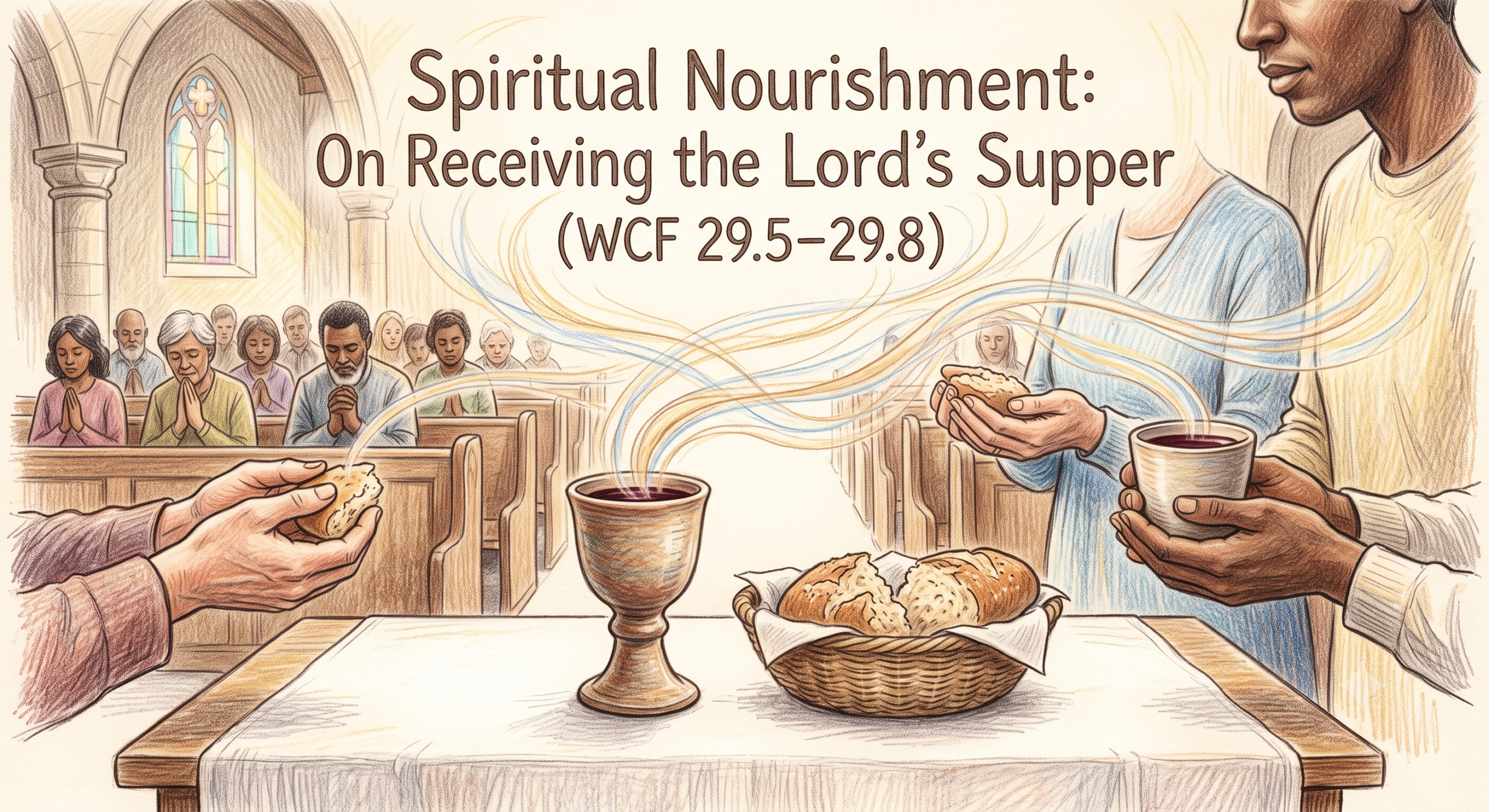
Throughout church history, no doctrine has been more fiercely debated than the Lord’s Supper. During the Reformation, the exact nature of Christ’s presence in the bread and wine was the ultimate theological dividing line, permanently fracturing the movement into different traditions.
What exactly happens when a Christian eats the bread and drinks the wine? Is it a literal consumption of human flesh? Is it merely a somber memory exercise? Or is it something else entirely?
In paragraphs 5 through 8 of Chapter 29, the Westminster divines articulate the crowning jewel of Reformed sacramentology: Spiritual Real Presence.
The Confession teaches that while the elements remain truly bread and wine, believers spiritually feed upon the real Christ by faith; it utterly rejects the physical transformations of Transubstantiation and the localization of Consubstantiation, and warns that participating without faith brings divine judgment.
Sacramental Language (WCF 29.5)
To understand the biblical teaching on the Supper, we first have to understand how the Bible speaks. When Jesus instituted the Supper, He held up bread and said, “This is my body” (Matt. 26:26). How are we to understand this?
The Confession explains this using the concept of sacramental union (which we covered in Chapter 27). The outward elements (bread and wine) have such a close relationship to the realities they represent (Christ’s body and blood) that they are “sometimes called by the name of the things they represent.”
When Jesus says, “This is my body,” He is using sacramental language. He is not saying the bread physically transformed into His flesh (He was sitting physically whole right in front of them!). Rather, the sign is so intimately connected to the reality it signifies that they share the same name. Therefore, the Confession affirms that “in substance and nature, they still remain truly and only bread and wine, as they were before.”
The Rejection of Transubstantiation (WCF 29.6)
Having established that the elements remain bread and wine, the divines issue a devastating critique of the Roman Catholic doctrine of Transubstantiation. Rome teaches that at the moment a priest consecrates the elements, the physical substance of the bread and wine vanishes and is replaced by the physical body, blood, soul, and divinity of Jesus Christ, even though the “accidents” (the taste, look, and smell) of bread and wine remain.
The Confession rejects this completely, stating it is “repugnant, not to Scripture alone, but even to common sense, and reason.” Furthermore, it argues that Transubstantiation:
- Overthrows the nature of a sacrament: A sacrament requires two things: a visible sign and an invisible reality. If the sign actually becomes the physical reality, the sign is destroyed, and the sacrament ceases to exist.
- Causes gross idolatries: Because Rome believes the bread is literally God, they command people to worship it, pray to it, and carry it around in parades (which WCF 29.4 explicitly condemned). To worship a piece of bread, no matter what theological gymnastics are used to justify it, is idolatry.
Christ’s physical, human body ascended into heaven (Acts 3:21) and remains there until His return. To claim His physical body can be on thousands of altars across the globe simultaneously destroys the doctrine of His true humanity.
Spiritual Real Presence (WCF 29.7)
If the bread remains bread, does that mean the Lord’s Supper is just an empty memorial? Is it just a time to close our eyes and try really hard to think about Jesus? Absolutely not.
Here, the Confession articulates the profound mystery of Spiritual Real Presence. When worthy receivers partake of the bread and wine, they “inwardly by faith, really and indeed… spiritually, receive, and feed upon, Christ crucified.”
We really feed on Christ. The Lord’s Supper is a true communion with the living Lord. But how?
- Not Corporally or Carnally: We do not eat physical flesh with our teeth.
- Not In, With, or Under: The Confession explicitly rejects the Lutheran view (often called Consubstantiation), which argues that Christ’s physical body is present “in, with, or under” the physical bread.
- But Spiritually by Faith: Christ’s physical body is in heaven, and we are on earth. We cannot pull Him down to the bread, so the Holy Spirit lifts our hearts up to Him. By the mysterious operation of the Holy Spirit, the distance is bridged, and our souls are truly nourished by Christ Himself, just as surely as our physical bodies are nourished by the bread and wine.
Faith is the mouth of the soul. Without faith, you are just eating a snack. With faith, you are feasting on the King.
Fencing the Table and Unworthy Reception (WCF 29.8)
Because the Lord’s Supper is a real, spiritual encounter with the living God, it is profoundly dangerous for those who approach it with hostility, unbelief, or unrepentant sin.
Drawing on the terrifying warnings of 1 Corinthians 11:27-29, the Confession states that when “ignorant and wicked men” take the bread and wine, they do not receive Christ. Instead, “they receive not the thing signified thereby; but, by their unworthy coming thereunto, are guilty of the body and blood of the Lord, to their own damnation.” Treating the holy covenant seals of God as common things brings spiritual judgment.
Because of this severe danger, the church is commanded to protect both the holiness of Christ and the souls of the wicked by practicing church discipline. This practice is historically called fencing the table. The elders of the church must ensure that “ignorant and ungodly persons” are not admitted to the table until they repent and profess true faith. To knowingly allow an unrepentant rebel to take the Lord’s Supper is akin to handing a loaded gun to a toddler; it is a failure of pastoral love.
Conclusion
The Lord’s Supper is a profound gift to the weary, stumbling Christian. We do not come to the table because we are perfect; we come to the table because we are hungry, weak, and in desperate need of our Savior. When we eat the bread and drink the cup in faith, we are not performing a magic ritual, nor are we merely jogging our memories. We are sitting at the family table, brought into the very presence of our ascended Lord by the power of the Holy Spirit, and fed with the grace we need to continue our pilgrimage home.
Key Terms
- Transubstantiation: The Roman Catholic error that the substance of the bread and wine physically transforms into the literal body and blood of Christ.
- Consubstantiation: The Lutheran error that Christ’s physical body is present “in, with, or under” the physical bread and wine. (While modern Lutherans reject the term “consubstantiation,” the Confession specifically rejects their “in, with, or under” formula).
- Memorialism / Zwinglianism: The error that the Lord’s Supper is merely a symbolic memory exercise with no unique spiritual grace or presence of Christ conferred.
- Spiritual Real Presence: The Reformed doctrine that while the bread remains bread, the Holy Spirit bridges the gap between believers on earth and Christ in heaven, so that by faith, believers truly and really feed upon Christ for their spiritual nourishment.
- Fencing the Table: The pastoral duty of the elders to guard the Lord’s Supper, ensuring that only those who profess faith in Christ and are not under church discipline are permitted to partake, thereby preventing the ungodly from bringing judgment upon themselves.