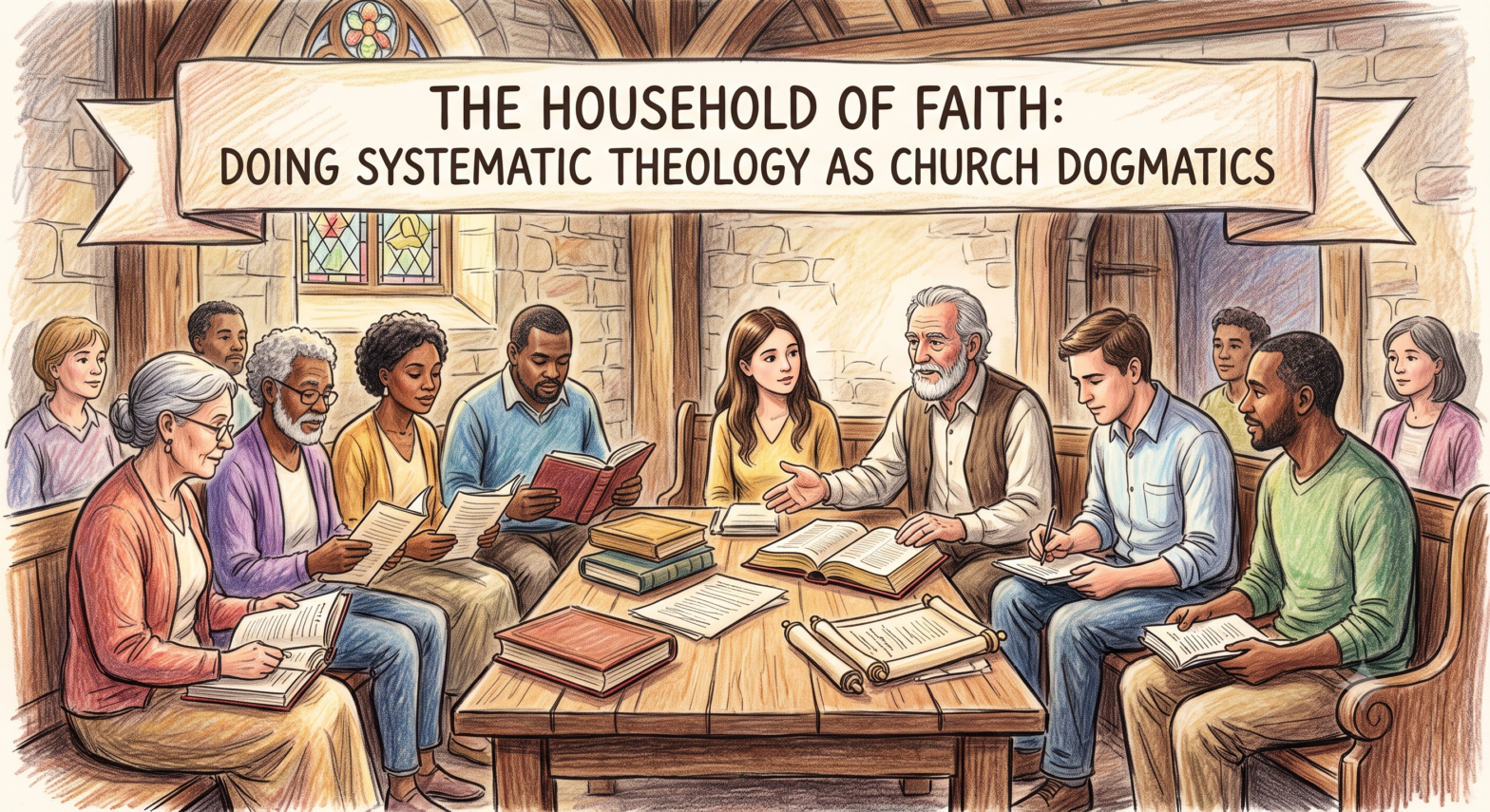
We live in an era that worships the autonomous self. From our personalized social media algorithms to our “build-your-own” spirituality, the modern West is deeply committed to the myth of the self-made man. We are told that true authenticity requires us to shed the baggage of the past, reject institutional authority, and discover our own truth.
Tragically, this hyper-individualism has deeply infected the contemporary church. It often manifests in a high-sounding but dangerous slogan: “No creed but Christ, no book but the Bible.” Many young men, newly awakened to the intellectual depth of the Reformed faith, unconsciously carry this rebellious mindset into their study of doctrine. They buy systematic theology volumes, retreat into their private studies with their internet connections, and begin to reconstruct Christian theology from scratch. They view themselves as theological pioneers, charting new territory with nothing but their raw intellect, a clean desk, and a Logos Bible software package.
But this solitary, “Lone Ranger” approach to theology is a recipe for spiritual shipwreck.
If we are to study theology in a way that is faithful to the Scriptures and the historic Christian faith, we must abandon the illusion of the intellectual tabula rasa. We must recognize that we do not read the Bible in a vacuum. We do not stand at the beginning of church history, but rather on the shoulders of giants.
Constructive systematic theology must never be pursued as an individualistic, autonomous intellectual enterprise, but must be consciously executed as an ecclesial, confessional act of church dogmatics—rooted within the communion of saints and submitted to the subordinate standards of the historic Reformed tradition.
The Illusion of the Tabula Rasa: The Danger of “Lone Ranger” Theology
The modern impulse to bypass church history and do theology “just between me and my Bible” is often cloaked in the language of piety. It sounds incredibly spiritual to declare that one is uncorrupted by human traditions and listens only to the raw voice of Scripture. But this posture is fundamentally dishonest, and it represents a profound misunderstanding of how God has designed His church.
Sola Scriptura vs. Biblicism
To bring clarity to this issue, we must distinguish between the historic Reformed doctrine of Sola Scriptura and its modern, individualistic imitation, commonly referred to as Biblicism.
Sola Scriptura asserts that Holy Scripture is the sole infallible and ultimate authority for Christian faith and practice. However, it does not reject historical, ecclesiastical authority. It recognizes that God has given creeds, confessions, and teachers to His church to guide her in the truth. Sola Scriptura reads the Bible within the communion of the historic church, treating the historical consensus of the faithful as a highly authoritative guide, even if that guide is ultimately subordinate to the written Word.
Conversely, Biblicism is an individualistic free-for-all. Under the guise of honoring Scripture, it strips the Bible of its ecclesial and historical context, elevating the private judgment of the individual interpreter into the ultimate, functional authority. In this view, if my private reading of Romans contradicts two thousand years of church history, it is church history that must instantly give way to my personal brilliance. This is not the historic Protestant reformation; it is democratic rationalism wearing a theological mask.
The Church as the Pillar and Buttress of Truth
Our intellectual self-reliance is flatly contradicted by the Apostle Paul’s instruction to Timothy. Paul does not describe the individual Christian or the isolated academic as the ultimate defender of the faith. Rather, he describes “the household of God, which is the church of the living God, a pillar and buttress of the truth” (1 Timothy 3:15).
The truth of God is not a commodity floating in the ether, waiting for isolated individuals to capture it. It has been entrusted to a concrete, historical, covenant community. The Holy Spirit does not merely illuminate the mind of the isolated reader; He has been poured out upon the body of Christ, guiding the church through centuries of struggle, debate, and consensus (Ephesians 4:11-14). To ignore this historical guidance is not a mark of spiritual maturity; it is a mark of extreme hubris.
Reclaiming “Church Dogmatics”
If theology must be done within the household of faith, then our systematic theology is best understood not merely as “Christian philosophy,” but as church dogmatics. While the term “Church Dogmatics” is famously associated in the twentieth century with the Swiss theologian Karl Barth, the underlying concept is deeply rooted in the historic Reformed scholastic tradition.
What is Dogma?
To understand church dogmatics, we must first define what we mean by dogma. In ordinary speech, “dogmatic” is a pejorative term used to describe someone who is stubbornly opinionated. But in classical theology, a dogma is a very specific, ecclesiastical reality.
A dogma is not a private opinion or the theory of an individual theologian. Rather, a dogma is a doctrinal truth drawn from Holy Scripture that has been formally and authoritatively confessed by the church. As Herman Bavinck wrote in his Reformed Dogmatics:
It is, moreover, of the greatest importance for every believer, particularly for the dogmatician, to know which Scriptural truths, under the guidance of the Holy Spirit, have been brought to universal recognition in the church of Christ. By this process, after all, the church is kept from immediately mistaking a private opinion for the truth of God. Accordingly, the church’s confession can be called the dogma quoad nos (for us), that is, the truth of God as it has been incorporated in the consciousness of the church and confessed by it in its own language.[1]
A private person cannot write dogma. I can write an essay, a blog post, or a systematic outline, but I cannot create dogma. Dogmatics is the intellectual labor of the church processing, defending, and summarizing the faith that was “once for all delivered to the saints” (Jude 1:3).
The Ecclesial Location of Theology
This means that when we engage in systematic theology, we are not acting as independent contractors. We are working within a specific, covenantal household. The church is the womb in which theology is conceived, the home in which it is nurtured, and the theater in which it is lived out.
Our theology must be from the church, by the church, and for the church. If your theology cannot be preached from a local pulpit, if it cannot be used to counsel a grieving widow, and if it cannot be submitted to a local session of elders for oversight, then it is not church dogmatics. It is merely academic speculation.
The Role of Confessions as Subordinate Standards
Doing theology as church dogmatics means doing theology confessionally. In the Reformed tradition, we do not view confessions—such as the Westminster Standards or the Three Forms of Unity—as rivals to the authority of Scripture. Rather, we view them as the living, authoritative summaries of what the church has concluded the Scripture actually teaches.
The Norming Norm and the Normed Norm
To keep the relationship between Scripture and confessions in its proper, biblical order, classical theology developed a vital distinction: the distinction between the norming norm (norma normans) and the normed norm (norma normata).
The norming norm is Holy Scripture. The Bible is the absolute, unruled ruler. It is the infallible, self-attesting word of the living God. It rules over all councils, all synods, all confessions, and all individual intellects. Scripture alone has the authority to bind the human conscience (Isaiah 8:20).
The normed norm is the confession of the church. The confessions are “ruled rulers.” They possess a real, authoritative power, but it is a derivative and subordinate power. They are authoritative precisely because, and to the extent that, they faithfully summarize the teachings of Scripture.
When we adopt confessional standards, we are not adding a second book to our Bibles. We are publicly declaring: “This is what we believe the Bible actually means.” Confessions are necessary to distinguish the orthodox faith from heresy, to preserve the unity of the church, and to provide a public testimony of our doctrine to the world.
Confessions as Guardrails
For the systematic theologian, the historic confessions of the church are not restrictive cages, but protective guardrails. When you drive a truck along a winding mountain pass, you do not look at the guardrails and complain that they are limiting your freedom of movement. You thank God for them, because they keep you from plummeting to your death.
Our confessions keep us from driving off the theological cliffs that have already claimed countless heretical souls throughout church history. When a young man thinks he has discovered a “new, brilliant interpretation” of a text that completely bypasses the historic confessions, he has not discovered a fresh truth. He has simply wandered onto a path that the church has already marked, tested, and labeled “Danger: Here Be Heresy.”
The Practical Posture: The Grace of Submission
Loved ones, let us bring this down to where we live, and let us speak with the directness of brothers. It is incredibly easy to be “confessional” on paper while remaining a law unto yourself in practice.
We live in a unique, digital moment where a young man can go to his local library, download three hundred historic Reformed volumes onto his tablet, join dozens of theological discussion groups, and begin to fancy himself a giant of the faith. He can spend his evenings debating the finer points of the covenant of works, the distinction between active and passive obedience, or the metaphysical structure of divine simplicity.
But if you look at his actual life, a tragic pattern often emerges.
This same young man, who possesses a massive digital library and a highly refined confessional vocabulary, is often completely disconnected from the actual, messy, organic life of the local church. He sits in the pews on Sunday morning, looking down his nose at his pastor’s sermon, mentally cataloging every minor theological imprecision. He refuses to submit his life, his marriage, or his intellectual output to the oversight of his local elders. He acts as an online, self-ordained pope, dispensing theological decrees from his keyboard while refusing to perform the basic, humble, feet-washing service required of a member of Christ’s body.
If this describes you, hear this hard truth in love: you are not doing Reformed theology. You are practicing a highly intellectualized, baptized form of secular individualism. You are using the glorious, Christ-exalting truths of historic Reformed theology to build a monument to your own ego.
To do systematic theology as church dogmatics requires a posture of ecclesiastical submission. It means recognizing that your local church—with all its flaws, with its historically average pastor, and with its messy, broken congregants—is the actual, divinely ordained household where your theology must be tested, shaped, and lived out.
It means that if your local elders tell you that your theological hobby-horses are causing division in the body, you shut your mouth, step back, and submit to their pastoral care (Hebrews 13:17). It means that you value the unity and peace of your local congregation far more than you value winning an argument on the internet. It means that you view your study of systematic theology not as a tool to gain intellectual dominance, but as a humble, diaper-changing, dish-washing service to the saints of God.
Conclusion
Systematic theology is not a solitary sport. It is a choral symphony.
As we prepare to step into the history and methodology of Protestant Scholasticism in our next article, let us resolve to do so with our feet firmly planted in the soil of the local church. Let us lay aside the hubris of the lone explorer, and let us enter the theological treasury of the Reformed confessional tradition with the gratitude of heirs.
We are not the first to read the Scriptures. We are part of a massive, blood-bought army that has marched across the centuries, singing the praises of the Triune God in the language of the historic creeds and confessions. Let us join their song, holding fast to the infallible Word as our only absolute authority, and submitting to the historic confessions of our church as our reliable, time-tested guide.
Key Terms
- Church Dogmatics / Dogmatic Theology: The systematic study and defense of the doctrinal truths drawn from Holy Scripture that have been formally and authoritatively confessed by the church. It is distinguished from private academic philosophy by its ecclesiastical origin, authority, and focus.
- Sola Scriptura: The historic Protestant doctrine that Holy Scripture is the sole infallible and ultimate authority for Christian faith and practice. It does not reject the historical, subordinate authority of church creeds, confessions, and teachers, but submits them entirely to the written Word.
- Biblicism: The individualistic, ahistorical distortion of Sola Scriptura that treats the private judgment of the individual interpreter as the sole, ultimate authority, ignoring or rejecting the historical consensus, confessions, and subordinate authority of the historic church.
- Norma Normans (Norming Norm): A Latin scholastic phrase referring to Holy Scripture as the supreme, infallible, and unruled rule of faith and practice. It is the absolute standard by which all other theological formulations must be measured.
- Norma Normata (Normed Norm): A Latin scholastic phrase referring to the creeds and confessions of the church as subordinate, ruled rules. They possess a real, derivative authority that is dependent upon and subject to the infallible standard of Scripture.
[1] Herman Bavinck, Reformed Dogmatics, ed. John Bolt, trans. John Vriend, vol. 1 (Baker, 2003), 30.