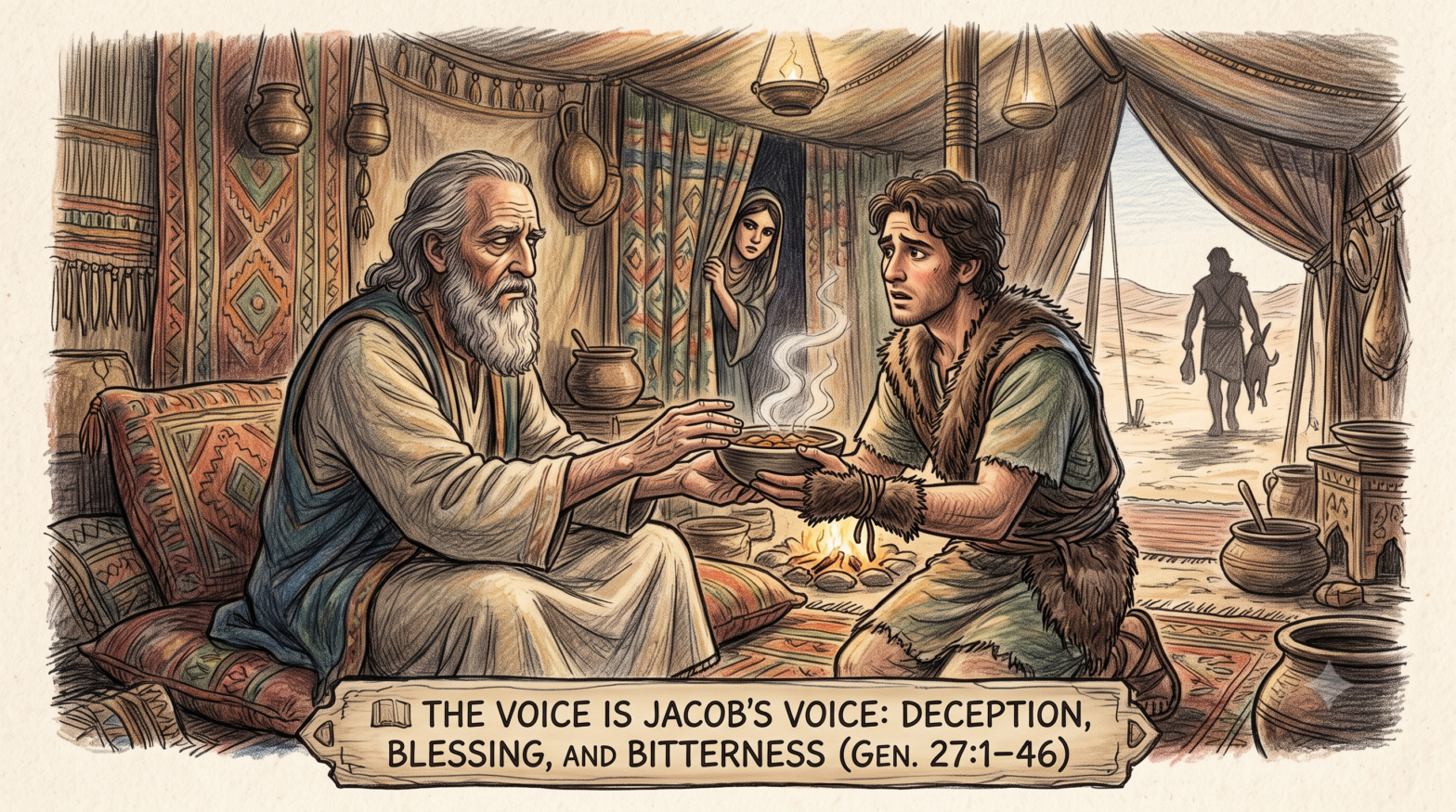
Loved ones, if you ever need proof that the Bible is not a sanitized book of fairy tales, look no further than Genesis 27. This chapter is a masterclass in human dysfunction. We are invited into the private tent of the patriarchs to witness a family completely tearing itself apart.
In this story, there are no heroes. Every single member of this family—Isaac, Rebekah, Jacob, and Esau—acts in the flesh, motivated by appetite, favoritism, manipulation, and deceit. No one stops to pray. No one seeks the Lord. Yet, towering over the ruins of this family’s failed morality is the unstoppable, sovereign will of God. God’s electing purposes will stand, even when His people do everything in their power to make a mess of them.
Genesis 27 records Isaac’s fleshly attempt to bless Esau, Rebekah and Jacob’s treacherous deception to steal the blessing, Isaac’s terrifying realization of God’s sovereignty, and the bitter, violent fallout that fractures the family forever.
Verses 1–17
1 When Isaac was old and his eyes were dim so that he could not see, he called Esau his older son and said to him, “My son”; and he answered, “Here I am.” 2 He said, “Behold, I am old; I do not know the day of my death. 3 Now then, take your weapons, your quiver and your bow, and go out to the field and hunt game for me, 4 and prepare for me delicious food, such as I love, and bring it to me so that I may eat, that my soul may bless you before I die.” 5 Now Rebekah was listening when Isaac spoke to his son Esau. So when Esau went to the field to hunt for game and bring it, 6 Rebekah said to her son Jacob, “I heard your father speak to your brother Esau, 7 ‘Bring me game and prepare for me delicious food, that I may eat it and bless you before the Lord before I die.’ 8 Now therefore, my son, obey my voice as I command you. 9Go to the flock and bring me two good young goats, so that I may prepare from them delicious food for your father, such as he loves. 10 And you shall bring it to your father to eat, so that he may bless you before he dies.” 11 But Jacob said to Rebekah his mother, “Behold, my brother Esau is a hairy man, and I am a smooth man. 12 Perhaps my father will feel me, and I shall seem to be mocking him and bring a curse upon myself and not a blessing.” 13 His mother said to him, “Let your curse be on me, my son; only obey my voice, and go, bring them to me.” 14 So he went and took them and brought them to his mother, and his mother prepared delicious food, such as his father loved. 15 Then Rebekah took the best garments of Esau her older son, which were with her in the house, and put them on Jacob her younger son. 16 And the skins of the young goats she put on his hands and on the smooth part of his neck. 17 And she put the delicious food and the bread, which she had prepared, into the hand of her son Jacob.
The Collision of Schemes
Isaac is old, blind, and convinced he is near death (though he will actually live for many more decades). He decides it is time to pass on the patriarchal blessing. But notice what motivates him: “prepare for me delicious food, such as I love… that my soul may bless you.” Isaac is driven entirely by his physical appetite. Worse, he is willfully attempting to thwart the word of God. Decades earlier, God had explicitly prophesied that “the older shall serve the younger” (Gen. 25:23). Isaac knows this, yet he secretly tries to bestow the covenant blessing upon his favorite, profane son, Esau.
Rebekah overhears the plot and immediately launches a counter-scheme. Instead of trusting the God who made the prophecy to fulfill it, she relies on her own manipulation. She commands Jacob to fetch two goats so she can mimic the taste of wild game.
When Jacob hesitates, his concern is not that lying is a sin against God; his only concern is that he might get caught and receive a curse instead of a blessing. Rebekah chillingly replies, “Let your curse be on me, my son.” She dresses Jacob in Esau’s best garments and binds goatskins to his hands and neck to mimic his brother’s hairy skin. The trap is set.
Verses 18–29
18 So he went in to his father and said, “My father.” And he said, “Here I am. Who are you, my son?” 19 Jacob said to his father, “I am Esau your firstborn. I have done as you told me; now sit up and eat of my game, that your soul may bless me.” 20 But Isaac said to his son, “How is it that you have found it so quickly, my son?” He answered, “Because the Lordyour God granted me success.” 21 Then Isaac said to Jacob, “Please come near, that I may feel you, my son, to know whether you are really my son Esau or not.” 22 So Jacob went near to Isaac his father, who felt him and said, “The voice is Jacob’s voice, but the hands are the hands of Esau.” 23 And he did not recognize him, because his hands were hairy like his brother Esau’s hands. So he blessed him. 24 He said, “Are you really my son Esau?” He answered, “I am.” 25 Then he said, “Bring it near to me, that I may eat of my son’s game and bless you.” So he brought it near to him, and he ate; and he brought him wine, and he drank. 26 Then his father Isaac said to him, “Come near and kiss me, my son.” 27 So he came near and kissed him. And Isaac smelled the smell of his garments and blessed him and said, “See, the smell of my son is as the smell of a field that the Lord has blessed! 28 May God give you of the dew of heaven and of the fatness of the earth and plenty of grain and wine. 29 Let peoples serve you, and nations bow down to you. Be lord over your brothers, and may your mother’s sons bow down to you. Cursed be everyone who curses you, and blessed be everyone who blesses you!”
The Depths of Deceit
What follows is one of the most painful, tense scenes in Scripture. Jacob stands before his blind father and unleashes a barrage of calculated lies. He lies about his identity: “I am Esau your firstborn.” He lies about his actions: “I have done as you told me.”
But the most grievous sin occurs in verse 20. When Isaac questions how the hunt was so fast, Jacob brings God into his lie: “Because the LORD your God granted me success.” To use the holy name of Yahweh to cover up a theft is blatant blasphemy.
Isaac is highly suspicious. He relies on his hearing: “The voice is Jacob’s voice.” But instead of trusting his ears or inquiring of the Lord, Isaac yields to his physical senses—the feeling of the hairy goatskins and the smell of the outdoors on Esau’s garments.
Satisfied by his senses and his stomach, Isaac pronounces the irreversible patriarchal blessing. He blesses Jacob with the “dew of heaven and the fatness of the earth” (agricultural abundance and material wealth) and grants him absolute supremacy: “Be lord over your brothers… Cursed be everyone who curses you, and blessed be everyone who blesses you!”
Verses 30–40
30 As soon as Isaac had finished blessing Jacob, when Jacob had scarcely gone out from the presence of Isaac his father, Esau his brother came in from his hunting. 31 He also prepared delicious food and brought it to his father. And he said to his father, “Let my father arise and eat of his son’s game, that you may bless me.” 32 His father Isaac said to him, “Who are you?” He answered, “I am your son, your firstborn, Esau.” 33 Then Isaac trembled very violently and said, “Who was it then that hunted game and brought it to me, and I ate it all before you came, and I have blessed him? Yes, and he shall be blessed.” 34 As soon as Esau heard the words of his father, he cried out with an exceedingly great and bitter cry and said to his father, “Bless me, even me also, O my father!” 35 But he said, “Your brother came deceitfully, and he has taken away your blessing.” 36 Esau said, “Is he not rightly named Jacob? For he has cheated me these two times. He took away my birthright, and behold, now he has taken away my blessing.” Then he said, “Have you not reserved a blessing for me?” 37 Isaac answered and said to Esau, “Behold, I have made him lord over you, and all his brothers I have given to him for servants, and with grain and wine I have sustained him. What then can I do for you, my son?” 38 Esau said to his father, “Have you but one blessing, my father? Bless me, even me also, O my father.” And Esau lifted up his voice and wept. 39 Then Isaac his father answered and said to him: “Behold, away from the fatness of the earth shall your dwelling be, and away from the dew of heaven on high. 40 By your sword you shall live, and you shall serve your brother; but when you grow restless you shall break his yoke from your neck.”
The Trembling and the Tears
Jacob scarcely escapes the tent before Esau arrives. When Isaac realizes he has been deceived, the text says he “trembled very violently.” Why such a violent, uncontrollable physical reaction? It was undoubtedly the shock of a profound family betrayal, but it was likely something deeper. In that terrifying moment, Isaac was brought face-to-face with the overwhelming realization that God’s sovereign will had prevailed over his own fleshly preferences. Isaac recognizes the divine authority behind what just happened, declaring, “Yes, and he shall be blessed.” He realizes the patriarchal blessing was prophetic and irrevocable, and that God had ensured it went to the younger son just as He had prophesied years before.
Esau lets out an exceedingly bitter cry. The writer of Hebrews warns us about this exact moment: “See to it that no one is sexually immoral or profane like Esau, who sold his birthright for a single meal. For you know that afterward, when he desired to inherit the blessing, he was rejected, for he found no chance to repent, though he sought it with tears” (Heb. 12:16-17).
Esau wept, but his tears were the tears of a profane man who was sorry he lost the earthly wealth; he was not weeping in genuine repentance before God.
Isaac then gives Esau a prophecy that sounds like a blessing but is actually a tragic anti-blessing. The Hebrew prepositions imply deprivation: Esau will live away from the fatness of the earth and the dew of heaven. He will live a violent, restless life by the sword in the arid regions of Edom.
Verses 41–46
41 Now Esau hated Jacob because of the blessing with which his father had blessed him, and Esau said to himself, “The days of mourning for my father are approaching; then I will kill my brother Jacob.” 42 But the words of Esau her older son were told to Rebekah. So she sent and called Jacob her younger son and said to him, “Behold, your brother Esau comforts himself about you by planning to kill you. 43 Now therefore, my son, obey my voice. Arise, flee to Laban my brother in Haran 44 and stay with him a while, until your brother’s fury turns away— 45 until your brother’s anger turns away from you, and he forgets what you have done to him. Then I will send and bring you from there. Why should I be bereft of you both in one day?” 46 Then Rebekah said to Isaac, “I loathe my life because of the Hittite women. If Jacob marries one of the Hittite women like these, one of the women of the land, what good will my life be to me?”
The Bitter Fruit
Sin always brings a harvest of sorrow. Esau resolves to murder Jacob as soon as Isaac dies (a chilling echo of Cain and Abel). To save Jacob’s life, Rebekah is forced to send her favorite son hundreds of miles away to her brother Laban in Haran.
Rebekah tells Jacob to go just for a “while,” until Esau calms down. But she miscalculated the cost of her deception. She will never see her beloved son again. Jacob will spend the next twenty years in exile, being deceived and manipulated by his uncle Laban—reaping exactly what he sowed.
Conclusion
Genesis 27 is a dark chapter, but it points us to a brilliant Gospel reality by way of contrast.
Jacob secured his father’s blessing through lies, wearing the stolen garments of the favored firstborn son. He approached his father in fear, knowing he deserved a curse.
But loved ones, when we approach our Heavenly Father, we do not have to lie. We, too, are clothed in the garments of the Firstborn Son—but we didn’t steal them. Jesus Christ, the true and righteous Elder Brother, willingly gave us His garments of perfect righteousness. When God the Father looks at us, He does not see our sin; He smells the sweet fragrance of Christ’s obedience.
Because of Jesus, we don’t receive a stolen blessing that brings a legacy of fear and exile. We receive an eternal inheritance, freely given by grace, forever securing our place in the Father’s house.
Key Terms
- Patriarchal Blessing: In the Old Testament, a father’s deathbed blessing was not merely a wish for good luck; it was a legally binding, prophetic declaration guided by the Holy Spirit that determined the future destiny and covenant status of the descendants. Once spoken, it was irrevocable.
- “Isaac trembled very violently”: A profound physiological and emotional response. Isaac shook with shock not only at the deep deception within his own family, but likely with a sudden awe at the realization that God’s sovereign will (that the older would serve the younger) had prevailed despite his own plans to the contrary.
- Profane: A word used in the New Testament (Heb. 12:16) to describe Esau. It means godless, secular, or common. Esau lived entirely for the physical, earthly moment (food, hunting, earthly wealth) and had no appetite or reverence for the holy things of God.
- Dew of Heaven / Fatness of the Earth: Metaphors for rich, well-watered agricultural land resulting in abundant crops and wealth. While Jacob received this, Esau’s prophecy declared he would live away from these fertile areas, settling in the arid, rocky region of Seir (Edom).