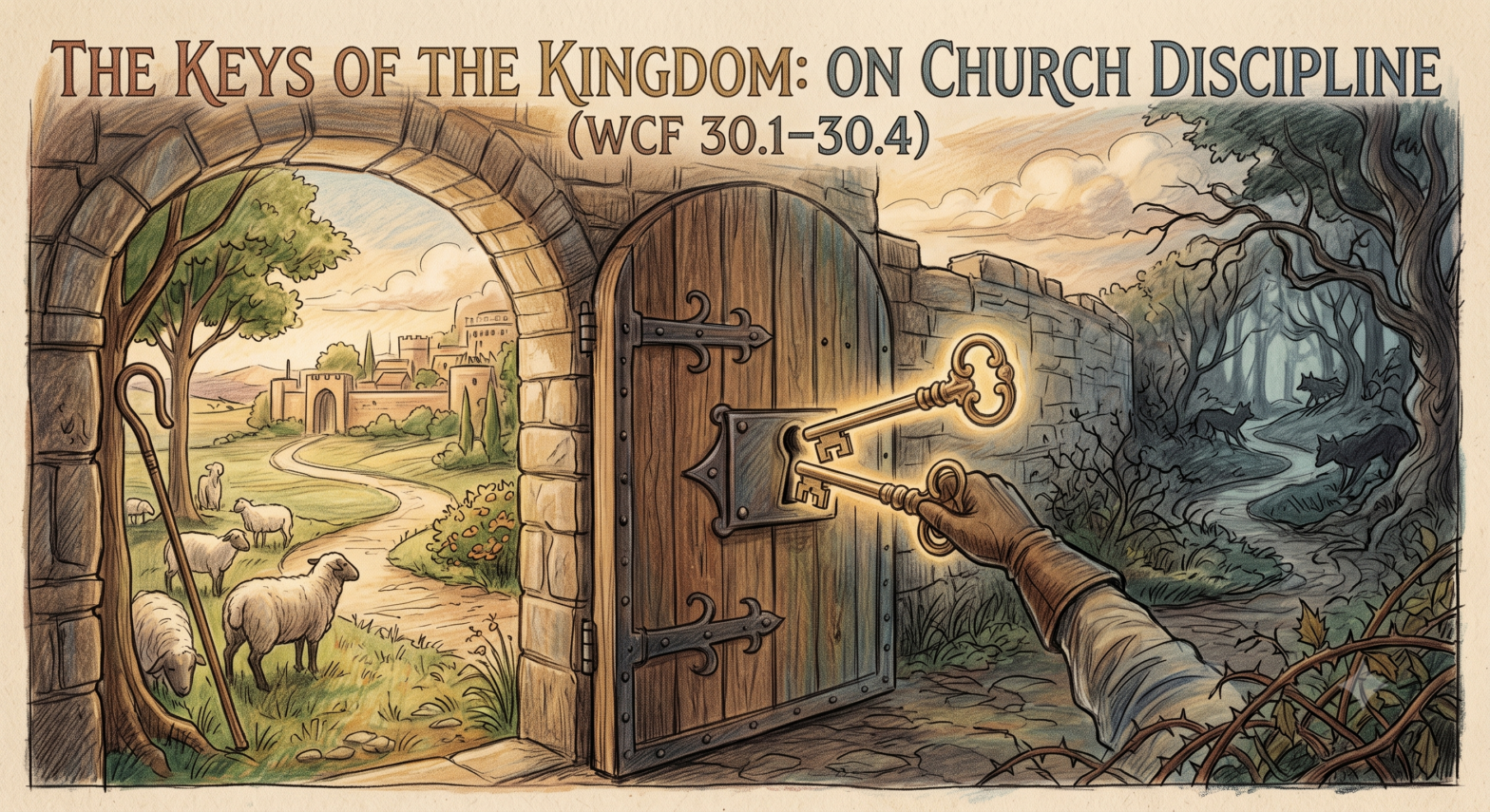
In modern evangelicalism, the concept of “church discipline” has almost entirely vanished. To the modern ear, discipline sounds harsh, judgmental, and fundamentally unloving. Because many view the church merely as a voluntary club or a weekly inspirational gathering, the idea that church leaders have actual, binding authority over someone’s life feels deeply offensive.
However, the Reformers understood that a church without discipline is like a human body without an immune system, or a sheepfold without a fence. It is entirely defenseless against infection and wolves. Alongside the faithful preaching of the Word and the right administration of the sacraments, the Reformed tradition has historically identified church discipline as the third essential mark of a true church. Therefore, a congregation that completely abandons biblical discipline is not merely a defective church; it ceases to be a true church at all.
The Confession teaches that Christ has appointed a distinct spiritual government for His Church; that He has entrusted the “keys of the kingdom” to church officers to retain or remit sins; that church discipline is a necessary act of love to reclaim the erring, protect the flock, and honor Christ; and that it must proceed patiently through escalating steps of admonition, suspension, and excommunication.
A Distinct Government (WCF 30.1)
The Confession begins with a massive claim about the authority of Jesus: “The Lord Jesus, as King and Head of His Church, hath therein appointed a government.”
Jesus did not merely leave behind a book of teachings; He established an organized, visible society with a structured government. Crucially, this government is placed “in the hand of Church officers” and is completely “distinct from the civil magistrate.”
As we saw in Chapter 23, God has ordained two distinct governments on earth. The civil magistrate wields the sword to govern the public square through physical force and temporal laws. The church officers (elders) wield the keys to govern the visible church through spiritual authority. A president cannot excommunicate a citizen, and a pastor cannot imprison a church member. The church’s authority is entirely spiritual, but it is real, binding, and derived directly from the King.
The Power of the Keys (WCF 30.2)
What exactly is this spiritual authority? The divines draw upon the language of Jesus in Matthew 16:19 and John 20:23, declaring that church officers have been committed “the keys of the kingdom of heaven.”
With these keys, they have the power “to retain, and remit sins.” To the modern Protestant, this sounds dangerously close to Roman Catholicism. Can a Presbyterian elder forgive your sins?
The Reformed understanding of the keys is declarative and ministerial. A priest does not possess magical power to absolve guilt. Rather, Christ has authorized His officers to officially declare His Word. When officers faithfully preach the Gospel, they are using the keys to “open” the kingdom to penitent sinners. Conversely, when church officers exercise discipline against an unrepentant member, they are using the keys to “shut” the kingdom against the impenitent.
When a church court (such as the local Session, a regional Presbytery, or even the General Assembly) lawfully suspends or excommunicates someone based upon the Word of God, Jesus promises that their earthly judgment reflects a heavenly reality: “Whatever you bind on earth shall be bound in heaven” (Matt. 18:18).
The Purposes of Discipline (WCF 30.3)
Why would the church ever exercise such severe authority? If God is love, shouldn’t we just tolerate sin? The Confession lists five reasons why church censures (formal acts of discipline) are absolutely necessary. Notice that the very first reason is driven by profound pastoral love:
- For reclaiming and gaining offending brethren: The primary goal of discipline is never to punish; it is always to restore. It is a severe mercy designed to wake a sleeping believer up to the deadly reality of their sin.
- For deterring others: Public discipline puts a holy fear of sin into the rest of the congregation, preventing them from falling into the same trap.
- For purging out the leaven: As Paul warned in 1 Corinthians 5, a little leaven ruins the whole lump. Tolerating open, unrepentant sin spiritually infects and corrupts the entire church body.
- For vindicating the honor of Christ: When someone takes the name of Christ but lives like the devil, they drag the Gospel through the mud. Discipline publicly clears the name of Jesus, demonstrating that He does not endorse their wickedness.
- For preventing the wrath of God: If a church knowingly allows “notorious and obstinate offenders” to continually partake of the Lord’s Supper, they profane God’s covenant and invite His judgment upon the whole congregation (1 Cor. 11:27-34).
The Steps of Censure (WCF 30.4)
Because the goal is restoration, church discipline is not a swift, vindictive execution. It is a patient, proportional, and escalating process. “For the better attaining of these ends,” officers must proceed according to the “nature of the crime, and demerit of the person.”
The Confession outlines three formal steps of censure:
- Admonition: A formal, official warning from the elders. The offender is confronted with their sin from Scripture and called to repent.
- Suspension from the Lord’s Supper: If the person remains stubborn, they are temporarily barred from coming to the Table (fencing the table). This is a severe spiritual time-out, designed to make them feel the weight of their severed fellowship with Christ and His body.
- Excommunication: If the person remains utterly obstinate and unrepentant, the church exercises the final key. Excommunication is the formal removal of a person from the membership of the visible church. As Paul describes it in 1 Corinthians 5:5, it is delivering a person “to Satan for the destruction of the flesh, so that his spirit may be saved in the day of the Lord.” The church formally declares, “Based on your unrepentant rebellion, we can no longer affirm that you are a Christian. We must now treat you as an unbeliever.” In many ways, excommunication is simply a formal recognition of the unrepentant sinner’s own choice to leave. To reject church discipline is to reject the church, and to reject the church is to reject her Head. Opting out of church discipline is, in reality, opting out of the church altogether.
Even in this final, terrifying step, the goal remains restoration. The door is always open for the prodigal to return in true repentance and be joyfully welcomed back into the fold (2 Cor. 2:6-8).
Conclusion
A church that refuses to practice biblical discipline is not just a defective church; it is not a church at all. Furthermore, it is not a loving church, but an incredibly cruel one. To watch a sheep wander toward a cliff and refuse to use the shepherd’s crook to pull them back is pastoral malpractice. The keys of the kingdom are heavy, and church censures are agonizingly painful for the elders who must administer them. Yet, they are a vital gift from our King—a spiritual immune system given to keep the bride of Christ pure, safe, and faithful until He returns.
Key Terms
- The Keys of the Kingdom: The spiritual authority given by Jesus Christ to the officers of His church to preach the Gospel and administer church discipline, thereby opening or shutting the kingdom of heaven.
- Church Censures: The formal, official acts of discipline enacted by the church elders (the Session) against an erring member.
- Suspension: A temporary censure wherein an unrepentant member is barred from partaking of the Lord’s Supper until they manifest true repentance.
- Excommunication: The highest and most severe church censure, wherein an obstinately unrepentant person is formally removed from the membership of the visible church and declared to be outside the covenant community.